Chinese
 Spanish
 French
 Russian
 German
 Portuguese
 Indonesian
 Thai
 Vietnamese
 Arabic


Portable DO meter salinity compensation must use the salinity of the water being measured. When moving from freshwater to brackish water, update that input and check the local absolute-pressure setting before interpreting dissolved oxygen in mg/L. Temperature compensation alone does not supply salinity. Keep the concentration, temperature, compensation inputs and measurement location together in the record. An optical probe reduces membrane servicing, but it does not remove these requirements.
The previous site's settings can travel with the instrument
A technician finishes a freshwater inspection and takes the same meter to a brackish production tank. The probe responds and the display stabilizes, so the result appears trustworthy. However, a retained freshwater salinity setting can make the displayed concentration inappropriate for the new water. A stable display establishes neither the correct compensation input nor representative sampling.
This matters when supervisors compare sites, investigate an aeration complaint or use a spot check to question a fixed probe. Different temperature, salinity and saturation conventions can produce numbers that should not be directly compared. Before buying another meter, establish whether the existing field procedure captures these conditions. The general field DO meter guide addresses instrument selection; this guide concentrates on the transfer between water types.
Portable DO meter salinity compensation needs a defined input
Dissolved salts affect oxygen solubility. Temperature and salinity are relevant when expressing the oxygen response as concentration. Atmospheric pressure also matters to calibration and the saturation convention. Confirm the compensation functions and input workflow for the actual meter; a correction available on another instrument does not establish that function in the ordered configuration.
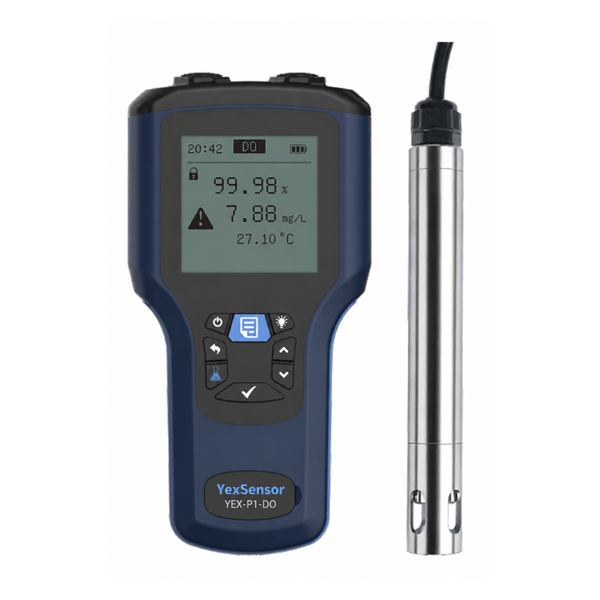
The current YEX-P1-DO optical meter page documents salinity and absolute-pressure settings. It does not establish that the standard DO probe measures salinity automatically. Its two sensor ports likewise do not prove that a particular conductivity probe is supplied or that live salinity compensation is enabled. Establish the delivered configuration and operator procedure.
| Model and item | Verified specification | Purchase or operating implication |
|---|---|---|
| YEX-P1-DO concentration | 0.00–20.00 mg/L; accuracy ≤±0.3 mg/L; resolution 0.01 mg/L | Select against the decision margin; do not substitute resolution for accuracy. |
| YEX-P1-DO response and cable | T90 ≤60 s; standard 5 m cable | Plan stabilization and safe access; the response specification is not a universal fixed waiting time. |
| YEX-P1-DO records | GPS, interval/lock-triggered storage, USB CSV export | Demonstrate which settings accompany the exported result and link any missing inputs externally. |
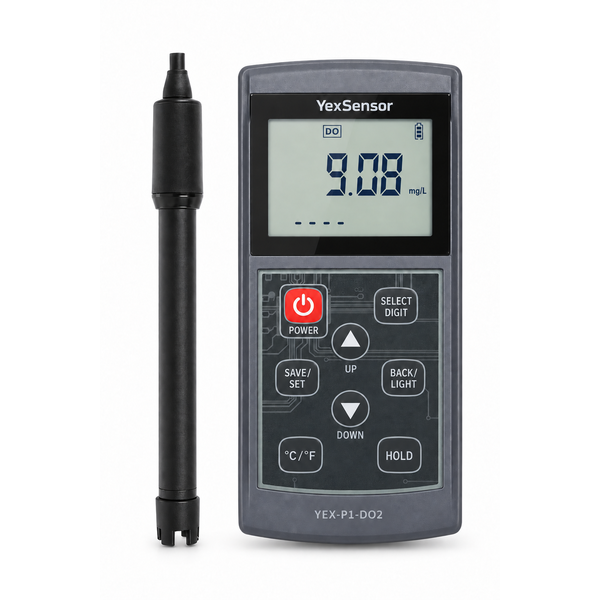
| YEX-P1-DO2 concentration | 0.00–20.00 mg/L; accuracy ≤±0.3 mg/L | A membrane alternative with the same published concentration range, but a different maintenance and recording workflow. |
| YEX-P1-DO2 manual entries | Salinity 0.0–50.0 g/L; atmospheric pressure 60.0–110.0 kPa | Check each site against these limits and enter compatible units. |
| YEX-P1-DO2 temperature | Measurement 0.0–60.0 °C; automatic compensation 0.0–40.0 °C | A temperature display above 40.0 °C does not extend the documented compensation band. |
The YEX-P1-DO2 specification lists an SD02 electrode with a 3 m cable. Its supplied USB cable is described for charging; data export and internal storage are not documented there. Do not carry the optical model's GPS or CSV capability across to this model.
Choose how salinity will be measured and transferred
| Workflow | When it can work | Required evidence |
|---|---|---|
| Separate salinity result entered manually | Discrete sites with controlled, time-matched field measurements | Salinity instrument, scale, temperature basis, uncertainty and correct DO entry units |
| Validated connected conductivity/salinity configuration | Salinity changes during a survey and the exact supported system has been demonstrated | Compatible sensor, conversion, compensation behavior and retained records |
| Fixed value in the procedure | A documented stable matrix where the value is verified often enough for the task | Evidence of stability and a trigger for remeasurement after water changes |
For a route that changes water type, manual entry is workable when the salinity source and operator checks are reliable. A connected configuration can reduce transcription, but availability must be demonstrated for the actual system. Treat an unknown salinity as missing information rather than silently entering zero. Do not use a conductivity reading in µS/cm as though it were a salinity value.
Use different checks at a freshwater pond and a brackish tank
Freshwater route: obtain a salinity value of suitable sensitivity instead of assuming that every freshwater site is identical. In low-salinity work, a coarse screening tester may not resolve differences needed by the approved procedure. Record why the selected value is adequate. Compare repeated measurements at the same representative depth, avoiding bank disturbance, sediment and bubbles.
Brackish production tank: measure salinity after a water exchange, dilution or salt adjustment when that event could invalidate the previous entry. Take the salinity and DO observations from representative water, close enough in time for the operating conditions. A surface sample taken above a poorly mixed inflow may not represent the DO probe depth. Describe the mixing condition instead of presenting a single number as a whole-tank assessment.
A route that changes elevation or weather: check the pressure source as well as the sample. Use local absolute atmospheric pressure in the units required by the meter. A weather service's sea-level-corrected pressure is not the same input. Follow the delivered calibration procedure and document the saturation convention; do not apply a second correction to a value the instrument has already compensated.

A percent display, practical salinity and g/L are not interchangeable labels. For example, do not type a percent result directly into a g/L entry. Establish the scale definition and any required conversion with the instrument supplier and laboratory. Density and the chosen salinity convention can matter. The YEX-YD-100 screening tester should therefore be assessed as a distinct instrument, rather than assumed to be a bundled or automatically linked DO accessory.
Verify the entire field record before accepting the reading
At the start of the route, inspect the probe and perform the specified calibration or verification. For YEX-P1-DO, the official procedure supports a 100% water-saturated-air calibration and a two-point 0% plus 100% procedure. Use correctly prepared references, stable temperature and the supplied instructions. A manufacturer's reference to 100% does not authorize ignoring pressure or inventing the conditions for another model.
At each site, identify the location and intended depth, rinse appropriately, inspect for retained bubbles and let the probe equilibrate with the water. Check units, sample salinity, local pressure, calibration status and storage mode before saving. Use a stability criterion appropriate to the task. T90 ≤60 s means a specified fraction of a step response under its test conditions; it does not guarantee final equilibrium after every change of water temperature or handling.
The YEX-P1-DO probe is rated IP68 and its meter IP65. Keep the handheld unit out of the water. A standard 5 m cable does not establish an authorized immersion depth or strain capacity. The membrane model's electrode immersion limits require separate confirmation. Arrange safe access and cable support, and follow the supplied cap or membrane maintenance instructions after each route.
For acceptance, save observations from representative freshwater and brackish sites. Reopen the optical meter's CSV on the receiving computer and link it to the fields below. Add missing fields on a controlled record. For YEX-P1-DO2, agree an external record unless additional documented functions are supplied.
Field record template: complete one linked record at each measuring point. This is a proposed field sheet, not a statement that every field is stored by either meter.
| Record field | Entry required |
|---|---|
| Location and timing | Site, point, depth, collection time and saved-record identifier |
| Salinity | Value, scale/unit, source instrument and measurement time |
| Atmospheric pressure | Local absolute value, unit, source and time |
| Result and settings | DO mg/L, temperature, saturation convention, probe ID, calibration status and abnormal handling |
Make the bid include the compensation workflow
State the water types, expected salinity scale and range, sample temperatures, sites, depths and DO decision margin. Include the pressure source, calibration responsibility and required record fields. The supplier should identify the exact meter, electrode, cable, battery configuration, consumables and instruction versions. Specify optical cap support or membrane/electrolyte supplies according to the selected model.
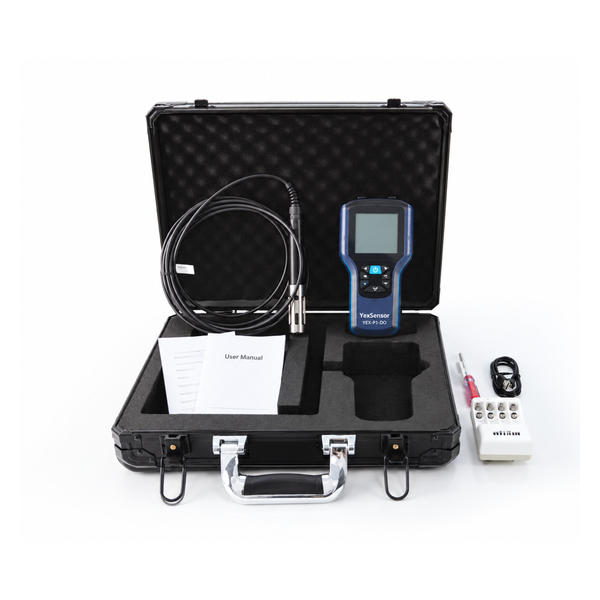
Request a demonstration of input limits and of the data path, including what happens when an operator changes sites. Where a connected salinity sensor is proposed, list its model and show actual compensation and export behavior. Confirm delivery terms and service in writing. A two-port meter, USB connector or carrying-case photograph alone does not establish the complete functionality.
Send the site and record requirements
Provide the water types, salinity scale, temperature range, sampling depths, pressure source and required data fields. Identify whether the YEX-P1-DO optical configuration needs a separate verified salinity measurement workflow.
Send Your Project RequirementsFrequently asked questions
Q1. Is portable DO meter salinity compensation the same as temperature compensation?
A1. No. Temperature and salinity are different inputs. The DO concentration calculation needs an appropriate salinity value when dissolved salts are relevant. Establish whether the supplied system measures it through a compatible sensor or requires manual entry. Record the source, scale and timing of that value, rather than treating a temperature-corrected display as proof that all compensation is correct.
Q2. Which atmospheric pressure should be entered?
A2. Use the applicable local absolute atmospheric pressure and the units specified by the meter procedure. Sea-level-corrected weather pressure describes a different quantity. YEX-P1-DO2 documents manual entry from 60.0 to 110.0 kPa. Check that the site is within range and retain the pressure source, time and calibration convention so another operator can reproduce the measurement conditions.
Q3. Can a salinity percentage be entered directly as g/L?
A3. No. First establish what the percentage represents and which salinity quantity the DO entry requires. Mass fraction, practical salinity and mass per volume are distinct. A valid conversion may require a defined composition convention or density. Retain that basis with the field procedure. A decimal shift copied from an unrelated instrument is insufficient measurement evidence.
Q4. Should a multi-site team choose optical or membrane DO?
A4. Choose for the complete route, maintenance resources and recording task. YEX-P1-DO documents optical sensing, GPS and USB CSV export. YEX-P1-DO2 documents a membrane electrode, manual compensation limits and relevant servicing supplies. Both publish concentration accuracy of ≤±0.3 mg/L. Compare delivered workflows and acceptance results rather than assuming one technology alone resolves compensation or sampling errors.
Q5. Is a pocket salinity tester sufficient for compensation?
A5. It can be considered only if its scale, range and uncertainty meet the procedure's needs. YEX-YD-100 publishes 0–10% with 0.1% resolution, which can be too coarse for fine freshwater distinctions. Check the required sensitivity and the DO meter's entry convention. Select a more suitable salinity reference when the screening instrument cannot support the decision.
Q6. Can one fixed salinity value serve the whole route?
A6. Use one value only where documented stability and the measurement objective justify it. A route spanning freshwater and brackish water requires site-specific checks. Water exchange, salt addition, inflow changes or layering can invalidate the previous value even at one site. Define when salinity must be remeasured, and keep the evidence with the resulting DO records.
Q7. What must a supplier demonstrate before shipment?
A7. Demonstrate the actual probe configuration, compensation menus and limits, calibration procedure, supported recording and required export. Include identifiable example records with linked inputs. Where live conductivity compensation is promised, show the exact connected sensor and resulting behavior. Retain the supplied documentation and agreed accessories so receipt inspection can test the same functionality without relying on a sales photograph.
Q8. What should a supervisor retain after changing water types?
A8. Retain location, time, depth, concentration, temperature, salinity input and scale, pressure input and source, calibration status and any abnormal handling. Include probe identity and the original saved result. Record any subsequent recalculation separately. These details distinguish a genuine site difference from a changed setting and allow an external reviewer to assess whether the measurements are comparable.
Summary
Portable DO meter salinity compensation is a field procedure as well as a menu setting. Match the salinity scale, local pressure and stabilization practice to each water type. YEX-P1-DO and YEX-P1-DO2 offer different sensing, cable, maintenance and data arrangements. Specify the exact package, safe sampling access, input verification and traceable records before accepting a multi-site monitoring workflow.