Chinese
 Spanish
 French
 Russian
 German
 Portuguese
 Indonesian
 Thai
Thai Vietnamese
 Arabic

The short answer
If you run BOD₅ in a municipal or industrial wastewater laboratory, the instrument is the smallest part of the problem. Three things decide whether your BOD data holds up:
A stable 20 ± 1 °C incubation environment — without it, the number is not BOD₅, it is a number
The correct range and aliquot volume for your expected concentration
Correct pretreatment for acidic, chlorinated, seeded, or nitrifying samples
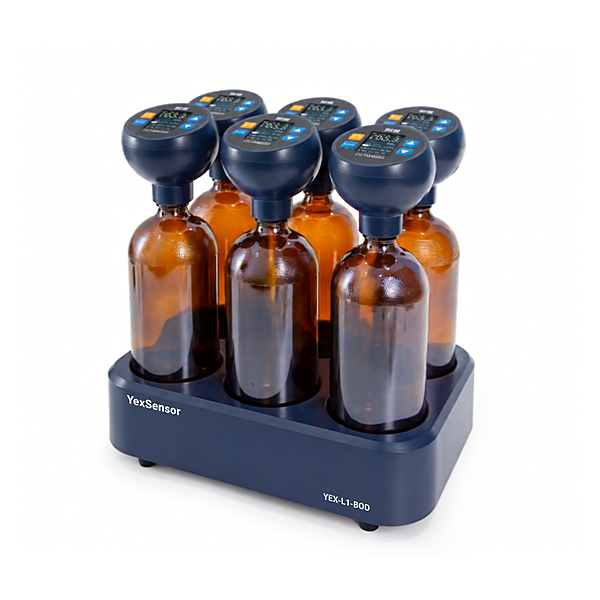
The instrument that fits this workflow is the YEX-L1-BOD Digital BOD Analyzer — a 6-position sealed-bottle unit using the pressure-difference method with CO₂ absorption. It removes iodometric titration and its operator-dependent error, and it retains BOD₅ results for up to 10 years.
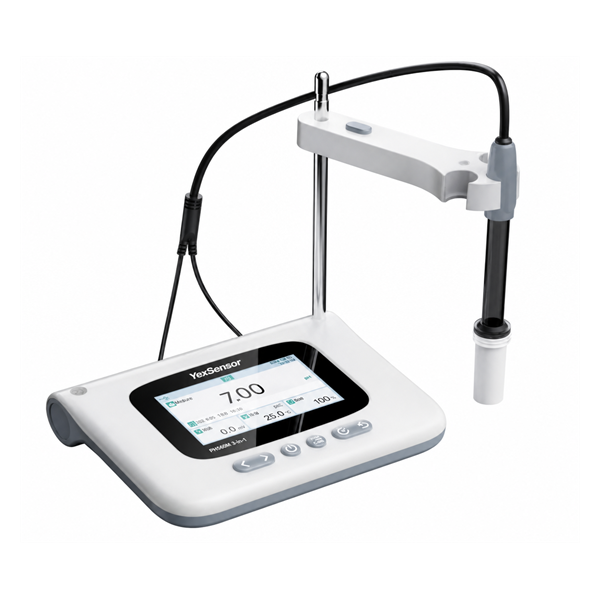
For a typical plant laboratory, the practical bench is the BOD analyzer for BOD₅ plus a YEX-L1-PH-ORP for the pH adjustment step and process control pH. The BOD method calls for pH adjustment to 6.7–7.5 with a documented record of it, which is why the two belong in the same quotation.
Most BOD setups are therefore specified as a workflow rather than as a single instrument, which is how the rest of this article treats it.
1. What problem a BOD analyzer actually solves
A wastewater laboratory running BOD₅ by iodometric titration is managing a chain of manual steps: dilution water preparation, seeding, initial dissolved oxygen measurement, 5-day incubation, final DO measurement, and titration. Every step has an operator dependency. The titration endpoint is a color change judged by eye. The dilution ratio is calculated by hand.
What this looks like in practice:
Two technicians run the same sample and get results 15% apart. Nobody can say which is right.
The BOD result arrives 5 days after the compliance deadline it was supposed to support. By the time it is available, the process decision has already been made on incomplete information.
An audit asks for the original reading behind last year's report. It is in a notebook, or it is not findable at all.
A pressure-difference BOD analyzer addresses all three. The measurement is a digital pressure reading, not a color endpoint. The sample volume and range are entered explicitly, so the dilution logic is recorded rather than recalculated. And the result is stored in the terminal — the YEX-L1-BOD keeps BOD₅ data for up to 10 years.
It does not remove the 5-day wait. Nothing does. What it removes is the ambiguity about whether the 5-day wait produced a defensible number.
2. Core specifications and what they mean for your plant
The range table is the single most important thing to understand
The YEX-L1-BOD covers 0–4000 mg/L, but "0–4000 mg/L" is not the operating specification. The unit works through eight fixed range and sample-volume combinations, and you select one per test:
| Range | Expected BOD concentration | Sample volume |
|---|---|---|
| 1 | 0–20 mg/L | 500 mL |
| 2 | 0–40 mg/L | 450 mL |
| 3 | 0–80 mg/L | 400 mL |
| 4 | 0–160 mg/L | 300 mL |
| 5 | 0–320 mg/L | 200 mL |
| 6 | 0–800 mg/L | 100 mL |
| 7 | 0–2000 mg/L | 50 mL |
| 8 | 0–4000 mg/L | 25 mL |
In practice the expected BOD is estimated before the test, then the largest listed aliquot unlikely to exceed its limit is selected and that exact volume entered into the corresponding terminal.
The estimate carries consequences. A low guess exhausts the pressure head and voids the test; a high guess commits a 580 mL culture bottle to an aliquot that only needed 25 mL.
Practical guidance for plant laboratories. Municipal influent typically lands in ranges 4–6 depending on the plant. Final effluent usually sits in ranges 1–3. Industrial wastewater receiving high-strength trade effluent can push into range 7 or 8. If your plant sees both municipal and industrial load, the wide range is what lets one instrument cover the whole site — which is also why it is a good fit for a distributor serving mixed municipal and industrial customers.
The volume you enter must be exact. A 300 mL aliquot entered as 250 mL produces a result that looks plausible and is wrong. Volume entry disagreements are the most common source of error here, and sit on the training side rather than the hardware side.
Incubation temperature — the specification that decides data validity
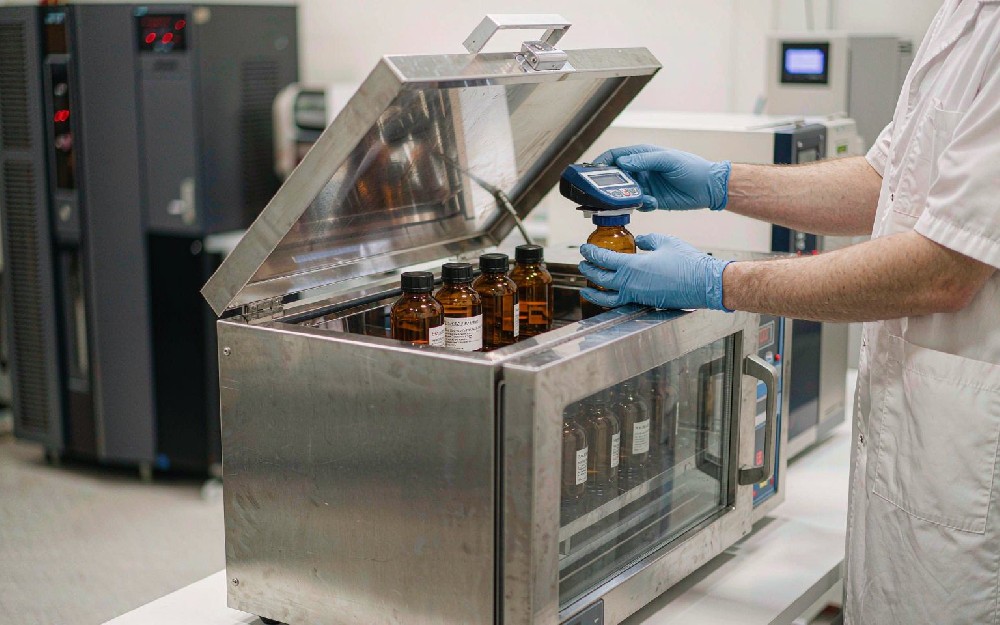
20 ± 1 °C. BOD₅ is defined at 20 °C, and the biological reaction rate shifts measurably with temperature. A converted refrigerator that swings ±3 °C does not produce BOD₅ data comparable to a reference laboratory.
The incubator is not included. The YEX-L1-BOD provides the sealed-bottle measurement and the digital pressure monitoring. It does not provide the incubation chamber. Quoting a complete BOD workflow therefore means listing the incubator as its own procurement item rather than assuming it ships with the analyzer.
Six-sample parallel operation — the throughput decision
The unit handles up to 6 samples per run with 580 mL culture bottles.
This defines your weekly ceiling. Because BOD₅ takes 5 days, a 6-position unit running continuously produces 6 results per 5-day cycle. A plant that needs 30 BOD results per week needs five units, or needs to reduce its BOD sampling frequency, or needs a contract laboratory for overflow.
This is why the weekly count belongs in the specification before purchase: one unit cannot absorb a 30-sample weekly load, and no amount of scheduling changes that arithmetic.
The accuracy check — what makes the data defensible
The YEX-L1-BOD meets the BOD₅ glucose-glutamic acid (GGA) accuracy check, with an expected result of 180–230 mg/L.
Run this check on day one after installation, and then on the schedule your method requires. This is what turns a delivered instrument into a validated method. The GGA check tests the whole chain — the seed, the dilution water, the incubation temperature, and the pressure measurement — not just the meter. If your GGA check fails, the instrument is very rarely the cause; the seed or the dilution water usually is.
Data retention — the answer to a question you will be asked in year three
BOD₅ result data retained for up to 10 years in the terminal. The terminal runs on a CR123 3 V lithium battery.
Compare this to a notebook. When a regulator, a client, or a consultant asks for the original reading behind a 2026 report, a 10-year digital record answers it in seconds. That is the entire value proposition of the electronic record, and it only pays off if the data was entered into the terminal in the first place rather than written on a bench sheet.
Power, size, and physical constraints
Power: 110–220 V AC, 50/60 Hz, rated 10 W
Main unit: 272 × 185 × 81.5 mm, 2.4 kg
Measurement method: sealed-bottle pressure difference with CO₂ absorption
Test duration: 1–30 days (5 days for standard BOD₅)
At 2.4 kg and 10 W the unit is a small bench instrument. The physical constraint is not the analyzer — it is the 6 × 580 mL bottles in the incubator, which need shelf space and a temperature-stable location.
3. Who this setup is for — and who it is not for
It is for you if
You run BOD₅ as a routine, recurring parameter — municipal plant laboratories, industrial wastewater laboratories, environmental monitoring stations.
You want to eliminate iodometric titration and the operator-dependent color endpoint judgment that comes with it.
You need retrievable historical records. Ten years of BOD₅ data in the terminal changes how you answer audit and dispute questions.
You are a contract laboratory or a multi-sample workflow operation that needs parallel sample handling rather than one-at-a-time processing.
You are a distributor building a wastewater laboratory catalog. The BOD analyzer is a product with defined consumables (bottles, CO₂ absorber, nutrients, seed, inhibitor) and a clear method boundary — both of which reduce support burden and return rates.
It is not for you if
You need same-day BOD results. The method is inherently 5-day. No pressure-difference instrument changes this. If you need immediate organic load indication, you want COD, not BOD — see the companion article on COD and nutrient testing for a wastewater laboratory.
You cannot maintain a dedicated 20 ± 1 °C incubation space. The instrument does not include one, and a temperature-unstable incubation room makes the data unreliable regardless of which analyzer you buy.
Your expected BOD regularly exceeds 4000 mg/L and you cannot dilute. Above 4000 mg/L, or with toxic substances present, samples must be diluted with properly prepared seeded dilution water into a suitable range, with the dilution ratio recorded and the required correction applied. This is standard practice, but it is a workflow commitment.
You need a turnkey laboratory. This is one instrument in a workflow, not a laboratory in a box.
4. How to select the range and prepare your samples
Step 1 — Estimate the expected BOD before you touch a bottle
Use your plant's historical data. If you have none, use a COD correlation as a first estimate and refine it after the first few runs. The estimate only needs to be good enough to pick a range, not accurate to the milligram.
Step 2 — Pick the largest aliquot that is unlikely to exceed its limit
Then enter that exact volume into the corresponding terminal. Record it. This is the step where plants quietly introduce error.
Step 3 — Handle the sample according to its condition
The table below summarises the sample controls that apply to real-world wastewater samples:
| Sample condition | Required control | What you need on hand |
|---|---|---|
| Acidic or alkaline wastewater | Adjust sample or diluted sample to pH 6–8; ordinary samples to pH 6.7–7.5, preferably 7.2 | A pH meter is recommended; document acid or alkali addition |
| Residual or combined chlorine | Let a small free-chlorine residual dissipate for 1–2 h, or use a validated sodium sulfite procedure | Verify dechlorination without overdosing |
| Particles, large dilution, or frozen sample | Homogenize thoroughly before taking the aliquot | Record the preparation; maintain representative sampling |
| High algae content | Filter through a 1.6 µm membrane and report the pore size | Only when permitted by the governing method |
| Conductivity below 125 µS/cm | Add nutrient and buffer solutions so conductivity exceeds 125 µS/cm | Confirm reagent preparation and addition volumes |
| Expected BOD above 4000 mg/L or toxic substances | Dilute with properly prepared seeded dilution water into range | Record the dilution ratio and apply the required correction |
| Insufficient microorganisms | Add seed solution at approximately 2% of total sample volume | Apply any seed correction required by the governing method |
| Nitrification interference | Add 2 mL/L of 1.0 g/L allylthiourea to separate carbonaceous demand | Record inhibitor use in the test report |
Two procurement implications follow directly.
First, the pH meter requirement. pH adjustment to 6.7–7.5 is required for ordinary samples, and the adjustment must be documented. That makes a benchtop pH meter part of the BOD workflow, not a separate purchase. The YEX-L1-PH-ORP covers it with −2.00 to 16.00 pH range, 0.01 pH resolution, ±0.05 pH indication error, automatic 1–5 point calibration with GB/USA/NIST/INST/DIN buffer groups, and USB record export. The multi-point calibration matters here because you are adjusting across the pH range of different waste streams, not measuring near neutrality all day.
Second, the consumables list. Seed solution, nutrient and buffer solutions, sodium sulfite, allylthiourea, and 1.6 µm membranes are all reagents you must have on hand for real samples. None of them are the instrument. When you build a BOD quotation, build the reagent requirements alongside it — a plant that receives an analyzer with no reagents loses a week waiting for the first order.
Step 4 — Run the GGA accuracy check and file the record
Expected result 180–230 mg/L. File it. This is your evidence that the method works.
Step 5 — Keep the data in the instrument, not on a bench sheet
The 10-year retention only has value if the data is entered. The retention only pays off if terminal entry is built into the procedure rather than left to the end of a shift.
5. How this compares to other approaches
Compared to iodometric titration
Titration costs less on the invoice and considerably more in labor and variability. It requires the operator to judge a color endpoint by eye, and it produces a number with no embedded record of the dilution ratio or the sample volume. The YEX-L1-BOD replaces the endpoint judgment with a digital pressure reading and records the sample volume explicitly. The BOD result becomes reproducible between operators, which is the whole point.
Compared to a respirometric / manometric BOD system from another supplier
The measurement principle is the same family — sealed bottle, pressure or oxygen change. The differences that matter commercially are the range/volume table (eight combinations here, covering 0–20 up to 0–4000 mg/L), the number of sample positions on one unit, and whether the data storage and retention are specified. Compare those three, not the headline range.
Compared to COD as a substitute
COD and BOD measure different things and are not interchangeable. COD is fast (hours, with digestion) and chemically defined. BOD is slow (5 days) and biologically defined. For process control, COD is more actionable. For discharge reporting and for assessing biodegradable organic load, BOD₅ is what the permit usually names.
A permit that names BOD₅ still requires BOD₅. Running both gives fast process feedback alongside compliant reporting, which is why the two usually sit on the same bench.
Compared to a converted refrigerator as an incubator
It is a common choice, and a frequent source of data that will not compare across laboratories. Without control to ±1 °C around 20 °C, a converted refrigerator introduces an error that better instrument accuracy does not compensate for — so incubation is worth settling before the rest of the budget is committed.
6. What buyers ask before ordering
How is the price determined? The BOD analyzer price is driven mainly by the instrument configuration and the peripheral items included in the quotation. The largest swing factor is usually not the analyzer — it is whether the order includes the incubation chamber, the reagent set, and consumables, because those are separate items with their own cost structure. Order quantity matters, but on this line configuration and scope matter more. The accurate way to get a number is to state your sample throughput, your expected BOD range, and whether the incubator and reagents should be quoted together with the instrument.
What is the minimum order quantity? Standard configurations ship in small quantities. Distributor orders with OEM packing, market-specific labeling, or bundled reagent kits carry higher minimums because they trigger separate production and packing setup. Confirm the MOQ against your actual configuration rather than the catalog line.
What is the lead time? Lead time depends on the configuration and, significantly, on whether reagents and consumables are part of the order — those have their own supply chain and their own shelf life. State your required delivery date with the RFQ so it can be checked against the real configuration. Expect reagent and consumable content to be the variable that surprises you, not the instrument.
Can it be customized? The sample capacity (6 positions) and the bottle format (580 mL) are structural. If a project requires a different bottle volume or a higher sample count, that is an engineering discussion, not a configuration option. Configuration-level choices — packing, labeling, distributor branding, bundled reagent sets — are routine.
How is it installed and commissioned? Installation is unpacking, connecting 110–220 V AC power, and loading the CR123 terminal battery. Commissioning should include establishing the incubation environment at 20 ± 1 °C before any sample is loaded, and running the GGA accuracy check with an expected 180–230 mg/L result. That GGA record is your baseline; keep it.
What about after-sales? YexSensor provides a one-year limited warranty from the purchase date, subject to the sales agreement and warranty card, with continuing maintenance support. Accessories and consumables are excluded unless agreed in writing. The warranty does not cover operation contrary to the manual or reagent instructions, unauthorized disassembly or repair, force-majeure damage, corrosive or chemical exposure, abnormal power, or products without valid purchase and warranty information.
For a BOD laboratory, note that the culture bottles, seals, and CO₂ absorber are consumables and sit outside the warranty. Stock them accordingly.
What about packaging and shipping? The main unit is 2.4 kg at 272 × 185 × 81.5 mm — a compact, conventional export shipment. The fragile items are the culture bottles and the terminal. If you are consolidating an order with an incubator and reagents, note that reagents may carry a different transport classification and a shelf-life constraint that the instruments do not.
What certifications and documentation are available? A certificate and warranty card ship in the packing list, along with the product user manual and the reagent operating manual. The GGA accuracy check specification (expected 180–230 mg/L) is stated on the datasheet, which is the document your method validation will reference. If your market or tender requires specific certification documents, list them on the RFQ — certification scope is configuration- and market-dependent, and it is far cheaper to resolve before production than after.
What is the difference between the lower-cost and higher-specification paths here? It is not brand tier, it is scope. The lower-cost path is the analyzer with standard accessories and a self-sourced incubator and reagents. The higher-specification path bundles the incubation chamber, a reagent set matched to your expected range, seed and nutrient solutions, inhibitor, and the pH meter for the adjustment step — quoted as one validated workflow rather than as separate line items.
For a wastewater plant, the bundled path is usually the better value, not because the item prices are lower, but because it eliminates the week of downtime between instrument delivery and the first valid BOD result. That week is the real cost of buying piecemeal.
7. What a working BOD bench looks like
A municipal plant laboratory running BOD₅ as a routine parameter typically ends up with:
| Item | Role |
|---|---|
| YEX-L1-BOD | The BOD₅ measurement — 6 parallel samples, pressure-difference method, 10-year data retention |
| YEX-L1-PH-ORP | pH adjustment to 6.7–7.5 (required by the method, must be documented); also process control pH and ORP for disinfection |
| 20 ± 1 °C incubator | Not supplied by the analyzer; the item that decides whether the data is BOD₅ at all |
| Reagent set | Dilution water nutrients, buffer, seed, sodium sulfite, allylthiourea, 1.6 µm membranes |
| 580 mL culture bottles | Consumable; size your stock against your weekly sample load |
Why the pH meter pairs with the BOD analyzer rather than being an afterthought. The BOD method requires pH adjustment across a range of sample types — acidic industrial effluent, alkaline cleaning waste, neutral municipal influent. A pH instrument that only does two-point calibration near neutrality will not hold accuracy across that spread. The YEX-L1-PH-ORP's 1–5 point calibration with selectable buffer groups (GB, USA, NIST/INST, DIN) is what makes the adjustment defensible across all your sample types, and the USB export gives you the record. For a plant that also controls chlorination or another disinfection step, the same unit covers ORP over ±1900 mV at 0.1 mV resolution.
If your plant needs fast organic-load feedback alongside BOD₅, the natural companion is a multi-parameter benchtop analyzer running COD and nutrients. That is covered separately in the wastewater COD and nutrient testing article.
8. Getting the right configuration
Installations that run smoothly almost always have three things settled before the purchase order:
How many BOD samples per week, at peak? This decides how many 6-position units you need. A 5-day method means 6 positions per unit is 6 results per 5-day cycle — work the arithmetic before the purchase order.
What is the expected BOD range across all your sample streams? This decides which of the eight range/volume combinations you actually use, and whether you need reagent sets for multiple ranges.
Do you need the incubator and reagents quoted with the instrument, or separately? This is the difference between a working BOD bench and a bench waiting for parts.
If you are not sure which configuration fits your plant — or which range and reagent set matches your sample streams — send your expected BOD range, your weekly sample count, and your sample matrix (municipal, industrial, or mixed) to sales@yexsensor.com. We will come back with a specific configuration and the reasoning behind it, which makes it straightforward to weigh against your shortlist.
For distributors, include the markets you serve and whether you need OEM packing or bundled reagent kits. Those answers change the quotation structure more than the order quantity does.
Frequently asked questions
1. What measurement principle does the YEX-L1-BOD use?
Sealed-bottle pressure difference with carbon dioxide absorption. The sample is sealed in a 580 mL culture bottle, microorganisms consume oxygen and produce CO₂, the CO₂ is absorbed, and the resulting pressure drop is read digitally. No iodometric titration and no operator-judged colour endpoint.
2. Is the incubator included in the BOD analyzer order?
No. The YEX-L1-BOD provides the sealed-bottle measurement and the digital pressure monitoring. The 20 ± 1 °C incubation chamber is a separate procurement item. It belongs on its own line in the quotation, since the incubation environment decides whether the result is BOD₅ at all.
3. How many BOD samples can one unit run per week?
Six samples per run, and BOD₅ takes 5 days, so a single 6-position unit produces 6 results per 5-day cycle under continuous operation. A plant needing 30 BOD results per week therefore looks at five units, a reduced sampling frequency, or a contract laboratory for overflow.
4. How is the accuracy of the BOD measurement verified?
With the BOD₅ glucose-glutamic acid (GGA) accuracy check, expected result 180–230 mg/L. Run it on day one after installation and then on the schedule your method requires. The GGA check validates the whole chain — seed, dilution water, incubation temperature and pressure measurement — not just the instrument.
5. Which range and sample volume should I select?
Estimate the expected BOD first, then choose the largest listed aliquot that is unlikely to exceed its limit, and enter that exact volume into the terminal. The eight combinations run from 0–20 mg/L at 500 mL to 0–4000 mg/L at 25 mL. Volume-entry mistakes are the most common source of error here.
6. Does a BOD laboratory also need a pH meter?
Yes. Ordinary samples are adjusted to pH 6.7–7.5 (preferably 7.2) and the adjustment documented; acidic and alkaline wastewaters are adjusted to pH 6–8. That makes a benchtop pH instrument part of the BOD workflow rather than a separate purchase.
7. How long is BOD₅ data retained?
Up to 10 years in the terminal. This is what allows a plant to answer a regulator's or a client's request for the original reading behind an old report without searching through notebooks.
8. What should be included in a BOD analyzer quotation request?
State your expected BOD range, your weekly sample count, and your sample matrix (municipal, industrial or mixed). Also state whether the incubation chamber, the reagent set and the pH meter should be quoted together with the instrument, and your required delivery date.
Summary
BOD testing in a wastewater laboratory is limited by the incubation environment, the range and aliquot selection, and the pretreatment procedure — not by the analyzer. The analyzer's job is to remove operator-dependent variability from the measurement step and to keep a retrievable record.
The YEX-L1-BOD does that with six parallel 580 mL positions, the sealed-bottle pressure-difference method, eight range/volume combinations covering 0–20 up to 0–4000 mg/L, a GGA accuracy check at 180–230 mg/L, and 10-year data retention. It does not include the incubator, and it does not shorten the 5-day method.
For a plant laboratory, quote it together with a 20 ± 1 °C incubator, a benchtop pH meter for the required pH adjustment, and a reagent set matched to your expected range. Together those make up a working BOD bench, where the analyzer on its own is one component of it.
Related products
YEX-L1-BOD Digital BOD Analyzer — 0–4000 mg/L across 8 range/volume combinations, 6 parallel samples, 10-year data retention
YEX-L1-PH-ORP Benchtop pH/ORP Analyzer — required for the pH adjustment step; −2.00 to 16.00 pH, ±1900 mV, 1–5 point calibration
YEX-L1-MP1 Benchtop Multi-parameter Analyzer — for COD and nutrient parameters alongside BOD₅
YEX-L1-WS Mobile Water Quality Workstation — for field verification and sampling campaigns