Chinese
 Spanish
 French
 Russian
 German
 Portuguese
 Indonesian
 Thai
 Vietnamese
 Arabic


To compare benchtop vs online turbidity readings, first establish whether both instruments saw the same water at the same time. Successful calibration checks do not guarantee agreement on process water. Then examine optical methods, sample handling and averaging. Adjusting the online calibration to match a transported bottle can hide a sampling error. Separate instrument performance from changes introduced between the process and the sample cell.
A disagreement can lead to the wrong purchase or adjustment
A treatment team sees a rising online trend while the laboratory reports a lower result. Replacing the installed probe seems reasonable, but the bottle may have been collected after the peak, settled during transport or come from another branch. Conversely, a dirty cell can make the bench result high. The procurement decision depends on identifying which part of the comparison is responsible.
Define the operational question before choosing a reference instrument. Investigating a filter event requires a time-matched comparison. Checking laboratory repeatability requires repeated preparation of a controlled sample. Verifying a reporting method requires the approved procedure and its quality controls. These tasks share equipment but need different evidence. The existing laboratory turbidity meter selection guide covers general purchasing; the procedure below addresses disagreements between measuring points.
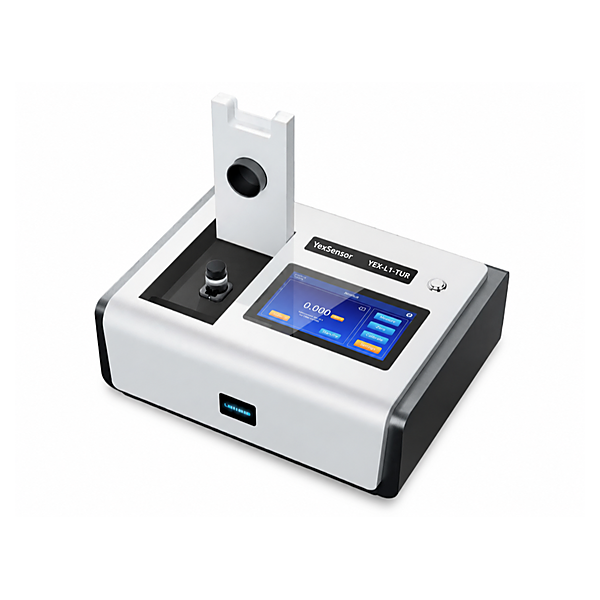
Which benchtop turbidity meter specifications affect the comparison?
Use the current YEX-L1-TUR specification to define the bench workflow. Its tungsten-light arrangement differs from the infrared LED scattering method published for YEX-S1PRO-TS. A selectable display unit does not change a lamp, detector geometry or method approval. Identify those details before expecting agreement on colored or changing particle populations.
| Model and verified item | Published value or condition | Decision for this investigation |
|---|---|---|
| YEX-L1-TUR range | 0–4000 NTU | Cover expected samples without assuming equal performance throughout the range. |
| YEX-L1-TUR accuracy | 0–1000 NTU: ±2% + 0.01 NTU; 1000–4000 NTU: ±5% | Apply the relevant band; retain the published expression and confirm its test basis for contractual acceptance. |
| YEX-L1-TUR resolution | 0.001 NTU at the lowest range | Do not use the last displayed digit as the permitted difference between instruments. |
| YEX-L1-TUR cell | 95 × 25 mm round borosilicate cell; minimum 25 mL | Specify compatible cells, fill volume and a repeatable orientation. |
| YEX-L1-TUR reading | Single, continuous or RST; adjustable 8–60 s response/averaging | Record mode and time setting so changing particles are not compared through different time filters. |
| YEX-S1PRO-TS principle | Infrared LED optical scattering | Investigate method-dependent behavior on actual water rather than forcing an arbitrary universal conversion. |
The bench product page references USEPA Method 180.1 and HJ 1075-2019 and offers NTU, FNU and EBC displays. This is insufficient by itself to approve every mode for a regulated report. Obtain the exact method, optical configuration and acceptance evidence required by the destination laboratory. The light source matters when interpreting NTU and FNU; neither the unit labels nor explanatory information constitute certification of either YexSensor model.
How should you compare benchtop vs online turbidity readings?
| Comparison | What it helps establish | What remains unresolved |
|---|---|---|
| Independent check standard on each instrument | Performance against the approved standard and procedure | Whether process particles respond alike to different optics |
| Immediate field-cell measurement beside the sample point | Whether transport or delay contributes to the difference | Differences between field and bench optical methods |
| Matched samples with recorded elapsed times | Settling, handling and preparation effects | Unrecorded process changes before collection |
| Repeated pairs across stable and changing process conditions | Whether disagreement depends on matrix or operating state | Conditions that the trial never observed |
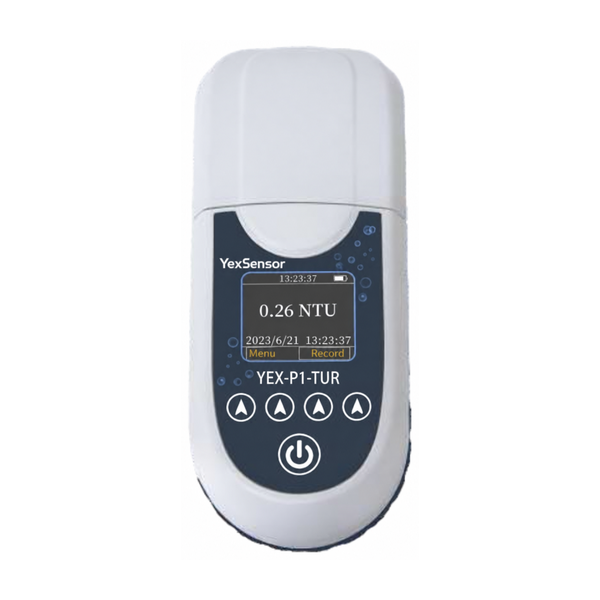
Start with independent instrument checks and a stable, accessible sample point. Add immediate field measurements when transport is a credible cause. Purchase a portable instrument for that defined task, not simply to supply a third number. The YEX-P1-TUR portable turbidity meter has near-infrared optics and its own cell and calibration procedure; it is not automatically an interchangeable reference for a tungsten bench instrument.
Separate timing, cell condition and changing solids
After a filter operating change: match the bottle collection time to the water arriving at the online sensor. If the probe is in a bypass, establish the actual line delay under the current flow. Compare the relevant recorded interval, not the display value observed when the bottle eventually reaches the laboratory. Retain the original trace and identify any averaging or alarm delay.
With floc-bearing or settling water: record collection, mixing, filling and reading times. Prepare matched portions using the approved handling procedure and observe whether the result changes while standing. The YEX-L1-TUR RST mode is intended for rapidly settling samples, but switching modes introduces another variable. Evaluate the mode explicitly before combining its results with a historical single-reading series.
Near a low operating limit: inspect clean cells for scratches, fingerprints, condensation and bubbles. Repeat the reading after reinserting the same cell in the documented orientation, then prepare another portion in a different verified cell. If the discrepancy follows a cell rather than the sample, address the cell. If it follows elapsed time, investigate handling. Neither observation alone establishes which process instrument needs recalibration.
Build a measurement path and a usable comparison record
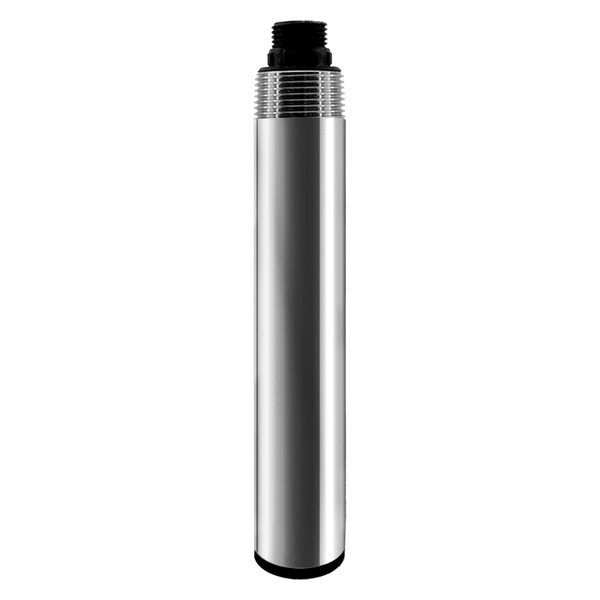
Trace the water from the process to the probe and sampling outlet. Note bypass volume, flow changes, flushing practice, bubbles and deposited solids. Use the site procedure to obtain a representative sample without scraping sediment from a stagnant line. For the bench reading, keep the exterior cell dry and clean and use the specified fill volume. Do not filter or dilute a portion unless the method requires it and the altered sample is clearly identified.
Separate repeated readings from independently prepared duplicates. Ten readings of one unchanged cell describe short-term reading behavior. They do not measure the variability of collection, transfer and preparation. Include both kinds when the operational decision depends on the complete sampling chain. Bubbles and settling are practical measurement limitations; the investigation must establish which applies at this site.
For each pair retain the process tag, collection point, clock offset, collection time, online interval, bench reading time, cell identifier, calibration/check status, mode, unit and operator. The YEX-L1-TUR stores up to 40,000 records and supports USB export. Confirm which metadata appear in an actual exported file; keep a linked worksheet for missing fields. Its reserved RS-485 connector does not establish standard Modbus capability.
Agree on the investigation criterion before changing settings. Examine the absolute difference near the operating limit and the direction of disagreement during events. Do not automatically sum advertised percentage specifications into a validated acceptance tolerance. The laboratory or project owner must account for method, reference uncertainty and handling. Preserve failed pairs with explanations instead of deleting them to improve apparent agreement.
Specify an investigation package rather than a range alone
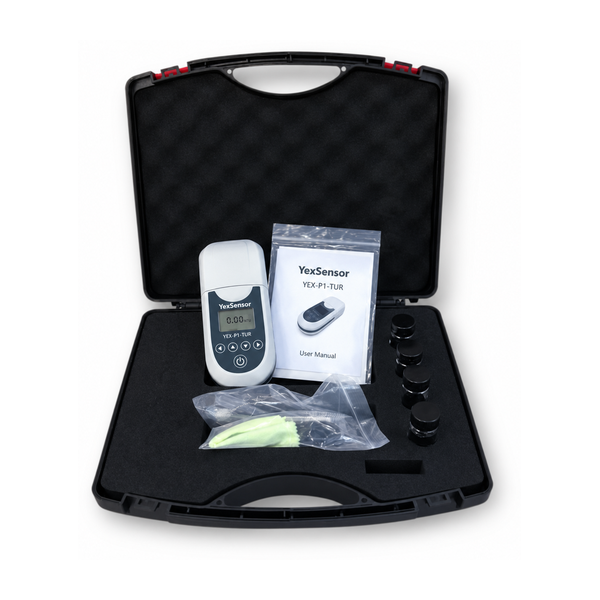
The purchasing schedule should name the bench model, expected sample bands, comparison task, required method, compatible cells, standards and independent checks. Include the reading mode, daily throughput, cleaning procedure, spare cells, power adapter and local data-export demonstration. Record any portable comparison instrument as a separate configuration, with its own method and accessories.
Define who collects paired samples, who assesses method equivalence and who authorizes an online adjustment. Include representative colored, settling and low-turbidity samples where they occur. Request the supplied procedure version and a witnessed export containing identifiable results. Agree commercial terms, consumables and service separately; a photograph or a connector label is not a delivery commitment.
Send the comparison conditions
Provide the two instrument models, sample location, operating range, required reporting method, paired traces and bottle timing. Identify the cells, standards and data fields needed for the YEX-L1-TUR bench configuration.
Send Your Project RequirementsFrequently asked questions
Q1. Can benchtop and online turbidity readings differ after a successful standard check?
A1. Yes. A standard check supports instrument performance under that check procedure. Process water can have different particle size, color and settling behavior, which interact with the optical arrangement. Retain both check results, then compare time-matched actual samples across relevant conditions. Define acceptable process agreement separately before approving a calibration adjustment or replacement instrument.
Q2. Can selecting FNU make a tungsten instrument equivalent to infrared optics?
A2. No. A displayed unit cannot replace a physical light source or detector arrangement. Identify the exact measurement method and approved reporting configuration for each instrument. Where optical methods differ, examine actual water and the laboratory's reporting requirement. Obtain method documentation for the supplied configuration rather than treating a unit menu as evidence of compliance.
Q3. Why can repeated readings of one bottle keep falling?
A3. Settling is one possible explanation, especially after floc formation, but investigate temperature change, bubbles and preparation as well. Record elapsed time and reading mode, and compare independently prepared portions. A falling sequence should not be silently averaged into a stable-water result. Evaluate the applicable settling procedure before adopting RST or changing an alarm reference.
Q4. Which benchtop turbidity meter specifications matter near the operating limit?
A4. Select for the required decision range, method, stated accuracy and quality-control workflow. Resolution describes display increments, not complete measurement uncertainty. YEX-L1-TUR publishes 0.001 NTU at its lowest range, while its accuracy has separate range bands. Require suitable check results and sample repeatability near your operating limit instead of ranking bids by decimals alone.
Q5. When is a portable turbidity meter useful in this investigation?
A5. It is useful when measuring immediately beside the sample point can reveal transport or delay effects. Keep collection and preparation controlled, and document the portable model's optical method. Its result provides another defined observation, not automatic arbitration. Select compatible cells, standards and data records so the field comparison can be reviewed alongside the bench measurements.
Q6. Must an online probe be recalibrated to the bench result?
A6. Establish a valid comparison first. Check calibration status, representative sampling, time alignment, cells and method differences before adjusting either instrument. An offset based on a delayed or altered sample can conceal the original problem. Follow the probe's approved adjustment procedure only after the responsible laboratory or process engineer accepts the evidence and records the change.
Q7. What should acceptance of a new bench meter demonstrate?
A7. Demonstrate identification of the supplied model, successful approved standard checks, repeatability on relevant water, saved calibration settings and a readable data export. Include the cells, reading modes and operating conditions in the record. Method-specific acceptance belongs in the purchase specification; a broad range or a factory inspection statement does not define the complete laboratory acceptance test.
Q8. What must be retained after the disagreement is resolved?
A8. Retain original paired results, sampling times, relevant process events, standard checks, cell identifiers, method settings and the cause supported by evidence. Record any adjustment with its effective date and approver. List untested matrices explicitly. This allows the next shift or replacement supplier to reproduce the comparison instead of inheriting an unexplained correction factor.
Summary
Use a benchtop turbidity meter to investigate a defined sample and method, with controlled cells, preparation and timing. YEX-L1-TUR fits bench workflows requiring its documented range, modes and USB records; portable and online instruments serve different observation points. Align the water path and timestamps before interpreting disagreement. Specify method evidence, standards, comparison samples, accessories and acceptance responsibility in the purchase package.