Chinese
 Spanish
 French
 Russian
 German
 Portuguese
 Indonesian
 Thai
Thai Vietnamese
 Arabic


Products Description
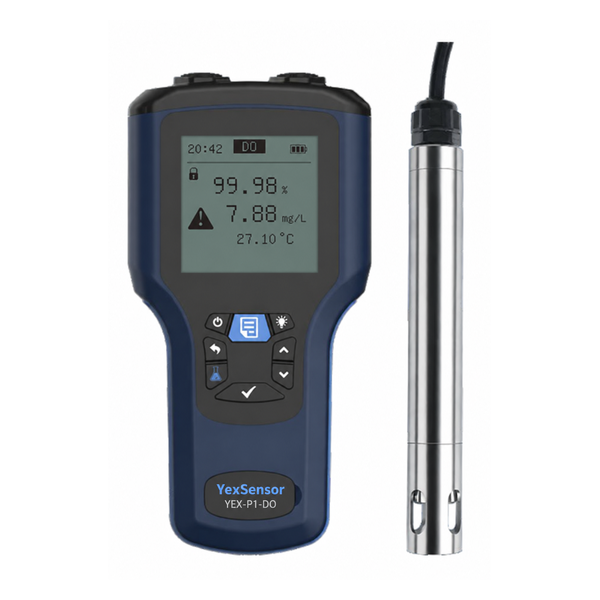
YEX-P1-DO Portable Fluorescence Dissolved Oxygen Meter: Stable Field DO Measurement with GPS, Compensation, and Traceable Records
- Three values on one screen: measure dissolved oxygen concentration from 0.00 to 20.00 mg/L, oxygen saturation from 0.0 to 200.0%, and water temperature from 0.0 to 50.0 °C.
- Optical measurement for practical field work: fluorescence-quenching technology, a 316L stainless-steel IP68 probe, salinity and atmospheric-pressure compensation, and T90 response within 60 seconds.
- Records tied to place and time: GPS coordinates, automatic interval or lock-triggered storage, alarms, reading stabilization, and CSV export to a Windows computer through USB.
Product Overview
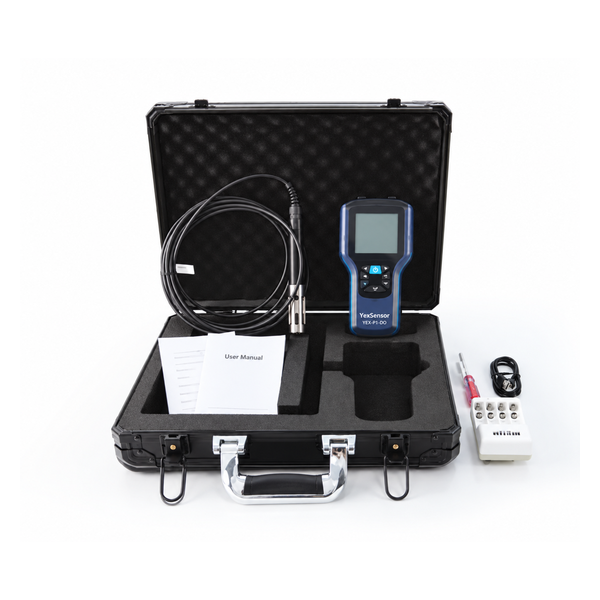
YexSensor YEX-P1-DO is a portable fluorescence dissolved oxygen meter for trained operators who need concentration, saturation, and temperature at treatment plants, surface-water sites, aquaculture facilities, water-supply systems, and laboratories. The handheld meter uses a 3.3-inch monochrome LCD and accepts up to two supported sensors through two ports. Its dissolved oxygen configuration combines the meter with a 316L stainless-steel optical probe, a standard 5 m cable, and a protective carrying case.
The fluorescence-quenching sensing cap changes its optical response according to oxygen concentration. Probe electronics convert that response into dissolved oxygen concentration and saturation while applying temperature compensation. The method avoids the routine membrane filling and electrolyte management associated with traditional electrochemical probes, but it still requires a clean sensing cap, correct calibration, suitable sample flow, compensation settings, and documented quality control.
Selection Considerations and Measurement Boundaries
Define the required values and operating environment
The installed dissolved oxygen probe covers 0.00-20.00 mg/L, 0.0-200.0% saturation, and 0.0-50.0 °C. The handheld meter is IP65 and must not be immersed. The connected probe is IP68, provided that its cable, connector, cap, and seals remain intact. Procurement teams should state the minimum, normal, and maximum expected DO, water temperature, depth, cable route, sample flow, fouling risk, and whether measurements are spot checks or unattended intervals.
Compensation inputs are part of the result
Dissolved salts reduce oxygen solubility, and atmospheric pressure changes oxygen saturation. Enter measured salinity whenever possible and use local absolute atmospheric pressure, not a weather station's sea-level-corrected value. High-altitude sites, saline water, rapidly changing weather, and samples with temperature gradients need particular attention. Conductivity must not be entered as salinity without a valid conversion.
Configuration affects power and supplied accessories
The manual covers a built-in lithium-battery meter and a rechargeable-AA NiMH version. The lithium configuration uses the supplied USB charging cable and 5 V adapter; the AA configuration uses four matched rechargeable AA cells, an external AA charger, and a screwdriver. Accessories, probe quantity, cable length, battery system, and approved expansions follow the confirmed sales order and final packing list.
Key Technical Advantages
Fluorescence measurement with defined performance
The probe specifies DO accuracy of ≤±0.3 mg/L, repeatability of ≤±0.3 mg/L, resolution of 0.01 mg/L, and T90 response of ≤60 s. Temperature-compensation accuracy is also specified as ≤±0.3 mg/L. These values support field and laboratory work where range, response, and repeatability must be known before purchase, while the actual project acceptance plan should include calibration checks and comparison with an approved reference method where required.
Stainless-steel probe for repeated deployment
The 316L stainless-steel probe measures Ø34.2 × 185 mm excluding its connector and carries an IP68 rating. A 5 m cable is standard, with other lengths available by agreement. The optical cap must be protected from scratches, oil, biological growth, direct handling, solvents, and impact. A typical preventive cap-replacement interval is approximately one year, but exposure, sunlight, cleaning, fouling, and measurement duty determine the actual service life.
Calibration and compensation for changing sites
The meter supports temperature calibration, one-point 100% calibration in water-saturated air, and two-point 0% plus 100% calibration. Salinity and absolute-pressure compensation can be set for the sample and location. Calibration records should identify the operator, probe, standard preparation, temperature, pressure, salinity, result, and date. Recalibration is required after cap replacement, relevant maintenance, failed verification, or according to the quality plan.
Field data management without assuming online control
GPS can display and save coordinates with readings. Data may be stored at an interval of at least one minute while the main measurement screen is active, or when a manual or automatic reading lock is completed. Historical records can be reviewed, filtered, deleted, and exported as CSV to a Windows computer through USB. The manual does not specify RS-485, Modbus, Bluetooth, Wi-Fi, cloud, LIMS, or SCADA connectivity.
Technical Specifications
| Parameter | Specification |
|---|---|
| Probe Parameters | |
| Principle | Fluorescence quenching |
| Measured values | DO concentration, oxygen saturation, temperature |
| DO range | 0.00-20.00 mg/L |
| Saturation range | 0.0-200.0% |
| Temperature range | 0.0-50.0 °C |
| DO accuracy / repeatability | ≤±0.3 mg/L / ≤±0.3 mg/L |
| Resolution | 0.01 mg/L |
| Response time | T90 ≤60 s |
| Temperature-compensation accuracy | ≤±0.3 mg/L |
| Material / protection | 316L stainless steel / IP68 |
| Dimensions / cable | Ø34.2 × 185 mm; 5 m standard |
| Handheld Meter Parameters | |
| Display | 3.3-inch monochrome LCD |
| Sensor / computer interfaces | Two sensor ports / one USB port |
| Positioning / storage | GPS coordinates; interval and lock-triggered storage |
| Protection | IP65; do not immerse |
| Power options | Built-in lithium battery or four rechargeable AA NiMH cells |
| Operating environment | -5 to 50 °C; 10-85% RH, non-condensing |
| Storage environment | -15 to 65 °C; 5-85% RH, non-condensing |
| Dimensions / weight | 200 × 101 × 36 mm / approximately 420 g |
Calibration and Compensation
| Function | Reference condition | Control point |
|---|---|---|
| Temperature calibration | Probe and traceable thermometer in the same mixed bath | Match depth, allow stability, enter reference temperature |
| One-point 100% | Water-saturated air above clean water | Cap remains in humid air, not submerged; avoid sun and condensation |
| Two-point 0% + 100% | Fresh sodium-sulfite zero solution followed by water-saturated air | Remove bubbles, rinse between points, verify both environments |
| Salinity / pressure | Measured salinity and local absolute atmospheric pressure | Confirm units; do not substitute conductivity or sea-level pressure |
Calibration should be performed with a clean probe, stable temperature, sufficient equilibration, and a correctly prepared reference. Bubbles on the cap, direct sunlight, condensation, rapid temperature change, aged standards, and contamination can invalidate the result. The factory-coefficient reset is a deliberate diagnostic action, not a substitute for correct calibration.
Application Scenarios
Wastewater treatment and aeration control
Spot-check aeration basins, biological reactors, secondary treatment, and effluent to assess oxygen availability and process changes. Use representative flow across the cap and keep the probe away from bubbles discharged directly by diffusers. Alarms can flag project-defined high and low values, while automatic lock supports consistent routine readings.
Aquaculture and recirculating systems
Measure concentration, saturation, and temperature in ponds, tanks, raceways, and recirculating systems. Record the time and GPS location when comparing sites. Salinity must be entered for brackish or marine systems, and biofouling should be inspected frequently because growth on the optical cap can slow or bias response.
Surface water, reservoirs, and environmental surveys
The carrying case, battery options, GPS, and storage modes support multi-site field campaigns. At each site, measure away from bank disturbance, bottom sediment, trapped bubbles, and thermal gradients. Define depth, stabilization criterion, duplicate readings, calibration verification, and data-export frequency in the field plan.
Drinking-water and source-water checks
Use the meter for intake, treatment-stage, storage, and distribution investigations where dissolved oxygen is relevant to process, corrosion, taste, or biological conditions. The instrument does not itself determine regulatory compliance; the approved method, sampling plan, calibration record, and acceptance criteria govern reporting.
Laboratory verification and teaching
One-point and two-point calibration, compensation, digital filtering, reading lock, and stored records make the system useful for method demonstrations and routine laboratory checks. Reference thermometers, fresh zero solution, water-saturated air, clean vessels, and suitable quality-control samples remain user responsibilities.
Probe Connection and Routine Measurement
Switch the meter off and dry both connector faces. Align the red marks and push the plug straight into the socket until it clicks; never rotate the keyed connector or pull on the cable. To disconnect, switch off, pull back the release sleeve, and withdraw the plug straight. A wet, dirty, forced, or twisted connector can damage sealing and signal integrity.
Before measurement, confirm the active DO sensor, battery, date and time, units, salinity, pressure, calibration status, filter, alarm, GPS, and storage mode. Rinse with part of the sample, immerse the sensing area at the required depth, and provide gentle representative flow. Keep the cap away from vessel walls, sediment, air bubbles, sunlight, and sharp temperature gradients. Wait for stability or automatic lock, save the required values and coordinates, then rinse and protect the probe.
Alarms Filtering GPS and Data Management
| Setting | Available control | Engineering use |
|---|---|---|
| High / low alarm | Visual and optional buzzer warning | Project thresholds; verify after configuration |
| Digital filter | 2-40 | Low values respond faster; high values smooth more slowly |
| Reading lock | Manual; automatic Fast, Medium, or Slow | Standardize the stability criterion for the task |
| Interval storage | 1 minute or longer; 0 disables | Runs while the main measurement screen is active |
| Lock storage | Save when manual or automatic lock completes | Confirm the stored-record indication before moving sites |
| GPS | Coordinate display and automatic coordinate storage | Requires a valid outdoor fix; disable when unnecessary to save power |
| USB export | Dissolved oxygen records in CSV format | Verify time, units, decimals, coordinates, and record count |
Historical records can be browsed and deleted from the meter. Delete-all actions cannot be undone, so export required data first. Use a USB data cable rather than a charge-only cable, keep the meter switched on, select the current export function or YexSensor utility, and safely disconnect after transfer.
Maintenance and Optical Cap Care
Rinse the probe with clean water after every measurement. Remove deposits only with a gentle rinse; do not scrape, polish, touch, or apply organic solvent to the optical surface. Wipe the meter and cable with a soft damp cloth and dry them. Inspect the cap for scratches, cracks, delamination, discoloration, biological growth, oil, and persistent deposits. Do not operate the probe without its sensing cap.
Evaluate cap replacement at approximately one year as preventive practice, while actual life depends on exposure and duty. Calibrate and verify after replacement. For long storage, remove rechargeable AA cells or maintain the lithium battery appropriately, coil the cable loosely, protect the probe from impact, and use the original case. Store at -15 to 65 °C and 5-85% RH without condensation, and prevent water from freezing around the probe.
Configuration and RFQ Checklist
For a technically useful quotation, provide the water matrix, DO concentration and saturation range, temperature, salinity, altitude or absolute pressure, measuring depth, cable route, required cable length, number of probes, number of sites, expected fouling, spot or interval measurement, GPS requirement, logging interval, alarm values, language, preferred battery configuration, destination, plug, and applicable standard or acceptance test.
YexSensor will use these inputs to confirm the YEX-P1-DO meter, fluorescence probe quantity, 5 m or agreed cable length, lithium or rechargeable-AA power arrangement, charger and adapter, protective case, documentation, replacement-cap planning, and any approved sensor-port expansion. Final delivery follows the quotation, sales order, and packing list.
Standard Packing List and Ordered Configuration
| Item | Typical quantity | Configuration note |
|---|---|---|
| Portable meter | 1 | Lithium-battery or rechargeable-AA version |
| Fluorescence DO probe | Per order | 316L optical probe; standard 5 m cable |
| USB charging cable | 1 | Lithium-battery configuration |
| 5 V adapter | 1 | Lithium-battery configuration |
| AA battery charger | 1 | Rechargeable-AA configuration |
| Rechargeable AA cells | 1 set / 4 | Rechargeable-AA configuration |
| Screwdriver | 1 | Rechargeable-AA configuration |
| Protective carrying case | 1 | Transport and storage |
| User manual | 1 | English edition |
| Product certificate | 1 | Retain with the instrument record |
Inspect all delivered items before operation and report missing, damaged, leaking, or mismatched parts. Because charging accessories and batteries depend on the ordered power configuration, the product photograph must not be used as the sole definition of supply.
Quality Assurance and After Sales Information
For each measurement series, record the meter and probe serial numbers, cap status, calibration method and outcome, salinity and pressure settings, sample matrix, temperature, location, filter and lock mode, operator, date, and any deviations. When a result is unexpected, check flow, bubbles, thermal stability, fouling, compensation, calibration, and sample representativeness before concluding that the instrument is faulty.
The standard warranty period is one year from purchase unless the contract states otherwise. Warranty excludes operation, charging, connection, cleaning, storage, or transport contrary to the manual; unauthorized dismantling or repair; consumables and normal wear including optical caps, batteries, and seals; impact, meter immersion, connector misuse, corrosive contamination, force majeure, expired coverage, and insufficient purchase or identification information.
Frequently Asked Questions
1. What does the YEX-P1-DO measure?
It displays dissolved oxygen concentration from 0.00 to 20.00 mg/L, oxygen saturation from 0.0 to 200.0%, and water temperature from 0.0 to 50.0 °C. These values come from a fluorescence-quenching probe with temperature compensation. Salinity and local absolute pressure must also be set correctly when they affect the project result.
2. What accuracy and response should be specified?
DO accuracy and repeatability are each ≤±0.3 mg/L, resolution is 0.01 mg/L, and response is T90 ≤60 s. Temperature-compensation accuracy is ≤±0.3 mg/L. Field acceptance should additionally define calibration checks, stabilization, flow, temperature, matrix, and comparison criteria because these conditions affect the observed result.
3. Is the handheld meter waterproof?
The handheld enclosure is IP65 and must not be immersed. The connected probe is IP68 when the optical cap, cable, connector, and seals are intact. Keep connector faces clean and dry, align the red marks, push straight until latched, and never twist the keyed connector or support the probe by its cable.
4. How is the dissolved oxygen probe calibrated?
The meter supports temperature calibration, one-point 100% calibration in water-saturated air, and two-point calibration using fresh sodium-sulfite zero-oxygen solution followed by the 100% environment. Keep the optical cap free of bubbles and condensation, allow temperature to stabilize, rinse between standards, and document all settings and results.
5. Can the meter compensate saline or high-altitude samples?
Yes. Enter measured salinity and local absolute atmospheric pressure in the units displayed by the meter. Do not enter conductivity as salinity and do not use sea-level-corrected weather pressure. Confirm both values when moving between freshwater and saline sites, elevations, or changing weather conditions.
6. How are readings saved and exported?
Readings can be stored on a timed interval of at least one minute or when manual or automatic lock is completed. GPS coordinates can be stored when a valid fix is available. Historical DO records are exported in CSV format to a Windows computer through USB. RS-485, Modbus, Bluetooth, Wi-Fi, cloud, LIMS, and SCADA are not specified.
7. How often should the optical sensing cap be replaced?
Approximately one year is a preventive reference, not a fixed warranty life. Actual life depends on sunlight, fouling, oil, cleaning, immersion duty, storage, and damage. Inspect the cap routinely and replace it when performance or physical condition requires. Calibrate and verify the probe after replacement.
8. What information is needed for a quotation?
Provide matrix, DO range, saturation and temperature, salinity, altitude or pressure, depth, cable length, site count, fouling, logging and GPS needs, alarm thresholds, battery preference, language, destination, plug, applicable method, probe quantity, and acceptance requirements. YexSensor can then confirm the meter, probe, cable, power system, case, documentation, and service items.
Summary
YEX-P1-DO is suited to trained teams that need portable fluorescence dissolved oxygen concentration, saturation, and temperature measurement with a 316L IP68 probe, compensation, GPS, alarms, reading stabilization, automatic storage, and USB CSV export. Its boundaries are equally clear: the IP65 meter is not immersible, the optical cap requires care and periodic replacement, compensation and calibration must match the site, and USB is a local data interface rather than an industrial control protocol.
To configure the instrument for real field conditions, send YexSensor the water matrix, expected range, temperature, salinity, pressure or altitude, depth, cable length, number of locations, fouling risk, measurement and logging plan, GPS and alarm needs, battery configuration, destination, and acceptance method. These inputs allow the probe, cable, power accessories, packing list, calibration plan, and delivery scope to be confirmed before shipment.