Chinese
 Spanish
 French
 Russian
 German
 Portuguese
 Indonesian
 Thai
Thai Vietnamese
 Arabic

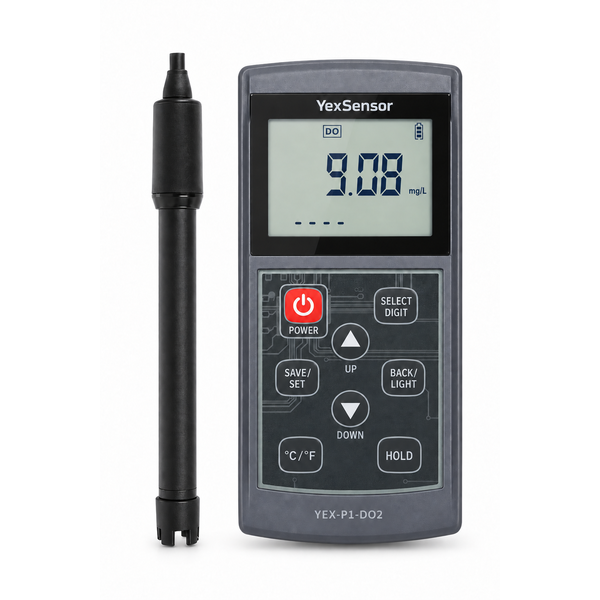

Products Description
Portable membrane dissolved oxygen measurement for aquaculture and water testing
- Four measurement readouts: dissolved oxygen concentration, oxygen saturation, electrode current, and temperature are available from the meter.
- Field adjustments: automatic temperature compensation plus manual atmospheric-pressure and salinity compensation.
- Portable instrument: rechargeable lithium battery, 3 m SD02 electrode cable, IP65 meter enclosure, and a carrying case.
Product Overview
The YEX-P1-DO2 is a portable dissolved oxygen meter that uses a membrane electrode. The manual describes it as a compact instrument for precise laboratory measurement and aquaculture work, with a clear display, operating prompts, a backlight, calibrated-point indication, and controls intended for routine field or bench use. The meter reports dissolved oxygen concentration and oxygen saturation, and also measures electrode current and temperature.
Its value is the combination of a dedicated SD02 dissolved oxygen electrode, a 3 m cable, and three compensation functions. Temperature compensation is automatic within its documented compensation range. Atmospheric pressure and salinity are entered manually so users can account for those conditions when preparing a measurement. The meter is intended for operators who need a portable membrane-method instrument and can follow a controlled probe preparation, calibration, and measurement procedure.
Measurement Scope and Selection Boundaries
The dissolved oxygen concentration range is 0.00-20.00 mg/L, with a stated resolution of 0.01 mg/L and accuracy of ≤ ±0.3 mg/L. Oxygen saturation is displayed from 0.0 to 200.0%, with 0.1% resolution and accuracy of ≤ ±3%. The response time is specified as ≤45 seconds. These specifications describe the meter and standard electrode as listed in the manual; actual results still depend on correct electrode preparation, calibration, sample conditions, and use of the applicable compensation settings.
The temperature measurement range is 0.0-60.0 °C (32-140 °F), while automatic temperature compensation is specified for 0.0-40.0 °C (32-104 °F). These are separate limits. Manual atmospheric-pressure compensation is 60.0-110.0 kPa, and manual salinity compensation is 0.0-50.0 g/L. Confirm that the expected sample and operating conditions fall within the applicable range before selecting the instrument.
The manual rates the meter enclosure IP65. It does not assign an IP rating to the SD02 electrode, specify an immersion depth, or give a probe pressure rating. Do not interpret the meter's IP65 rating as permission to immerse the main unit. Confirm the installation and immersion conditions for the electrode with YexSensor before deployment. The manual also does not specify RS-485, Modbus, USB data export, internal record capacity, or wireless connectivity; a USB cable is listed for charging.
Key Technical Advantages
Membrane electrode for dissolved oxygen testing
The YEX-P1-DO2 is explicitly identified as a membrane-method model and is supplied with the SD02 dissolved oxygen electrode. This gives laboratories and aquaculture operators a dedicated probe-based arrangement for measuring dissolved oxygen in solution. The manual describes resistance to interference as a product feature, but does not provide a quantified cross-interference table. For samples with unusual chemistry, suspended matter, or known interfering substances, validate the method with representative samples before making acceptance or process-control decisions.
Three compensation functions with separate operating ranges
Automatic temperature compensation covers 0.0-40.0 °C. Atmospheric pressure can be entered manually from 60.0 to 110.0 kPa, and salinity can be entered manually from 0.0 to 50.0 g/L. Keeping these functions distinct helps users document the conditions behind a result. Temperature measurement itself extends to 60.0 °C, so a displayed temperature outside the automatic compensation band should not be mistaken for a wider compensation range.
Multiple measurement readouts
The 32-bit microprocessor measures dissolved oxygen concentration, oxygen saturation, electrode current, and temperature. The concentration range is 0.00-20.00 mg/L; the saturation range is 0.0-200.0%. Electrode current and temperature provide additional context for checking electrode behavior and sample conditions. The manual does not specify a data-logging capacity, so retain project records in the approved external log or laboratory system unless a separate data function is confirmed.
Portable controls and rechargeable power
The LCD includes operating prompts, and the instrument has a backlight with ambient-light sensing. The panel labels identify power, select/digit, save/set, back/light, up/down, °C/°F, and hold controls. The manual specifies a rechargeable lithium battery, charging management, power-loss protection, and a USB charging cable in the packing list. It does not state a battery runtime or include a rated charger output in the specification table, so runtime and adapter compatibility should be confirmed for the intended work schedule.
Technical Specifications
| Measurement item | Specification | Selection note |
|---|---|---|
| Dissolved oxygen concentration | 0.00-20.00 mg/L | Select when the required result is concentration in mg/L. |
| Concentration resolution / accuracy | 0.01 mg/L / ≤ ±0.3 mg/L | Accuracy is the manual's stated value; do not substitute the resolution for accuracy. |
| Oxygen saturation | 0.0-200.0%; resolution 0.1%; accuracy ≤ ±3% | Use the saturation readout when the procedure requires percent saturation. |
| Temperature measurement | 0.0-60.0 °C (32-140 °F); resolution 0.1 °C (0.1 °F); accuracy ≤ ±0.3 °C | Measurement range is wider than the documented automatic compensation range. |
| Response time | ≤45 s | Allow for the response specified by the manual during sampling plans. |
| Instrument item | Specification | Boundary or note |
|---|---|---|
| Model | YEX-P1-DO2 | Portable membrane dissolved oxygen meter. |
| Standard electrode | SD02 dissolved oxygen electrode | Standard cable length: 3 m. |
| Automatic temperature compensation | 0.0-40.0 °C (32-104 °F) | This is the compensation range, not the full temperature measurement range. |
| Manual pressure compensation | 60.0-110.0 kPa | Enter the applicable atmospheric pressure manually. |
| Manual salinity compensation | 0.0-50.0 g/L | Enter salinity manually when required by the method. |
| Power | Rechargeable lithium battery | USB charging cable is listed in the packing list; runtime is not specified. |
| Meter protection | IP65 | The manual does not state an electrode IP rating or immersion depth. |
| Dimensions | 165 x 75 x 51 mm | Meter dimensions as listed in the manual. |
| Weight | 270 g, excluding electrode | Probe and cable are additional to the stated meter weight. |
All values above follow the YEX-P1-DO2 user manual. No probe material, probe IP rating, immersion depth, storage capacity, data-export protocol, or battery runtime is added where the manual gives no value.
Measurement and Compensation Workflow
Use the SD02 membrane electrode with the meter and follow the electrode preparation and calibration instructions supplied for the instrument. The packing list includes 30 mL of dissolved oxygen electrolyte, a spare membrane cap, a rubber O-ring, and sandpaper as electrode accessories. These items are relevant to maintaining the electrode assembly; they are not substitutes for following the complete preparation procedure in the manual.
Before measurement, allow the probe and sample to reach stable conditions in accordance with the operating procedure, then check that the selected measurement mode matches the result needed: concentration, saturation, electrode current, or temperature. The manual specifies a response time of no more than 45 seconds. Use stable readings and the applicable calibration-point indication rather than recording a transient display as a final result.
Apply automatic temperature compensation within 0.0-40.0 °C. When required, enter atmospheric pressure manually within 60.0-110.0 kPa and salinity within 0.0-50.0 g/L. Record the compensation settings with the result so another operator can understand the conditions used. If an operating value falls outside a stated range, do not extrapolate the specification; verify the method and measurement suitability with YexSensor.
For quality control, use representative samples and a documented calibration routine. Recheck calibration when the electrode has been maintained, the sample matrix changes, or readings do not agree with an approved check procedure. The manual does not state a universal calibration interval or reference solution value, so set those controls according to the applicable method and project requirements.
Application Scenarios
The manual identifies aquaculture as the model's design focus and lists source-water monitoring, wastewater treatment, research institutions, drinking-water supply, swimming-pool water, and other water-related uses. Suitability depends on the measurement range, sample matrix, electrode preparation, and field installation conditions.
| Scenario | Measurement need | Points to confirm |
|---|---|---|
| Aquaculture | Portable dissolved oxygen concentration or saturation checks. | Confirm probe immersion conditions, salinity entry, and the required measurement schedule. |
| Source-water and drinking-water monitoring | Field or laboratory measurements of dissolved oxygen in water samples. | Check the expected range and the method's accuracy requirement against the stated specifications. |
| Wastewater treatment | Portable measurement for sampling and process observation. | Validate representative sample interference and confirm the probe cleaning procedure. |
| Research and teaching laboratories | Concentration, saturation, electrode current, and temperature readouts. | Document calibration, compensation inputs, and any required external data record. |
Setup and Routine Measurement
Connect the SD02 electrode securely and inspect the cable, membrane cap, and O-ring before use. Prepare the electrode using the supplied manual and the included electrolyte. Keep the meter itself protected from water exposure beyond the stated IP65 enclosure rating. The electrode is intended for measuring dissolved oxygen in a sample, but the manual does not state a probe immersion rating; obtain the approved immersion conditions for the intended setup.
Power on the meter, select the required display mode, and use the control panel labels to navigate settings. Select °C or °F as needed. Enter pressure and salinity values manually when the method requires compensation. Allow the reading to respond within the specified ≤45-second response time, then confirm that the display and calibration-point indication are stable before recording the result.
For repeated field measurements, keep a consistent sequence for sampling, probe handling, compensation entries, reading, rinsing, and recordkeeping. This reduces operator-to-operator variation and makes differences between sites or sampling times easier to interpret. Follow the full manual for electrode conditioning and calibration steps; this product page summarizes the selection-relevant specifications and does not replace the operating instructions.
Data, Power, and Operation
The meter is powered by a rechargeable lithium battery and includes charging management and power-loss protection. A USB charging cable appears in the standard packing list. The manual does not provide an operating-time figure or a specified charger output. Confirm the charging supply accepted by the unit before selecting an adapter, and plan charging around the sampling schedule instead of assuming a runtime.
The panel includes SAVE/SET and HOLD labels, but the manual's specification section does not state a record capacity or describe export functions. It also does not specify USB data transfer, RS-485, Modbus, Bluetooth, Wi-Fi, cloud service, LIMS, or SCADA connectivity. Treat the included USB cable as a charging accessory unless a separate written specification confirms data communication. If project records must be transferred automatically, confirm the exact interface and workflow before ordering.
Maintenance and Troubleshooting
Maintain the membrane electrode
The included 30 mL electrolyte, spare membrane cap, O-ring, and sandpaper are specific to electrode care. Use them only as directed in the user manual. Inspect the membrane cap and O-ring for damage or leakage, and keep the electrode connector and cable clean and undamaged. The manual does not specify a replacement interval for the membrane or electrolyte, so base replacement on the manual's procedure and verified electrode performance.
Check the measurement setup
If a reading is unstable or outside an expected range, verify the selected measurement mode, electrode connection, probe preparation, calibration state, sample representativeness, and compensation entries. Confirm that automatic temperature compensation is being used only within its specified 0.0-40.0 °C range. Check that manual pressure and salinity values are entered in the correct units and within their documented ranges.
Protect the meter and document service conditions
Keep the meter enclosure, charging connection, and controls in suitable condition and avoid immersing the main unit. The meter is rated IP65, while no probe IP rating is stated in the manual. For service support, provide the model and serial information, sample conditions, measurement mode, temperature, pressure and salinity inputs, electrode preparation or maintenance performed, and the displayed reading. This context helps distinguish an instrument issue from a probe or method issue.
Configuration and RFQ Checklist
For a project quotation, provide the sample type, expected dissolved oxygen range, whether concentration or saturation is required, expected sample temperature, salinity and atmospheric-pressure conditions, tests per day, and the intended field or laboratory use.
Also confirm electrode cable reach, immersion arrangement, calibration and maintenance expectations, charging arrangements, required certificates and manual language, and whether results must be recorded or transferred to another system. The manual lists a standard SD02 electrode with a 3 m cable and a USB charging cable; confirm any longer cable, alternate accessory, data interface, or special configuration in writing before ordering.
Packing List and Order Confirmation
| Documented item | Description | Receipt check |
|---|---|---|
| Main unit | YEX-P1-DO2 meter, 1 unit | Verify model and inspect display, controls, and enclosure. |
| Dissolved oxygen electrode | SD02 probe, 1; 3 m cable | Check probe, cable, connector, membrane cap, and O-ring. |
| Dissolved oxygen electrolyte | 30 mL | Check container and label; use according to the manual. |
| Spare membrane cap and rubber O-ring | Electrode accessories | Confirm both accessories are included and undamaged. |
| Sandpaper | Included accessory | Retain for electrode maintenance as directed. |
| USB charging cable | Included accessory | The manual lists it for charging; data transfer is not specified. |
| User manual | Product documentation | Retain for operation and electrode preparation. |
| Product certificate and warranty card | Product documentation | Keep with the sales and serial-number records. |
| Carrying case | Storage and transport case | Check case condition and fit of supplied components. |
The user manual lists the items above. Confirm the exact configuration, quantities, charging supply, certificates, and any optional accessories in the signed sales order and final packing list. Reconcile the delivered items against those records before first use.
Warranty and Service
The manual includes a product certificate and warranty card but does not state a warranty duration. The applicable warranty period and service terms should therefore be confirmed in the supplied warranty document and sales contract. Keep the product model, serial information, purchase record, certificate, and warranty card together.
When requesting support, provide the displayed value and mode, sample conditions, electrode preparation and maintenance history, temperature, compensation inputs, and photographs of the probe or meter if relevant. Confirm replacement electrolyte, membrane caps, O-rings, and other service items against the approved electrode procedure.
Frequently Asked Questions
1. What does the YEX-P1-DO2 measure?
It measures dissolved oxygen concentration from 0.00 to 20.00 mg/L and oxygen saturation from 0.0 to 200.0%. The meter also measures electrode current and temperature. Concentration accuracy is ≤ ±0.3 mg/L, and saturation accuracy is ≤ ±3%, according to the user manual.
2. Is the YEX-P1-DO2 a fluorescence meter?
No. The YEX-P1-DO2 is identified in its manual as a membrane dissolved oxygen meter and is supplied with an SD02 dissolved oxygen electrode. It is a separate model from YEX-P1-DO fluorescence equipment. Select the method required by the project and do not transfer specifications between the two models.
3. What are the temperature measurement and compensation ranges?
Temperature measurement covers 0.0-60.0 °C (32-140 °F), with 0.1 °C (0.1 °F) resolution and accuracy of ≤ ±0.3 °C. Automatic temperature compensation is specified only from 0.0 to 40.0 °C (32-104 °F). The compensation limit should not be inferred from the wider temperature measurement range.
4. How are salinity and atmospheric pressure handled?
Both are manual compensation inputs. The documented salinity range is 0.0-50.0 g/L, and the atmospheric-pressure range is 60.0-110.0 kPa. Enter the values required by the method and retain them with the result. If project conditions fall outside these ranges, confirm suitability before purchase.
5. What electrode and cable are supplied?
The standard electrode is the SD02 dissolved oxygen electrode with a 3 m cable. The packing list also includes 30 mL of dissolved oxygen electrolyte, a spare membrane cap, a rubber O-ring, and sandpaper. Confirm cable reach and the probe's approved immersion conditions for the installation.
6. Can the meter export measurements over USB or communicate with a PLC?
The manual lists a USB charging cable, but does not document USB data export, internal record capacity, RS-485, Modbus, or PLC communication. Do not select the cable as a data interface. If electronic transfer or control-system integration is required, obtain a written interface specification before ordering.
7. Is the complete meter assembly IP65 or IP68?
The manual specifies IP65 for the meter. It does not state an IP rating or immersion depth for the SD02 electrode, so the complete meter-and-probe assembly should not be described as IP68 based on this document. Keep the main unit out of the water and confirm probe installation limits with YexSensor.
8. What warranty period and charging adapter are included?
The manual lists a warranty card and USB charging cable, but does not state a warranty duration, battery runtime, or charger output. Confirm the warranty terms in the sales contract and verify adapter compatibility with YexSensor. Do not assume an adapter, extended runtime, or data function is included.
Summary
The YEX-P1-DO2 is a portable membrane dissolved oxygen meter for users who need concentration and saturation readings with an SD02 electrode. Its documented limits include 0.00-20.00 mg/L concentration, ≤ ±0.3 mg/L concentration accuracy, 0.0-200.0% saturation, automatic temperature compensation from 0.0-40.0 °C, and manual pressure and salinity compensation. The meter is IP65; the manual does not specify probe immersion rating, runtime, or data interfaces.
Before ordering, confirm sample conditions, probe installation, compensation inputs, cable reach, calibration procedure, and required record transfer with YexSensor.