Chinese
 Spanish
 French
 Russian
 German
 Portuguese
 Indonesian
 Thai
Thai Vietnamese
 Arabic

A portable water quality meter should be purchased as a field measurement system, not as a collection of impressive parameter names. For integrators and engineering contractors, the correct choice depends on the measurement decision, sensor principle, water matrix, calibration plan, data traceability, environmental protection, and whether the project needs spot checks or continuous PLC-connected monitoring.

Why Industrial Buyers Search for a Portable Water Quality Meter
System integrators investigate a portable water quality meter when measurements are needed before a permanent station is available, at multiple inspection locations, or beside an online sensor for an independent check. This type of field water quality testing equipment supports site surveys, process troubleshooting, commissioning, environmental screening, aquaculture inspection, and comparison sampling.
The procurement question is whether the complete procedure will produce defensible data. The team must know the fitted sensor, calibration method, sample exposure, stored metadata, and reference method. Portable instruments provide mobility and verification; fixed RS485 Modbus RTU sensors provide continuous process visibility. Many projects need both.
Portable Water Quality Meter Principles and Their Engineering Meaning
The sensing principle determines calibration materials, stabilization behavior, interference risk, cleaning, and replacement parts. Evaluate the wet-end technology before comparing display or software features.
Electrochemical Measurement for pH and ORP
A pH sensor measures the potential difference between a glass electrode and a reference electrode. Reliable field results depend on hydrated glass, fresh buffers, temperature equilibrium, a clean reference junction, and correct storage.
ORP uses a noble-metal surface, commonly platinum, with a reference electrode and reports oxidation-reduction potential in millivolts. It is not a direct concentration measurement. The project must define how ORP supports an operating decision instead of applying one universal threshold to every matrix.
Fluorescence Measurement for Dissolved Oxygen
YEX-P1-DO uses fluorescence quenching: blue light stimulates the sensing cap, and dissolved oxygen changes the fluorescence response. The meter combines that response with temperature and compensation settings to calculate concentration and saturation. The method avoids routine electrolyte replacement, but bubbles, sunlight, fouling, cap damage, and incorrect salinity or pressure settings can still distort results.
Conductivity, Salinity, and TDS Measurement
Conductivity sensors measure current carried by dissolved ions. YEX-P1-MP configurations may use two- or four-electrode graphite sensors depending on range. Salinity and TDS are related to conductivity but do not identify every dissolved substance. State minimum, normal, and maximum conductivity plus the reporting unit so the correct configuration and calibration standard can be selected.
Optical Scattering for Turbidity
The YEX-P1-MP family lists a 90-degree scattering turbidity option. Optical windows must be clean and bubble-free; particle size, color, settling, scratches, and stray light can affect the result. Turbidity in NTU is not interchangeable with suspended solids mass concentration. Any conversion requires a site-specific correlation.
Ion-Selective, UV Absorption, and Fluorescence Sensors
Ion-selective configurations for ammonia, nitrate, or chloride depend on conditioning, ionic strength, pH, temperature, and interfering ions. UV absorption can support configured COD, TOC, BOD, or nitrate screening, while fluorescence options cover chlorophyll, blue-green algae, and oil-in-water. Validate these matrix-dependent methods against the agreed reference before contractual use.
Where the Portable Meter Fits in an Industrial Monitoring Architecture
The portable meter is the acquisition layer for route-based or temporary measurements. YEX-P1-MP provides two sensor ports, GPS-supported records, automatic interval storage, stability-lock storage, and USB export. These features support surveys, online-tag checks, troubleshooting, and commissioning when sample IDs, calibration records, and file ownership are defined. They do not create a continuous SCADA connection.
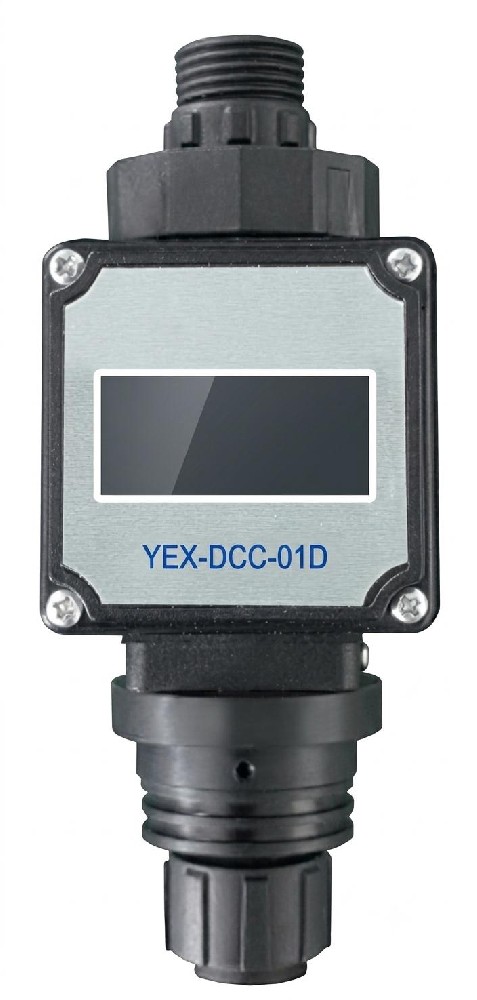
For unattended monitoring, alarms, remote telemetry, or PLC control, specify online water quality sensors with approved RS485 Modbus RTU registers and a controller or gateway. The YEX-DCC-01D portable data collection device is a separate field tool for compatible sensors; it displays address, type, value, and temperature and provides RS485 and 4–20 mA output. It is not the battery-operated YEX-P1-MP analytical platform.
| Project requirement | Suitable architecture | Procurement boundary |
|---|---|---|
| Multi-location survey or inspection route | YEX-P1-MP with selected portable sensors | Define parameters, ranges, calibration, GPS/data records, and carrying accessories |
| Dedicated field dissolved oxygen checks | YEX-P1-DO | Define concentration/saturation requirement, compensation settings, cap care, and cable length |
| Online sensor setup and local signal verification | YEX-DCC-01D with compatible sensor | Confirm 12–24 VDC supply, RS485/4–20 mA wiring, connector, and protocol compatibility |
| Continuous PLC, SCADA, or IoT monitoring | Online YexSensor probe plus controller or gateway | Approve Modbus register map, address plan, power, mounting, alarms, and historian tags |
| Regulatory or contractual reporting | Portable or online measurement plus agreed reference method | Define method equivalence, sample chain, acceptance tolerance, and laboratory responsibility |
Verified YexSensor Portable Meter Specifications
The following values come from the YEX-P1-MP User Manual, Version 1.00, and YEX-P1-DO User Manual, Version 1.00. YEX-P1-MP is configurable; only sensors listed in the purchase specification are supplied. The nameplate, sensor certificate, and ordered configuration take precedence over this family-level summary.
| Selection item | Verified specification | Project procurement check |
|---|---|---|
| YEX-P1-MP display | 3.3-inch monochrome LCD | Confirm readability and required operating language for field teams |
| Instrument size and weight | 200 × 101 × 36 mm; 420 g | Include protective case, standards, cables, and batteries when evaluating field portability |
| Sensor and data interfaces | Two sensor ports; one USB port | List simultaneous parameter needs and the required export workflow |
| Data records | Automatic interval save and automatic stability-lock save | Define sampling interval, file naming, sample ID, reviewer, and retention period |
| Location and language | GPS position query/automatic storage; Chinese and English | Confirm GPS reception limits and require manual location entry when a fix is unavailable |
| YEX-P1-MP enclosure | IP67 | Keep connectors dry and cap unused ports; IP67 does not permit careless wet connection |
| Power | Rechargeable lithium battery or AA NiMH batteries | State field duration, charging access, spare battery policy, and transport restrictions |
| Meter operating conditions | −5–50 °C; 10–85% RH, non-condensing | Verify ambient conditions separately from each probe's water-contact limits |
| pH option | 0–14 pH; 0–60 °C; ±0.02 pH; 0.01 pH resolution; T90 ≤20 s | Specify buffer set, expected pH band, storage solution, and acceptance check |
| Dissolved oxygen option | 0–20 mg/L; 0–200%; 0–50 °C; ±0.3 mg/L; 0.01 mg/L resolution | Define salinity/pressure compensation, optical-cap spares, and reference procedure |
| Conductivity option | 0–20,000 µS/cm or 0–200 mS/cm; accuracy ±1% | Select range and cell configuration from actual water data; state reporting unit |
| Turbidity option | 0–1,000 NTU; 0.01 NTU resolution; linearity ±5% F.S. | Define expected particle conditions, standards, bubble control, and cleaning method |
| YEX-P1-DO protection | IP65 meter; IP68 probe | Protect the handheld unit from immersion while confirming probe retrieval and connector care |
| YEX-P1-DO probe | 316L; Ø34.2 × 185 mm; standard 5 m cable | Check material compatibility, required reach, sampling depth, and safe cable handling |
Field Use Method for a Defensible Measurement Campaign
1. Define the Decision Before Mobilization
State why each parameter is measured. Online-sensor comparison, spatial profiling, and process troubleshooting require different locations, intervals, reference samples, stabilization times, and acceptance criteria. Prepare a field sheet with sample ID, coordinates, time, process state, sensor serial number, calibration status, operator, units, and observations.
2. Inspect and Connect the Ordered Sensors
Power YEX-P1-MP off before connecting a sensor. Dry the connectors, align the marks, push straight until locked, and cap unused ports. Inspect optical surfaces, membranes, junctions, cables, O-rings, and guards. After power-up, confirm sensor recognition, battery, date, time, unit, GPS, and storage mode. Document any configuration or unit change.
3. Complete Water Quality Meter Calibration for the Working Range
Use fresh traceable standards that cover the working range. Use two- or three-point buffers for pH, a certified conductivity standard near the duty, specified zero/span checks for optical sensors, and matrix-aware standards for ion-selective sensors. For optical DO, clean the cap, allow temperature equilibrium, perform the approved saturation calibration, and enter salinity and pressure or altitude correctly. Preserve failed calibration records.
4. Measure a Representative Point
Rinse the sensor and immerse the active area at the required depth, away from walls, sediment, air-water interfaces, and dosing points unless they are the test target. Remove bubbles and wait for temperature and measurement stability. Use manual storage for spot checks, interval storage for profiles, and stability lock for equilibrium results. For comparisons, align location and time and record relevant mixing, aeration, weather, cleaning, batch, or flow changes.
5. Close the Measurement and Preserve Evidence
Before leaving, review the parameter, time, sensor, result, temperature, and position. Export by the approved USB procedure and preserve raw files with field notes. Rinse sensors and follow sensor-specific storage instructions. Do not store pH glass in deionized water; protect optical surfaces from scratches and quarantine equipment that fails verification.
Industrial Application Scenarios
Industrial Wastewater Field Testing and Process Troubleshooting
Field challenge: A treatment plant may show unstable aeration, nitrification, sludge settling, or discharge trends, but one fixed instrument cannot identify conditions throughout the process.
Integration approach: Use a portable multiparameter water quality meter for industrial wastewater field testing across influent, equalization, aeration zones, clarifier, and final effluent. Synchronize portable readings with SCADA tags and grab samples. Use each parameter only where its selected sensor and method are appropriate.
Project value: The team obtains spatial and time-linked evidence for troubleshooting, sensor-location review, and future online monitoring design instead of replacing equipment based on one unexplained reading.
Aquaculture Water Quality Inspection
Field challenge: Oxygen, salinity, pH, algae, and ammonia can vary with depth, feeding, aeration, weather, and circulation. A measurement taken beside an aerator may not represent the culture zone.
Integration approach: Establish repeatable locations, depths, and times. Record aerator state and feeding events. Use a dedicated portable dissolved oxygen meter where DO profiling is the main task, or configure YEX-P1-MP for the required parameter set. Export GPS-linked records for farm management review.
Project value: The operator can compare zones and operating periods and can use the survey to select representative positions for permanent online sensors.
Environmental Water Survey Equipment for Rivers and Lakes
Field challenge: Rivers, lakes, reservoirs, and stormwater sites require measurements across locations where fixed power and communications are unavailable.
Integration approach: Specify the portable platform as environmental water survey equipment within a documented sampling grid. Define duplicates and blanks, combine field readings with laboratory samples, use interval storage for profiles, and preserve coordinates, weather, flow observations, and calibration checks.
Project value: The resulting dataset supports station-location studies, event screening, and monitoring-network expansion while maintaining traceability beyond a handwritten result.
Commissioning and Online Sensor Verification
Field challenge: A PLC value can disagree with a field measurement because of the wet end, sampling point, scaling, unit, register interpretation, time delay, or maintenance condition.
Integration approach: Place the portable probe beside the online sensor, allow both to stabilize, and document the process state. Check the online signal from sensor to PLC and historian. Use the YEX-DCC-01D where compatible digital sensor address, value, temperature, RS485, or 4–20 mA verification is required.
Project value: The contractor can separate analytical differences from communication and configuration faults and can close FAT/SAT records with evidence.
Portable Multiparameter Water Quality Meter Selection Guide
Start with the measurement list and water matrix, not the number of channels. For every parameter, state range, unit, reference method, stabilization requirement, and resulting action. Remove parameters without a defined decision or verification plan.
Choose YEX-P1-DO when portable fluorescence dissolved oxygen is the central task. Choose YEX-P1-MP when teams need interchangeable sensors, two ports, GPS-linked records, and a common multiparameter workflow. For simpler single-parameter inspections, compare the YexSensor portable pen tester range with the project's accuracy, calibration, recordkeeping, and traceability requirements.
Evaluate meter, connector, and probe protection separately. An IP68 probe does not make an IP65 or IP67 meter submersible. Review chemical compatibility, cable length, depth, temperature, and transport conditions.
Define stored values, GPS handling, export, timestamp and unit control, and database ownership before award. If remote alarms or continuous SCADA data are mandatory, a portable meter alone is the wrong system boundary.
Compare standards, buffers, membranes, optical caps, reference solution, O-rings, cables, batteries, cleaning materials, case, training, and spares. A low instrument price can become a high project cost when teams cannot calibrate or restore it.
System Integration and Commissioning Notes
For online verification, use matching tag names, units, location codes, and time basis. Define allowed time difference and comparison tolerance; combined uncertainty includes both sensors, sampling, matrix, temperature, timing, and reference method.
Do not connect a portable analytical meter to a PLC unless the ordered product documentation explicitly provides the required industrial interface. The verified YEX-P1-MP manual specifies sensor ports and USB export; it does not state that the meter is an RS485 Modbus RTU slave for continuous automation. Use an online sensor and approved gateway/controller for that requirement.
Perform incoming inspection and functional acceptance. Confirm model, sensors, ranges, serial numbers, cables, accessories, manuals, standards, power, language, storage, and export. Site acceptance should cover calibration, representative measurement, data review, cleaning, storage, and handover.

Frequently Asked Questions About Portable Water Quality Meters
1. What measurement principles can a portable water quality meter use?
A portable water quality meter can use glass-electrode measurement for pH, platinum-electrode measurement for ORP, fluorescence quenching for dissolved oxygen, electrode-based conductivity measurement, 90-degree optical scattering for turbidity, ion-selective electrodes for specific ions, and UV or fluorescence methods for selected organic or biological indicators. The ordered sensor determines the actual capability. Procurement teams should request the principle, range, calibration method, interference limits, and consumables for every configured parameter.
2. How should a YEX-P1-MP meter be calibrated before field use?
Calibration must match the fitted sensor and expected working range. Use fresh pH buffers that bracket the sample, a certified conductivity standard near the expected value, approved turbidity standards, and at least two matrix-controlled standards for ion-selective sensors. Optical DO normally uses a 100% saturation calibration with correct pressure and salinity settings. Record standards, lot or certificate information, temperature, operator, result, and failed attempts under the project quality plan.
3. Can portable meter data be used to verify an online sensor?
Yes, but only through a controlled comparison. Place both sensors in the same representative water, align the measurement time, allow temperature and readings to stabilize, and record maintenance and process conditions. Compare the two instruments with the agreed reference method and combined uncertainty. A difference does not automatically prove online sensor failure; sampling position, units, compensation, fouling, time delay, and matrix response must be investigated.
4. Should a project select a dedicated portable DO meter or a multiparameter meter?
Select YEX-P1-DO when dissolved oxygen concentration, saturation, and temperature are the central field tasks and a dedicated fluorescence workflow is preferred. Select YEX-P1-MP when the team needs interchangeable sensors, two ports, GPS-linked records, or several parameters under one operating platform. The final decision should also compare cable reach, calibration workload, spare sensors, required simultaneous readings, and the competence of field personnel.
5. Is a portable water quality meter suitable for continuous PLC or SCADA monitoring?
Normally, no. A portable meter is designed for attended field measurements, surveys, troubleshooting, and verification. The verified YEX-P1-MP configuration provides USB data export but is not specified as a continuous Modbus slave. For unattended monitoring, use online YexSensor probes with RS485 Modbus RTU and an approved controller or IoT gateway. Use YEX-DCC-01D separately when compatible sensor setup and RS485/4–20 mA field verification are required.
6. How should buyers choose sensor ranges for industrial wastewater or environmental surveys?
Use actual minimum, typical, warning, and credible maximum values from the intended locations. Include startup, cleaning, storm, batch, and upset conditions. Select a range that covers the duty while retaining useful resolution in the operating band. Do not copy a range from a different model or assume a family-level option is included. Where historical data are weak, run a preliminary sampling campaign before finalizing the sensor package.
7. What should distributors request in a portable water quality meter quotation?
Request the exact meter and sensor models, measurement principles, ranges, accuracy or performance statements, temperature limits, cable lengths, wetted materials, protection grades, connectors, power options, storage and export functions, GPS capability, standards, consumables, carrying case, manuals, certificates, warranty, lead time, and exclusions. The quotation should distinguish included items from optional sensors and should identify any configuration-dependent specification requiring confirmation.
8. What acceptance tests should an engineering contractor include?
The acceptance plan should verify the delivered configuration, sensor recognition, physical condition, calibration, check-standard performance, stability, temperature response, GPS and timestamp records, manual/interval/stability storage, USB export, battery operation, cleaning, and correct storage. Site testing should add representative water comparisons and user training. If portable data will verify an online system, test units, tags, time alignment, quality states, and the agreed comparison procedure.

Summary
A portable water quality meter creates project value when its sensor principle, range, calibration procedure, field location, data record, and acceptance method are specified together. YEX-P1-MP supports configurable multiparameter field campaigns with two sensor ports, GPS-linked records, interval or stability storage, and USB export. YEX-P1-DO provides a dedicated fluorescence dissolved oxygen workflow. Neither should be presented as a substitute for an online PLC-connected monitoring system when continuous telemetry and alarms are required.
Before requesting a quotation, define the water matrix, measurement decisions, parameters, operating ranges, locations, sampling frequency, cable reach, environmental conditions, calibration standards, data workflow, reference method, accessories, spares, quantity, and schedule. A complete RFQ enables YexSensor and the integrator to configure a maintainable field measurement package and to define where portable verification ends and online monitoring begins.