


 Chinese
 Spanish
 French
 Russian
 German
 Portuguese
 Indonesian
 Thai
Thai Vietnamese
 Arabic

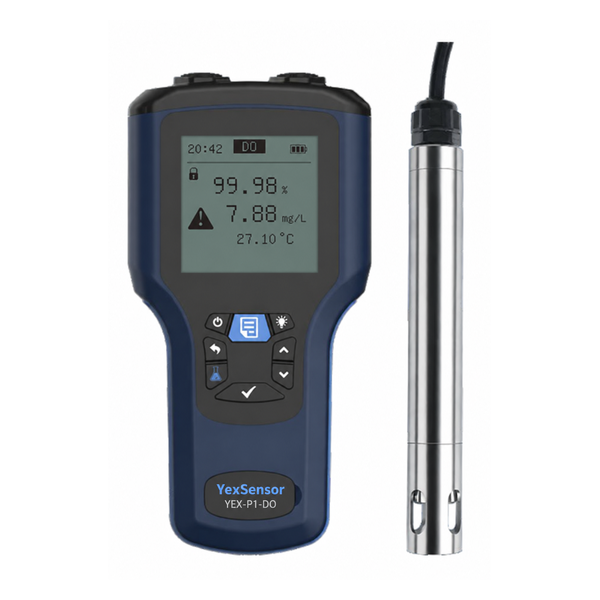
A dissolved oxygen meter should be selected from the water matrix, concentration and saturation range, temperature, salinity, pressure, measurement depth, response requirement and data workflow. For aquaculture, wastewater and environmental surveys, compensation and field handling often affect the project more than display resolution.
What Buyers Are Really Deciding
Wastewater teams may use DO to check aeration distribution, diagnose a biological process or verify an online loop. Aquaculture operators may compare ponds, depths or raceways before adjusting aeration. Environmental contractors may need a repeatable profile with time and location. These tasks have different stability, logging, cable and acceptance requirements.
The result is not determined by the sensor alone. Flow across the optical cap, bubbles, sunlight, rapid temperature change, salinity, local atmospheric pressure, fouling and measurement depth all influence the observed value. A purchase specification should therefore describe the procedure and environment together with range and accuracy.
Verified YEX-P1-DO Specifications and Their Meaning
| Item | Verified specification | Procurement meaning |
|---|---|---|
| Principle | Fluorescence quenching | No membrane replacement or electrolyte refill, but the optical cap still needs protection and replacement planning |
| Measured values | DO concentration, oxygen saturation, temperature | Specify which values and units must appear in reports |
| DO range | 0.00–20.00 mg/L | Check normal, alarm and maximum conditions against this range |
| Saturation range | 0.0–200.0% | Useful where temperature, pressure or photosynthesis can create supersaturation |
| Temperature range | 0.0–50.0 °C | Confirm the complete site envelope, not only average water temperature |
| Accuracy / repeatability | ≤±0.3 mg/L / ≤±0.3 mg/L | Write acceptance criteria from accuracy and method uncertainty, not the last display digit |
| Resolution / response | 0.01 mg/L / T90 ≤60 s | Allow stabilization and do not treat resolution as accuracy |
| Probe | 316L stainless steel, IP68, Ø34.2 × 185 mm | Check corrosion, fouling, clearance and safe retrieval |
| Cable | 5 m standard; other lengths by agreement | State depth, route and strain relief before ordering |
| Meter | IP65, two sensor ports, one USB port | The handheld unit must not be immersed; USB is for local data export |
Specification basis: the values above were checked against the current YexSensor YEX-P1-DO product information on October 6, 2026. Confirm the delivered probe, cable, power accessories, optical cap, documentation and any agreed options in the approved quotation before purchase.
The handheld operates from a built-in lithium battery or four rechargeable AA NiMH cells, depending on configuration. Its operating environment is -5 to 50 °C and 10–85% RH without condensation. The meter measures approximately 200 × 101 × 36 mm and 420 g. Confirm charger, adapter, plug and battery arrangement in the quotation rather than assuming one global package.
Optical DO vs Electrochemical DO
| Decision factor | Optical fluorescence | Electrochemical |
|---|---|---|
| Oxygen consumption | Does not consume oxygen at the sensing reaction | May require flow across the membrane depending on design |
| Routine service | Protect and periodically replace the optical cap | Membrane and electrolyte service may be required |
| Field stability | Useful for profiling and low-flow samples when properly stabilized | Can be appropriate where established SOPs and service skills already exist |
| Selection rule | Choose by performance, cap care and compensation workflow | Choose by method, flow need, maintenance capability and life-cycle cost |
The comparison is not a claim that one principle wins every project. Existing methods, operator training, spare parts and acceptance rules matter. If a laboratory or authority specifies a particular principle, that requirement controls. For new multi-site field work, optical technology often reduces membrane and electrolyte tasks, but it does not remove calibration or cleaning.
Calibration, Compensation and Verification
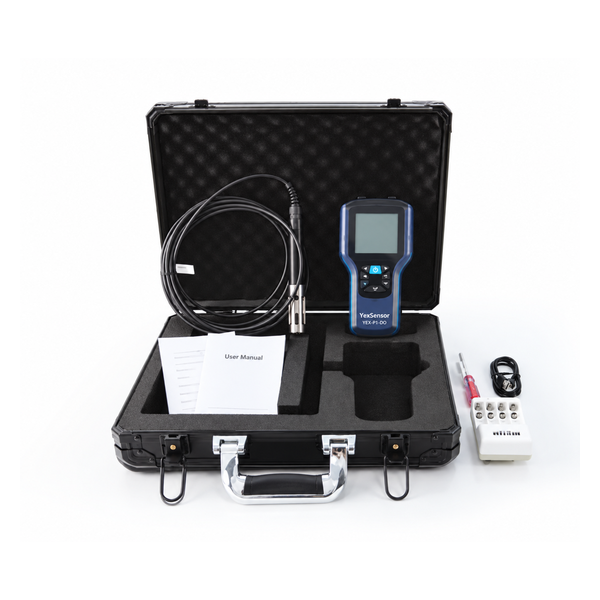
YEX-P1-DO supports temperature calibration, one-point 100% calibration in water-saturated air, and two-point calibration using fresh sodium-sulfite zero-oxygen solution followed by the 100% environment. Use a clean cap, stable temperature and sufficient equilibration. Avoid bubbles, condensation and direct sunlight. Rinse between standards and document the operator, reference, temperature, pressure, salinity, result and date.
Salinity and absolute pressure affect oxygen solubility. Enter the actual site values and confirm units. Do not substitute conductivity directly for salinity without an approved conversion, and do not use sea-level pressure for a high-altitude site. A stable reading with incorrect compensation is consistently wrong.
One-point calibration is appropriate for many routine checks when the expected range is near normal saturation. Two-point calibration is useful when the project must verify low DO, after cap replacement or when the quality plan requires both ends. An as-found verification before adjustment preserves evidence of drift.
Application Scenarios
Wastewater aeration basins
Challenge: bubbles and gradients can make one spot unrepresentative. Method: measure at defined depths and positions away from direct diffuser discharge, using the same stability setting and representative movement across the cap. Value: the team can compare zones and verify fixed sensors before changing aeration.
Aquaculture ponds and recirculating systems
Challenge: DO changes with temperature, time, depth and biomass demand. Method: record concentration, saturation, temperature, salinity and GPS at planned points; inspect biofouling frequently. Value: operators can identify spatial risk and confirm whether aeration changes improved conditions.
Rivers, reservoirs and environmental surveys
Challenge: bank disturbance, thermal layers and changing depth reduce comparability. Method: define coordinates, depth, duplicates, stabilization and calibration checks. Value: survey data can be compared between sites and repeated campaigns rather than becoming isolated readings.
Industrial water and cooling systems
Challenge: process temperature, corrosion concerns and intermittent flow change interpretation. Method: use a representative sample point and compare portable results with operating status and the installed sensor. Value: maintenance teams gain independent evidence before diagnosing process or instrument problems.
Data Logging and Interface Boundaries
Readings can be stored at timed intervals of at least one minute while the measurement screen is active, or when a manual or automatic lock completes. GPS coordinates can be stored when a valid fix is available. Historical DO records export as CSV to a Windows computer through USB. Verify timestamps, units, coordinates, decimal format and record count before deleting field data.
The manual does not specify RS485, Modbus, Bluetooth, Wi-Fi, cloud, LIMS or SCADA. If continuous automation is required, select an online YexSensor DO probe and controller or gateway rather than expecting the portable meter to become a control transmitter. This distinction affects cable, power, enclosure, register mapping and commissioning scope.
Installation, Handling and Maintenance
Switch the meter off and dry connectors before connecting the probe. Align the red marks, push straight until latched and never twist the keyed plug or pull the cable. Keep the meter above water and protect it from spray beyond its IP65 boundary. Provide strain relief and do not support the probe by its cable.
Rinse after measurement. Do not scrape, polish, touch or apply solvent to the optical cap. Inspect for scratches, cracks, delamination, oil, biofilm and deposits. Approximately one year is a preventive cap-replacement reference, not a guaranteed life; actual duty, sunlight, fouling and cleaning determine replacement. Calibrate and verify after a cap change.
Acceptance rule: a 0.01 mg/L resolution does not mean ±0.01 mg/L accuracy. Use the documented ≤±0.3 mg/L performance, reference uncertainty and field procedure when writing FAT or site criteria.
Where a Portable DO Meter Is Not the Right Choice
Do not use a handheld meter as the only instrument when the process needs continuous low-oxygen alarms, unattended trend records or automatic aeration control. Manual rounds can miss short nighttime, loading or equipment-failure events. An online DO probe connected to a controller, PLC or gateway is the appropriate architecture for continuous duty, with the portable meter retained for independent verification. Define the comparison procedure with the online sensor and reference-measurement correlation guide.
A portable result also should not be treated as a regulatory report without the required method, sampling plan, calibration evidence and chain of custody. GPS and CSV export improve traceability, but they do not define method compliance. Confirm the destination authority or customer procedure before procurement.
YEX-P1-DO may also be unsuitable where the 316L probe material, 0–50 °C water range or available cable arrangement does not fit the matrix and installation. Strongly corrosive chemistry, hazardous areas, inaccessible deep points or permanent high-pressure flow cells require a separately engineered solution. State these conditions early instead of assuming a portable stainless probe can be adapted after delivery.
Provide water matrix; DO concentration and saturation range; temperature, salinity and pressure or altitude; depth, route and cable length; sites and probe quantity; fouling; spot or interval plan; GPS and alarm requirements; battery preference; destination; accepted method and verification criteria. Review the YEX-P1-DO portable meter and Send Your Project Requirements.
FAQ About Dissolved Oxygen Meter Selection
Technical questions
1. What does an optical dissolved oxygen meter measure?
YEX-P1-DO reports DO concentration from 0.00 to 20.00 mg/L, oxygen saturation from 0.0 to 200.0% and temperature from 0.0 to 50.0 °C. Fluorescence quenching does not remove the need for temperature, salinity and pressure compensation. Specify required units and reporting fields before purchase. Confirm the complete site range as well.
2. Why do salinity and pressure matter?
Both affect oxygen solubility. Incorrect values can create systematic error even when the probe is clean and stable. Enter measured salinity and local absolute atmospheric pressure using the correct units. For brackish, marine or high-altitude work, include these values in the SOP, record and acceptance test. Recheck them when sites change.
3. Is the entire YEX-P1-DO system waterproof?
No. The 316L probe is IP68 when its cap, connector, cable and seals are intact. The handheld meter is IP65 and must not be immersed. Keep connector faces clean and dry, provide cable strain relief and use the carrying case. Separate these boundaries in training and inspection records. Replace damaged seals before redeployment.
Selection questions
4. Should a project choose a portable or online DO meter?
Choose portable equipment for surveys, profiles, commissioning and independent checks at multiple points. Choose an online sensor for continuous alarms, trends or aeration control through PLC/SCADA. Many plants need both. The portable meter verifies the fixed point, while the online instrument exposes events between manual rounds. Define correlation timing before commissioning.
5. When is two-point DO calibration appropriate?
Use zero plus 100% calibration when low-end performance must be verified, after cap replacement, after relevant maintenance or when the quality plan requires it. One-point water-saturated-air calibration may suit routine work near normal saturation. Always use fresh reference conditions and retain an as-found check before adjustment. Document both accepted points.
6. How should cable length be selected?
Allow enough cable for maximum depth, safe access, routing, strain relief and connection without supporting the probe by the cable. The standard is 5 m; other lengths require agreement. Excess unsupported cable can snag or move the probe, while insufficient length encourages unsafe handling and poor measurement placement. Include connector clearance in the route.
Procurement and project questions
7. What affects dissolved oxygen meter price?
Price depends on meter and probe quantities, cable length, lithium or rechargeable-AA power arrangement, charger and adapter, spare optical caps, case, documentation, inspection, training, destination and acceptance testing. Compare the complete field package and replacement-cap plan rather than the display unit alone. Confirm freight, insurance and international delivery terms separately.
8. What information is needed for a DO meter quotation?
Provide matrix, concentration and saturation range, temperature, salinity, pressure or altitude, depth, cable route, site count, fouling, measurement and logging plan, GPS, alarms, battery preference, quantity, destination and accepted method. These details let YexSensor confirm probe, cable, power, accessories and verification scope. Include the required delivery date and inspection plan.
Summary
Dissolved oxygen meter selection depends on the field procedure as much as the instrument specification. YEX-P1-DO provides fluorescence measurement across 0.00–20.00 mg/L, oxygen saturation and temperature, with a 316L IP68 probe, portable IP65 meter, salinity and pressure compensation, GPS and USB CSV export. It suits trained teams performing surveys, depth profiles, commissioning and independent verification. It is not the correct choice for unattended RS485 Modbus alarms or direct aeration control.
Reliable deployment requires representative flow, controlled depth, correct salinity and pressure inputs, documented calibration, protected connectors, optical-cap inspection and traceable data handling. Include matrix, expected range, temperature, altitude or pressure, salinity, cable route, site count, fouling, logging plan, accessories, quantity, destination and acceptance method in the RFQ so the supplied field package matches the actual measurement duty.



