Chinese
 Spanish
 French
 Russian
 German
 Portuguese
 Indonesian
 Thai
 Vietnamese
 Arabic


COD sensor turbidity compensation can support a process trend when the actual water matrix, clean optical path and independent checks remain within the conditions validated for that use. It does not make a dirty window, trapped bubble or changed organic mixture harmless. Keep the agreed trend role only while those checks remain satisfactory; investigate unexplained disagreement and suspend affected concentration decisions under the site's control plan when validity is unresolved.
For engineers and integrators, the purchase decision is therefore whether the complete measuring point can distinguish a useful process change from an optical or sampling problem. A compensated number alone cannot establish that distinction.
A smooth trend can still support the wrong decision
An optical COD estimate and laboratory chemical COD have different measurement bases. Particles can affect the optical signal, while the organic composition controls how UV response relates to the laboratory result. Correcting one influence does not prove that the other relationship remains valid.
The immediate risk is accepting a calm display as evidence of acceptable water. Conversely, a dirty sensing surface can provoke an unnecessary process response. Define whether the value supports observation, investigation, an alarm or automatic action. Agree who can restrict that use and what independent evidence permits its release. Reporting-method acceptance requires its own evidence.
What does the current S1PRO-COD specification establish?
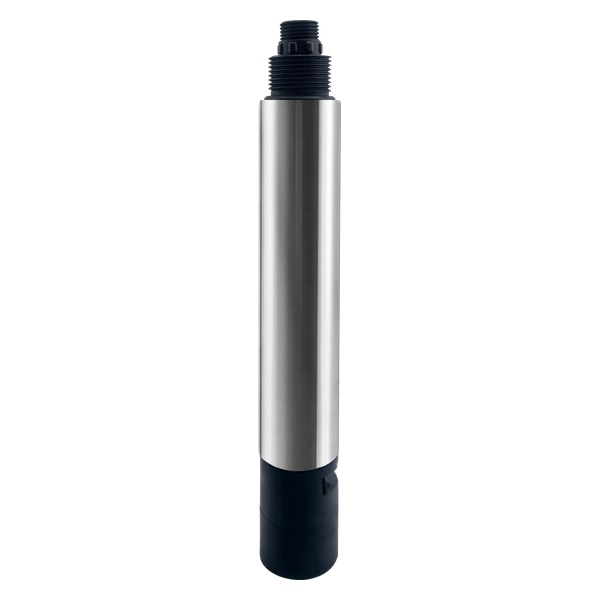
The YEX-S1PRO-COD UV254 sensor lists COD, turbidity, TOC and temperature outputs. Its official page identifies color, nitrate, solids, bubbles, window fouling and changing organic composition as possible influences. The following specifications describe this model; they do not define a universal wastewater acceptance envelope.
| YEX-S1PRO-COD item | Published value or configuration | Purchasing consequence and condition |
|---|---|---|
| Principle | UV254 absorption with turbidity compensation | Obtain the delivered compensation conditions; secondary/reference wavelengths and correction limits are not stated. |
| COD range alternatives | 0–200 / 0–500 / 0–1500 mg/L; customizable | Specify the supplied range against normal and upset water; these alternatives do not establish automatic range switching. |
| Turbidity range alternatives | 0–200 / 0–1000 NTU | Select the delivered range. Its upper limit is not a COD compensation pass threshold. |
| Accuracy statement | ±5%; temperature ±0.1 °C | Obtain the percentage basis and test conditions; do not infer site COD uncertainty or a turbidity-specific accuracy. |
| Response time | 10 s | Add sample transport and controller averaging to the timing review; the page does not identify this as T90. |
| Output and supply | RS-485 Modbus RTU or optional 4–20 mA, select one; 12–24 VDC, approximately 0.4 W | Order the interface and mapped parameter explicitly. Confirm available channels and any additional cleaning power. |
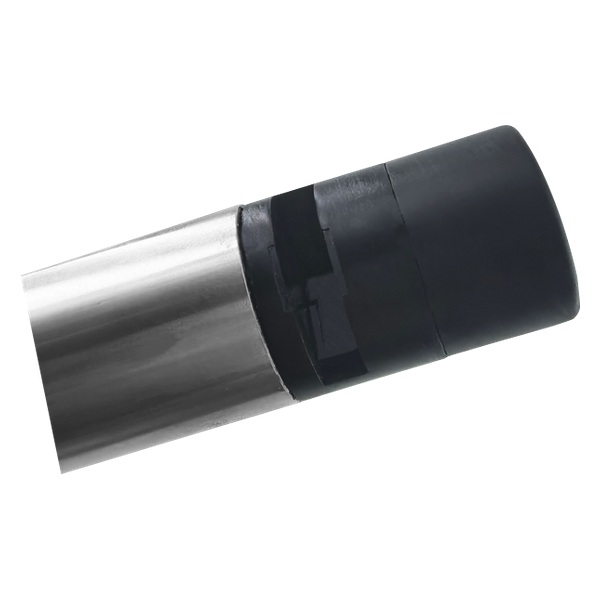
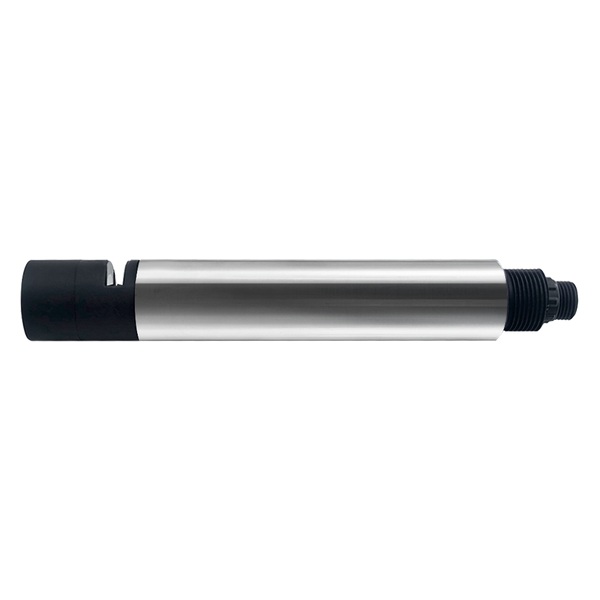
| Housing and protection | 316L stainless steel + ABS; IP68 | Assess actual chemical exposure and seals; these labels do not establish universal chemical compatibility. |
| Operating environment | 0–50 °C, non-freezing; pressure <0.2 MPa | Check local pressure, temperature and upset conditions before specifying a holder or bypass. |
| Mounting and cable | Immersion, NPT 3/4; default 5 m four-core shielded cable | Provide withdrawal space and a matched holder. Verify the delivered connection drawing rather than relying on wire colors. |
| Cleaning | Self-cleaning optional | State the ordered arrangement and its service requirements; a catalogue photograph does not prove a cleaner is included. |
Use COD sensor turbidity compensation within a defined decision boundary
Separate particle correction from fault removal and from chemical correlation. The observation suggests an investigation; it does not, by itself, identify the cause.
| Observed condition | Mechanism to investigate | Evidence needed | Trend-use decision |
|---|---|---|---|
| Solids rise; paired checks remain acceptable | Particle influence within the tested matrix | Clean optics, representative sample fraction and repeated checks in that solids region | Retain only the validated role; do not extrapolate to higher solids. |
| Signal shifts after cleaning or changes with entrained air | Deposits, bubbles or installation instability | As-found records, controlled cleaning and repeat comparisons after stabilization | Restrict affected use until the optical path is restored and checked. |
| Clean-window checks recover but laboratory disagreement persists | Changed absorbing composition or other matrix effects | Time-matched independent results identified by feed and process state | Investigate correlation; compensation alone cannot release the concentration decision. |
| Laboratory COD changes with little UV-based response | Material not adequately represented by UV254 | Repeated valid paired results and analytical assessment of the changed water | Evaluate another method for that decision; additional fitting may not resolve the ambiguity. |
Prefer continued operation with documented checks when evidence supports it. Prefer cleaning or installation correction when the optical path is suspect. Evaluate renewed matrix validation or another suitable analytical method when disagreement survives those corrections. No universal NTU cutoff can replace this sequence.
Separate a solids event, a cleaning event and a feed change
Rain-driven solids at an inlet: log the event, sample location and any laboratory settling, filtration or homogenization. A conditioned sidestream and an untreated laboratory aliquot may represent different fractions. Continue the established trend role only if the event lies within demonstrated conditions and current checks support it. A higher turbidity reading does not prove that COD has risen proportionally.
Progressive drift between cleaning visits: preserve the as-found estimate and paired reference result before intervention. Clean using the supplied procedure, restore representative water and obtain another pair after stabilization. Recovery supports a maintenance explanation, but changing water during the intervention can confound it. Record process conditions rather than treating every post-cleaning step as proof of fouling.
A new production ingredient: a changed proportion of weakly absorbing material can alter chemical COD without a comparable optical response. A clear window and low turbidity do not resolve that limitation. The feed-change calibration guide addresses the subsequent correlation study; first establish here whether physical optical faults remain unresolved.
Make cleaning and paired laboratory checks traceable
Place the sensing end in continuously wetted, representative water after adequate mixing. Avoid bubble collection, sediment accumulation and direct chemical injection. Check the specified pressure and temperature at the probe, including plausible disturbances. For a bypass, document transport delay and whether its conditioning changes the sample fraction. Provide safe removal and cleaning access.
Synchronize collection and archive times, allowing for sample transport and averaging. Match the online value to water at the sampling point. Preserve the laboratory method, sample treatment and applicable quality checks, including relevant interference controls. Agree coverage across normal operation, solids events and cleaning cycles rather than selecting only convenient steady samples.
For each cleaning event, retain the as-found reading, inspection, method used, intervention time and stabilized follow-up pair. Keep settings unchanged during the diagnostic comparison where the approved procedure permits. If settings must change, preserve versions and assess that intervention separately. Do not adjust a coefficient merely to erase an unresolved deposit effect.
Keep fitting samples separate from independent validation samples. Examine differences by solids band, process state and time since cleaning, especially near the actual action region. A single overall correlation coefficient can conceal a bias. The laboratory and process owner should agree tolerances and release criteria before judging results; no site dataset is implied here.
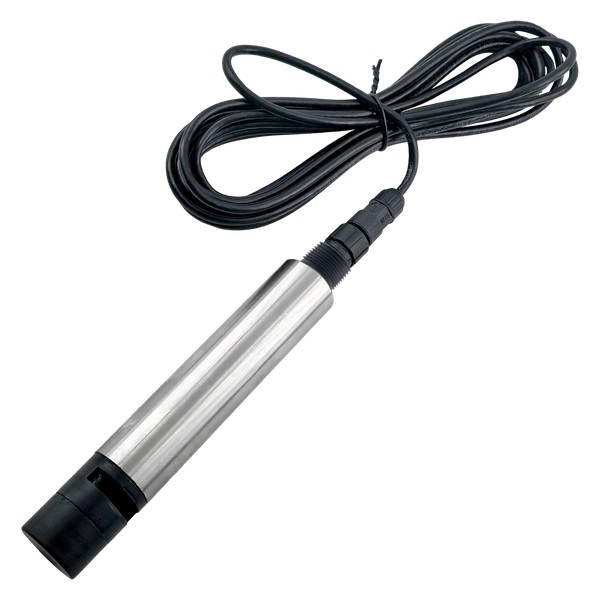
Commission the selected interface from the delivered wiring and communication revision. Verify parameter, units and scaling at the probe, PLC and historian. Request raw or uncompensated channels only if that version supports them; the published output list does not establish their availability. Distinguish communication failure, maintenance and invalid data from a fresh acceptable reading. Alarm and interlock responses belong to the configured control system and its acceptance tests.
Define the acceptance scope in the RFQ
Specify wastewater sources, expected solids and composition changes, COD reference method, sample handling, paired records and intended decision. Include temperature, pressure, chemical exposure, mounting, cable route, interface and cleaning access. Identify the exact range and optional cleaning scope. Require delivered-version documentation for compensation applicability, accessible signals, adjustment permissions and exclusions. Assign responsibility for laboratory work, validation, invalid-data handling and release after maintenance. Compare complete scope, not probe price alone.
Send the application and verification inputs
Provide the water matrix, range, paired online/laboratory records, sampling times, as-found and after-cleaning trends, installation, output and intended alarm role. Include quantity, destination and schedule for the YEX-S1PRO-COD configuration.
Frequently asked questions
Q1. What can COD sensor turbidity compensation correct?
A1. It addresses particle-related optical influence through the instrument's supplied design, rather than establishing agreement for every wastewater. YEX-S1PRO-COD lists turbidity compensation but does not publish its algorithm envelope or raw-channel availability on the product page. Obtain the delivered conditions and validate representative paired samples. Neither the turbidity range limit nor a low displayed NTU value independently releases a COD concentration decision.
Q2. Can fouling or bubbles imitate a COD change?
A2. Yes. Deposits and bubbles can disturb the optical path and produce a change unrelated to the intended water-quality interpretation. Record the as-found condition, inspect the installation and follow the supplied cleaning procedure. Repeat the comparison after stable representative water returns. If process water changed during cleaning, separate that effect before attributing recovery to maintenance. Recalibration should not conceal an unresolved optical obstruction.
Q3. Does a corrected UV signal equal laboratory chemical COD?
A3. No. Particle correction and the relationship between UV absorption and chemical oxygen demand answer different questions. Weakly absorbing constituents or changes in absorbing composition can alter that relationship even with clean optics. Use the agreed laboratory method and independent samples to establish the intended decision boundary. Method compliance and reporting acceptance require separate confirmation; compensation alone does not make the optical estimate an approved substitute.
Q4. When can the existing trend remain useful?
A4. Keep its established role when hardware, sample path and matrix remain within the validated region and current checks satisfy the agreed criteria. That may support process observation without authorizing every concentration-based action. Investigate persistent disagreement, unknown optical condition or operation outside the tested region, and apply the site's restriction or suspension procedure. Trend use still needs verification; a smooth trace is not a quality check.
Q5. When should cleaning precede recalibration?
A5. Investigate physical deposits, bubbles, sample mismatch and reference-method problems before changing a correlation. Compare time-matched as-found and after-cleaning records, including process conditions and any setting changes. If a clean, stable installation still disagrees with valid laboratory results, assess matrix suitability and the approved adjustment procedure. Preserve the previous configuration and validate independent samples afterward. One improved pair is insufficient evidence for a permanent adjustment.
Q6. When is another method or configuration preferable?
A6. Evaluate alternatives when relevant mixtures produce ambiguous optical responses, repeated valid checks fail or the required reporting method differs. First establish whether the cause is sample conditioning, optical condition or composition. A different installation may address bubbles or access; it cannot guarantee sensitivity to unrepresented constituents. Any alternative optical path or analytical method needs its own suitability evidence, maintenance scope and acceptance plan for the actual water.
Q7. Which compensation documents belong in the quotation?
A7. Include the exact model, supplied ranges, output option, cleaning configuration and document revisions. Require compensation applicability and exclusions, accessible signal definitions, approved adjustments and installation requirements. Provide actual water conditions, paired reference records and cleaning history so suitability can be assessed. If trial data are absent, identify the evaluation work and responsibility explicitly; do not treat a catalogue compensation statement as a completed application trial.
Q8. Which records define acceptance and revalidation?
A8. Retain matched online and laboratory values, timestamps, sample treatment, reference quality checks, operating state and configuration. Add cleaning events, independent validation results and known untested conditions. Agree the accepted use, tolerances, review responsibility and triggers for renewed checks before collecting the acceptance series. Set those criteria from the process decision and reference uncertainty rather than deriving them from the catalogue accuracy percentage or a universal NTU threshold.
Summary
Use compensation within a demonstrated matrix and decision boundary. YEX-S1PRO-COD provides UV254 monitoring with defined range, output and installation choices; particle correction does not resolve fouling, bubbles or every chemical change. Provide representative sampling, cleaning access and traceable archive data. Purchase the delivered documentation, paired checks, release criteria and maintenance responsibilities needed to decide when the trend remains useful and when its affected use must pause.