


 Chinese
 Spanish
 French
 Russian
 German
 Portuguese
 Indonesian
 Thai
 Vietnamese
 Arabic


Flow-through vs submersible water quality sensors is primarily a decision about sample integrity and service access. Choose direct immersion when the installed point represents the process and can be maintained safely. Choose a suitable flow-through arrangement when controlled sampling improves the measurement without introducing unacceptable delay, contamination or changes in the sample.

Flow-through vs submersible water quality sensors: compare the whole installation
A flow-through cell brings a sample to an accessible measuring chamber. A submersible arrangement places a suitably rated probe in the water being monitored. Neither is automatically more accurate. The relevant comparison is whether the complete installation preserves the quantity you need to measure throughout its operating cycle.
Compare installed cost, including retrieval or bypass accessories—not probe prices alone.
Do not assume that a threaded probe can be used in every cell or directly in any pressurized pipe. Match the specific sensor, sealing arrangement and installation method to the approved pressure and temperature envelope. IP68 is not a substitute for a process-pressure rating.
Use a decision matrix before choosing a model
| Decision | Direct immersion | Flow-through arrangement |
|---|---|---|
| Sample location | Depends on location, mixing and immersion | Depends on takeoff, transport and sample handling. |
| Response to a process change | No external sample-line transport delay | Includes transport, cell exchange and sensor response. |
| Service access | Requires safe probe retrieval or access | Can concentrate service at a panel if isolation is provided. |
| Fouling and solids | Probe remains exposed to local deposits | Lines and cells can also accumulate solids or block. |
| Gas-sensitive measurement | Avoid local bubble contact and stratification | Prevent gas exchange, pressure changes and air ingress. |
| Installation cost | Include mounting and retrieval equipment | Include pipework, flow control, drainage and verification. |
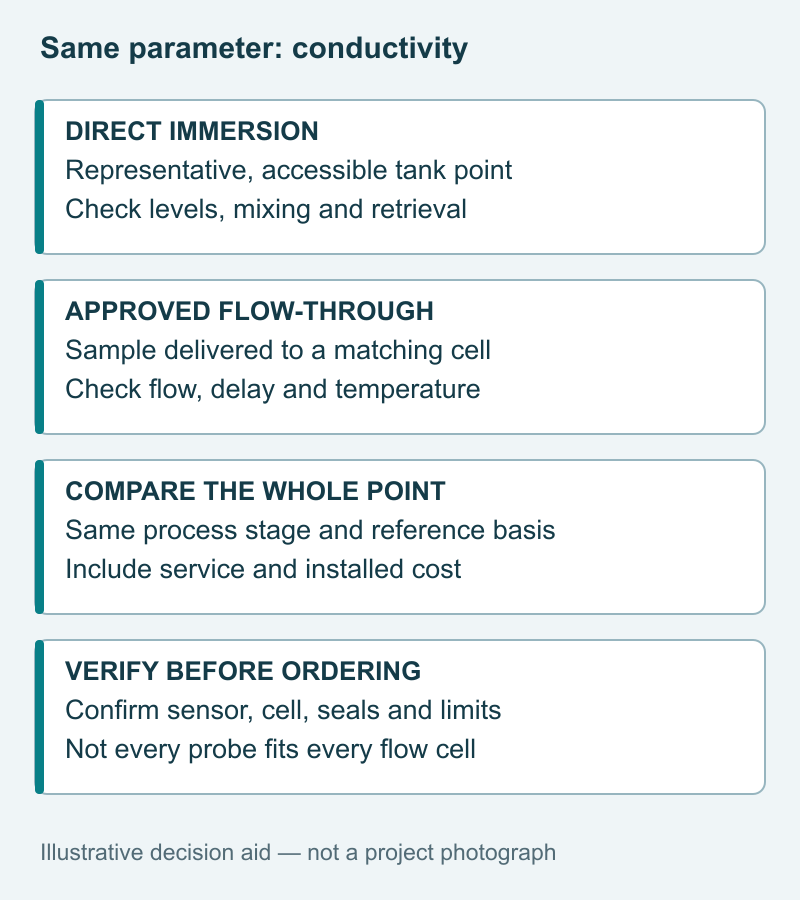
Compare the same parameter before comparing models. For tank conductivity, immersion avoids external transport; an approved bypass improves access but needs verified flow and temperature handling. For basin oxygen, immersion avoids sample-line gas exchange; a bypass requires evidence that transport preserves oxygen. A chlorine flow-cell model is not an alternative to an oxygen immersion model.
Understand what sample transport can change
Transport delay depends on the liquid volume in the sample route and the actual flow through it. As an illustrative calculation, a one-litre line carrying two litres per minute has a nominal transit time of thirty seconds before cell exchange and instrument response are considered. This is not a guaranteed response time for any YexSensor package.
Verify actual response and flow during commissioning; calculated transit time is not measured performance.
For dissolved oxygen, avoid arrangements that aerate or degas the sample. For chlorine, consider losses and reactions during transport. For conductivity, temperature change and compensation settings can affect comparisons. These mechanisms differ; one shared sampling arrangement should not be accepted for all parameters without examining each measurement duty.
Match product evidence to the installation, not the family name
The YEX-S1-RDO optical dissolved oxygen sensor manual specifies immersion installation. The YEX-S2-CL-S residual chlorine sensor manual specifies a flow-cell arrangement. These are different measurement duties, not interchangeable demonstrations of one universal installation method.
| Manual specification | YEX-S1-RDO | YEX-S2-CL-S |
|---|---|---|
| Measurement | Fluorescence dissolved oxygen | Constant-voltage chlorine measurement. |
| Measuring range | 0–20 mg/L | 0–2.000 or 0–20.00 mg/L as HClO. |
| Output | RS485 Modbus RTU | RS485 Modbus RTU; optional 4–20 mA. |
| Protection | IP68 | IP68. |
| Installation | Immersion | Flow cell; 3/4 NPT connection. |
| Temperature compensation | Automatic; Pt1000 | Automatic; Pt1000. |
| Manual working limits | 0–45°C; below 0.2 MPa | 0–60°C; ≤0.2 MPa; pH 4–9. |
| Manual materials | POM and 316L housing | 316L housing; confirm all wetted parts. |
| Calibration | Two-point calibration | Two-point calibration. |
Specifications follow the corresponding model manuals. YEX-S1-RDO specifies ±2% F.S. measurement accuracy. YEX-S2-CL-S specifies 12–24 V DC supply and 0.2 W consumption at 12 V. Apply each specification only to its named model; installation effects still require a project-level acceptance test.
A series name does not establish chemical compatibility. S1 is not necessarily entirely plastic; stainless-steel S1 Pro housings do not establish seawater suitability. Assess every wetted component, seal and cleaning chemical against the actual exposure.
Three applications show why the choice changes
Aeration-basin oxygen monitoring
The field challenge is spatial variation, bubbles and access around a working basin. A representative immersion point can avoid external sample transport, provided the probe can be retrieved safely and its installation limits are respected. The value is a measurement tied to the controlled zone. Use the aeration-tank DO placement guide to distinguish location selection from interface selection.
Treated-water chlorine monitoring
The field challenge is delivering a representative sample under the conditions required by the selected chlorine method. A compatible flow cell may provide accessible inspection and controlled delivery, but it also introduces pipework and a drain responsibility. The value is repeatable sampling and service access. Verify sample-flow failure behavior before using the signal for dosing or an operational release decision.
Industrial reuse-water conductivity monitoring
The field challenge is changing water composition, temperature and deposits. Direct immersion may suit a well-mixed accessible tank; a controlled side stream may suit an approved panel arrangement if it preserves the relevant sample. The value is a comparable conductivity trend. Evaluate the YEX-S1-EC configuration against the actual range and installation, rather than copying another project's cell or fittings.
These are illustrative, not documented customer results.

Design maintainability without sacrificing the measurement
For immersion, define water levels, orientation, solids exposure and retrieval. Do not suspend the probe by its cable unless expressly permitted. Avoid structures that create unrepresentative pockets around the sensing region.
For a flow cell, define the takeoff, isolation, pressure management, cell orientation and outlet destination. Confirm what happens when the sample supply stops or the drain becomes restricted. Do not return a changed sample to a process without considering the design and contamination implications. Cleaning must reach the sample line as well as the sensor.
For multichannel panels, check cell order, interactions and each branch's flow requirements. Total inlet flow does not establish delivery through every cell. Label valves to prevent accidental isolation during maintenance.
Integrate valid status as well as measured values
RS485 Modbus RTU can transfer measurements to a suitable PLC or gateway, but the data format and status behavior remain model-specific. A successful response does not establish sample flow or correct immersion. Combine instrument information with the independent installation checks the project requires.
During commissioning, compare the installed measurement with a suitable reference at the same process stage. Log sample conditions and timing, then test removal, isolation or loss of flow through an approved procedure. Define how maintenance and invalid data appear on the operator display. Do not let a stable retained value conceal an unavailable sample.
Compare purchase scope and lifecycle responsibilities
Compare quotations for the complete point: probe, cell or mounting, seals, cables, valves, flow components and commissioning. Price replacement access and shutdown requirements, not just hardware. Confirm documentation, delivery, packing, shipping, warranty and support in writing. Custom fittings need assembly approval; matching threads alone do not establish pressure suitability.
Project configuration review
Provide the parameter, water chemistry, expected range, temperature, pressure, proposed takeoff or immersion position, level variation, cable route, maintenance access and host interface. Include quantity and delivery destination. For an immersion oxygen point, review the YEX-S1-RDO product details, then Send Your Project Requirements with the proposed installation drawing for configuration review.

Frequently asked questions
Q1. How do I compare flow-through vs submersible water quality sensors?
The main difference is where the measurement contacts the water. A suitable immersion probe measures at the installed point; a flow-through arrangement measures water delivered to a cell. Compare representativeness, transport effects and access before choosing. Procurement should cover the complete installation and its operating limits, not assume the probe alone determines the result.
Q2. Does a flow cell improve accuracy?
Not automatically. It can provide controlled delivery and convenient service, but sample delay, gas exchange or deposits can introduce additional errors. Accuracy specifications for the sensor do not describe all those installation effects. Require an installed comparison with the relevant reference method and operating conditions before treating the flow cell as an improvement over direct measurement.
Q3. Is IP68 enough to approve a pressurized installation?
No. IP68 does not establish the allowable process pressure for a probe, cell, seal or fitting. Obtain the model-specific ratings and check the weakest part of the assembly, including transients and temperature exposure. Submit the complete proposed connection for review rather than approving pressure service from the ingress-protection label or thread size alone.
Q4. Which arrangement is preferable for dissolved oxygen?
Choose a representative immersion point when the probe and mounting suit the water and access requirements. A bypass may be considered where necessary, but its transport must not materially change the dissolved oxygen being measured. Confirm gas exchange, residence time and reference agreement before ordering the sample system. There is no universal bypass recommendation for every basin.
Q5. Can one flow-cell design serve every water-quality parameter?
Not without checking the individual measuring requirements. Sensor geometry, orientation, flow, pressure and sample behavior can differ between conductivity, oxygen and chlorine methods. Obtain confirmation for each sensor and branch. A shared panel can still be appropriate, but the quotation should identify compatible cells and separate operating conditions instead of presenting a universal chamber as sufficient evidence.
Q6. Should chloride-rich water automatically use a stainless-steel probe?
No. A stainless-steel housing alone does not establish resistance to the complete exposure. Chlorides, temperature, deposits, cleaning chemicals and other wetted components all matter. Request the exact material configuration and compatibility assessment. Do not select S1 Pro, S1 or S2 solely by a family label, and do not infer seawater suitability from appearance.
Q7. What should a sample-panel quotation include?
State the sensors and matching cells, pipework boundary, isolation, pressure management, flow indication, outlet arrangement and mounting. Include cable termination, documentation, commissioning and spare parts. Ask the supplier to identify exclusions and the responsibility for site connections. This makes comparison meaningful when one offer covers only instruments and another covers an operational sampling package.
Q8. What acceptance evidence should an integrator retain?
Keep the installation drawing, equipment labels, operating conditions, reference comparison and fault-response test results. Record sample flow or immersion conditions alongside the measured values. Include maintenance access and the replacement procedure. These records allow the owner or service contractor to reproduce the accepted arrangement rather than relying on a photograph of the finished panel alone.
Q9. When is an additional measuring point justified?
Add a point when it answers a different process decision, verifies a meaningful spatial difference or addresses a defined independence requirement. Two probes on the same failed sample line do not necessarily provide independent evidence. Specify the purpose, data handling and maintenance responsibility of the additional point before requesting a price for another sensor.

Summary
Choose installation by the measurement duty: preserve the sample, obtain representative data and provide safe service access. Direct immersion and flow-through sampling each have limitations that a catalog accuracy figure cannot resolve. YEX-S1-RDO and YEX-S2-CL-S illustrate distinct installation needs, while conductivity points require their own range and sample review. Verify pressure, chemistry, hardware compatibility and host status handling before procurement. A useful inquiry includes the installation drawing and service boundary so the supplier can assess the whole measuring point, not simply quote a probe with the right parameter name.


