


 Chinese
 Spanish
 French
 Russian
 German
 Portuguese
 Indonesian
 Thai
Thai Vietnamese
 Arabic

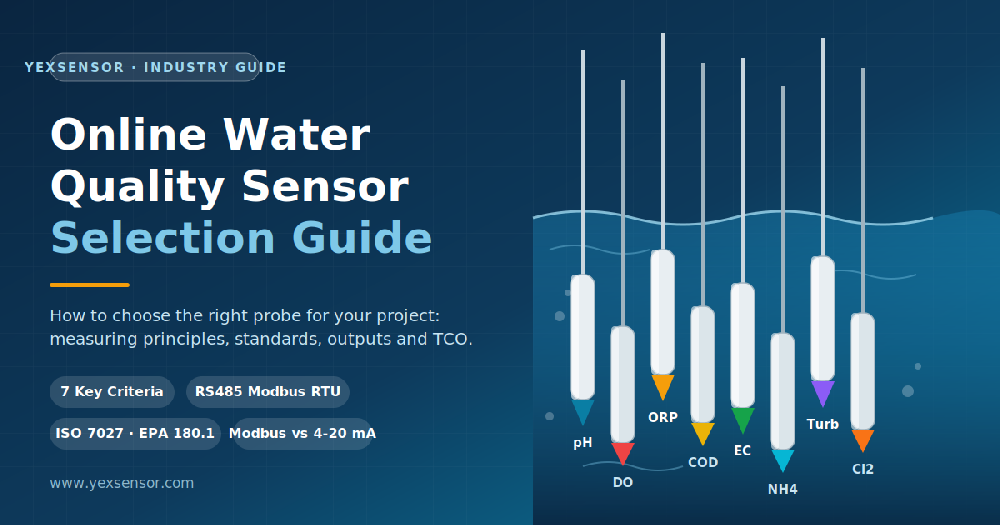
TL;DR: An online water quality sensor is a submersible or flow-through probe that continuously measures parameters such as pH, dissolved oxygen, conductivity, turbidity, COD, ammonium nitrogen or residual chlorine, and transmits the data to a PLC or SCADA system over RS485 Modbus RTU or 4–20 mA. To choose the right one, evaluate seven criteria: measuring principle and standards compliance, output protocol, housing and ingress protection, calibration and maintenance burden, installation point, power and wiring, and the supplier's engineering support. This guide walks through each criterion with parameter comparison tables, application mapping and a buyer FAQ.
An online water quality sensor is an in-situ analytical probe installed directly in a tank, pipeline, channel or natural water body. Unlike a laboratory test performed on a grab sample, it reports measurements continuously — typically every few seconds to minutes — so operators and control systems can respond to changes as they happen.
Choosing the right sensor matters commercially as well as technically: the global water quality sensor market was valued at USD 2.7 billion in 2024 and is projected to reach USD 4.22 billion by 2033 (SkyQuest, CAGR 5.1%), driven largely by tighter discharge regulations and the rollout of IoT-based monitoring. Yet a large share of dissatisfied buyers trace their problems back to a selection error made before the purchase — the wrong measuring principle, the wrong range, or the wrong output protocol for their control system.
This guide condenses the selection logic our application engineers use when specifying YexSensor online monitoring systems for customers in 29+ countries.
1. What Is an Online Water Quality Sensor?
An online water quality sensor is an instrument that sits in the water stream and converts a chemical or physical property — hydrogen ion activity, dissolved gas concentration, light scattering, electrochemical potential — into a digital or analog signal that a controller can read without human intervention.
Key distinction: a portable meter tells you what the water was like when you sampled it; an online sensor tells you what the water is doing right now.
Modern industrial sensors combine three building blocks in one body:
The measuring cell — e.g. a glass pH electrode, a fluorescence-based dissolved oxygen cap, or 90° infrared scattering optics for turbidity.
A built-in temperature element — because nearly every parameter is temperature-dependent, automatic temperature compensation (ATC) is standard.
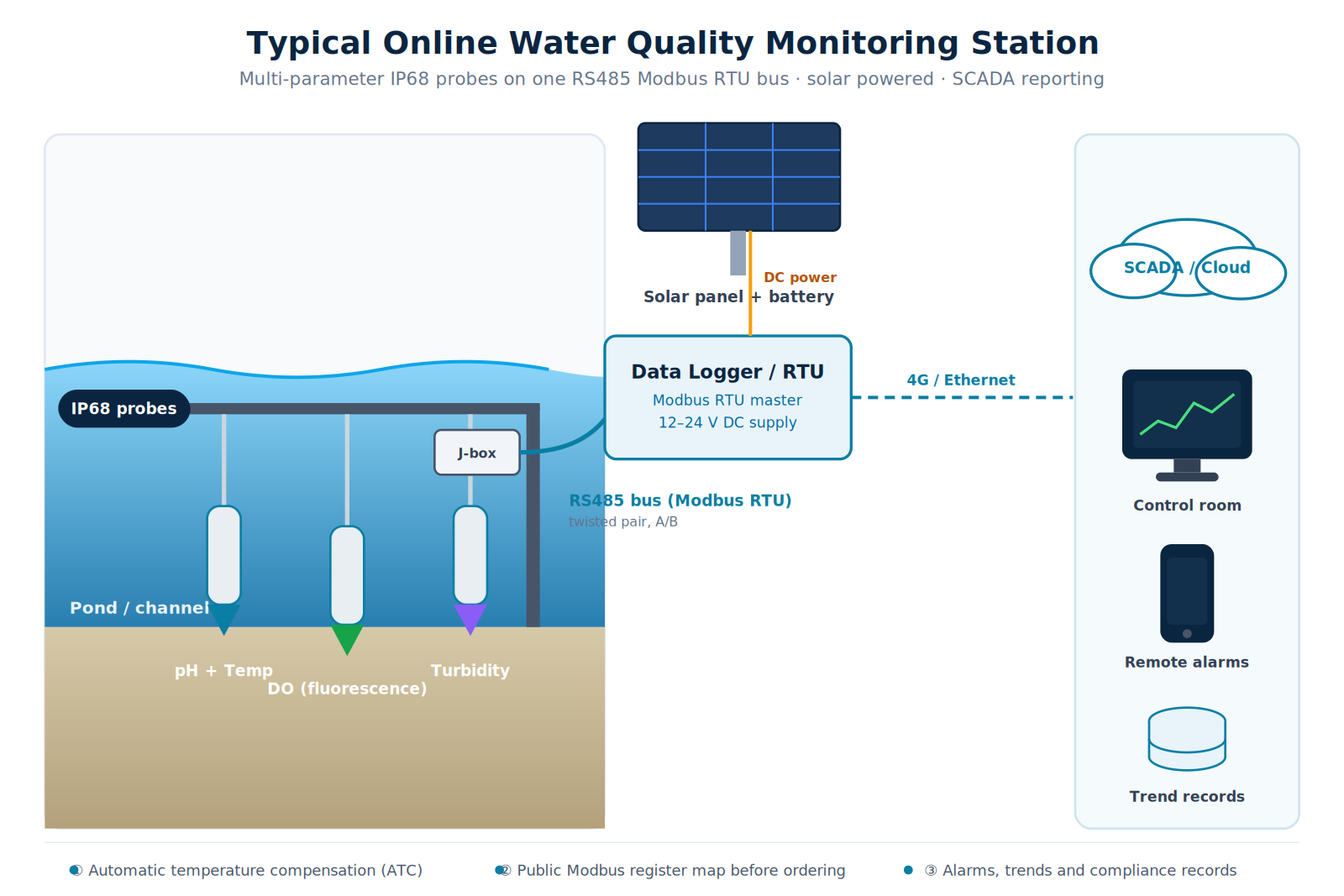
A digital interface — most commonly RS485 with Modbus RTU protocol, optionally backed up by a 4–20 mA analog output, with a 12–24 V DC supply and IP68 submersible construction.
Physically, online sensors come in three installation forms: submersible (lowered into tanks, channels or rivers), flow-through cell (mounted on a bypass line with controlled flow), and pipe insertion (screwed into a pressurized main). The right form depends on whether you need representative data, easy maintenance access, or both.
2. Why Continuous Monitoring Is Replacing Grab Samples
Regulatory pressure and IoT economics are pushing plants from periodic lab sampling toward permanent online instrumentation:
Compliance windows are shrinking. Discharge permits increasingly require continuous records rather than monthly lab reports.
Shock loads appear in minutes. A pH or conductivity spike from an upstream dump can kill a biology process long before the next sampling round.
Energy savings are measurable. Controlling aeration blowers on a fluorescence DO signal instead of a fixed schedule is one of the fastest-returning optimizations in wastewater treatment.
Labor cost drops. Optical and ISE-based probes are reagent-free, eliminating the recurring cost of chemicals used by traditional analyzers.
For buyers comparing suppliers, this shift also explains why multi-parameter digital sensors (RS485 Modbus output, IP68 bodies, one cable per station) have become the default architecture for new monitoring stations.
3. The Eight Core Parameters at a Glance
The table below summarizes the eight parameters that cover most industrial and environmental monitoring projects, the measuring principle behind each, and the relevant international standard.
| Parameter | Measuring principle | Reference standard | Typical online range | Main applications | YexSensor model |
|---|---|---|---|---|---|
| pH | Glass electrode, potentiometric | ISO 10523 | 0.00–14.00 pH | Wastewater, drinking water, irrigation | YEX-S1-PH |
| ORP | Platinum electrode, redox potential (mV) | ASTM D1498 | −1500 to +1500 mV | Disinfection control, denitrification | YEX-S1-ORP |
| Conductivity / TDS | Two-electrode (amperometric) or induction | ISO 7888 | 0–20 / 0–200 µS/cm up to 0–200 mS/cm (4 ranges selectable) | Process water, salinity, leak detection | YEX-S1-EC |
| Turbidity | 90° infrared light scattering (860 nm LED) | ISO 7027 / EPA 180.1 | 0–20 / 0–200 / 0–1000 NTU (selectable) | Drinking water, effluent, filter control | YEX-S1-TS |
| Dissolved oxygen | Fluorescence (luminescence) quenching | ISO 17289 / ASTM D888 | 0–20 mg/L | Aquaculture, aeration basins, surface water | YEX-S1-RDO |
| COD (organic load) | UV254 absorption, reagent-free surrogate | Correlated to dichromate (HJ 828 / SM 5220) | 0–200 / 0–500 mg/L equiv. KHP | Wastewater, industrial effluent | YEX-S1-COD |
| Ammonium nitrogen | Ion-selective electrode (ISE) | Correlated to SM 4500-NH3 | 0–10 / 0–100 / 0–1000 mg/L (selectable) | WWTP aeration control, aquaculture | YEX-S1-NHN / YEX-S2-NHN-A |
| Residual chlorine | Amperometric or potentiometric cell | SM 4500-Cl G / EPA 334.0 | 0–2.000 mg/L | Drinking water, pools, cooling water | YEX-S1-CL |
Two entries deserve a closer look because their technology choice is a frequent source of disputes:
Turbidity — ISO 7027 vs. EPA 180.1. ISO 7027 specifies an 860 nm infrared LED, which removes color interference and is the norm in Europe and most export projects; EPA Method 180.1 specifies a tungsten white-light source and is required when reporting under US drinking water regulations. Confirm which method your compliance reporting is tied to before ordering.
COD — UV254 vs. dichromate. A UV254 sensor measures organic absorption at 254 nm and converts it to a COD-equivalent value without reagents. It is excellent for trending and process control, but it is a surrogate: for regulatory reporting, verify the correlation against your local dichromate lab method on your actual water matrix.
4. The Seven Selection Criteria That Matter Most
Criterion 1 — Measuring principle and standards compliance
Start from the reporting requirement, not the datasheet. If your project is audited against a specific method (EPA 180.1 turbidity, dichromate COD, Standard Methods), the sensor's principle must map to it — or you must budget for periodic lab cross-checks. As a rule: optical/fluorescence methods minimize maintenance; electrochemical methods minimize cost; reagent-free surrogates (UV254 COD, ISE ammonium) maximize continuity but need lab correlation.
Criterion 2 — Output protocol and control-system integration
The output determines your wiring cost more than the sensor price does. A modern RS485 Modbus RTU water quality sensor carries multiple parameters over one twisted pair — pH and temperature on the same probe, for example — and daisy-chains dozens of nodes on a single bus to a PLC, RTU or datalogger. A 4–20 mA output needs one shielded cable per parameter plus a separate temperature input. Section 5 compares the two in detail.
Criterion 3 — Housing, materials and ingress protection
Continuous immersion is the harshest duty a sensor faces. Specify at minimum IP68 submersible construction, a corrosion-resistant wetted-body material (316L stainless steel, POM or PP), and — for high-chloride or seawater applications — 316L or titanium-metal components. For rivers and deep tanks, confirm the depth rating and cable gland sealing explicitly rather than assuming.
Criterion 4 — Calibration drift and maintenance burden
Maintenance and calibration typically represent 40–60% of a water analyzer's five-year total cost of ownership — often more than the purchase price of the sensor itself. Compare candidates on what they consume, not just what they cost:
Fluorescence DO: no membrane or electrolyte to renew; annual cap replacement, no zero calibration needed.
Glass pH: buffer calibration every 1–3 months depending on load.
Turbidity/COD in wastewater: expect fouling; automatic wipers or brushes pay for themselves within months.
ISE ammonium: periodic single-point calibration and (on some matrices) potassium compensation.
A practical plan is to trend drift data and let the data set the interval — our calibration frequency planning guide explains the method parameter by parameter.
Criterion 5 — Installation point and hydraulics
A correct sensor in the wrong place still produces useless data. Choose a location with representative, well-mixed flow; avoid dead zones, air bubble entrainment and direct sunlight; and keep the probe accessible for cleaning. For bypass cells, hold the flow rate inside the manufacturer's window. For a stage-by-stage walkthrough, see our online instrument installation location guide.
Criterion 6 — Power, wiring and environment
Most industrial probes run on 12–24 V DC with modest current draw, which allows solar-powered stations. Check four practical limits: maximum cable length and bus loading for RS485 runs, surge protection for outdoor networks, operating temperature range for unheated shelters, and freeze protection for shallow installations.
Criterion 7 — Supplier engineering support
Two identical-looking probes differ enormously in what happens after delivery. Before awarding the order, verify that the supplier can provide: a complete public Modbus register map, custom ranges and cable lengths, OEM/ODM support for system integrators, spare sensing elements, and engineering response within one business day. YexSensor supports these as standard, with exports to 29+ countries across municipal, industrial and agricultural projects.
YexSensor series quick map: our catalogue implements these criteria across three series — the economical S1 standard series (IP68 engineering-plastic housing, RS-485 Modbus RTU), the S1 PRO stainless-steel series (316L housings for seawater, high-chloride and oily duty, plus specialty analytes such as oil-in-water and blue-green algae), and the S2 flagship series (dual RS-485 + 4–20 mA output for mixed analog/digital plants). For the full side-by-side breakdown, see S1 vs S1 PRO vs S2: How to Choose the Right Sensor Series.
5. RS485 Modbus RTU vs. 4–20 mA: Which Output Should You Choose?
This is the single most common integration question we receive. The honest answer: for new multi-parameter stations, choose RS485 Modbus RTU; for legacy analog loops, choose 4–20 mA — and many YexSensor models offer both.
| Factor | RS485 Modbus RTU | 4–20 mA analog |
|---|---|---|
| Parameters per cable | Multiple (pH + temperature on one probe) | One per cable |
| Wiring cost | Low — daisy-chained twisted pair | Higher — one shielded pair per parameter |
| Max practical distance | ~1,200 m per segment | ~100 m per loop (typical) |
| Noise immunity | High (differential digital) | Good, but loop-dependent |
| Diagnostics | Register-level status and error codes | Limited (fault current only) |
| Best for | SCADA/RTU networks, solar stations, multi-parameter points | Legacy PLC analog cards, single-loop safety circuits |
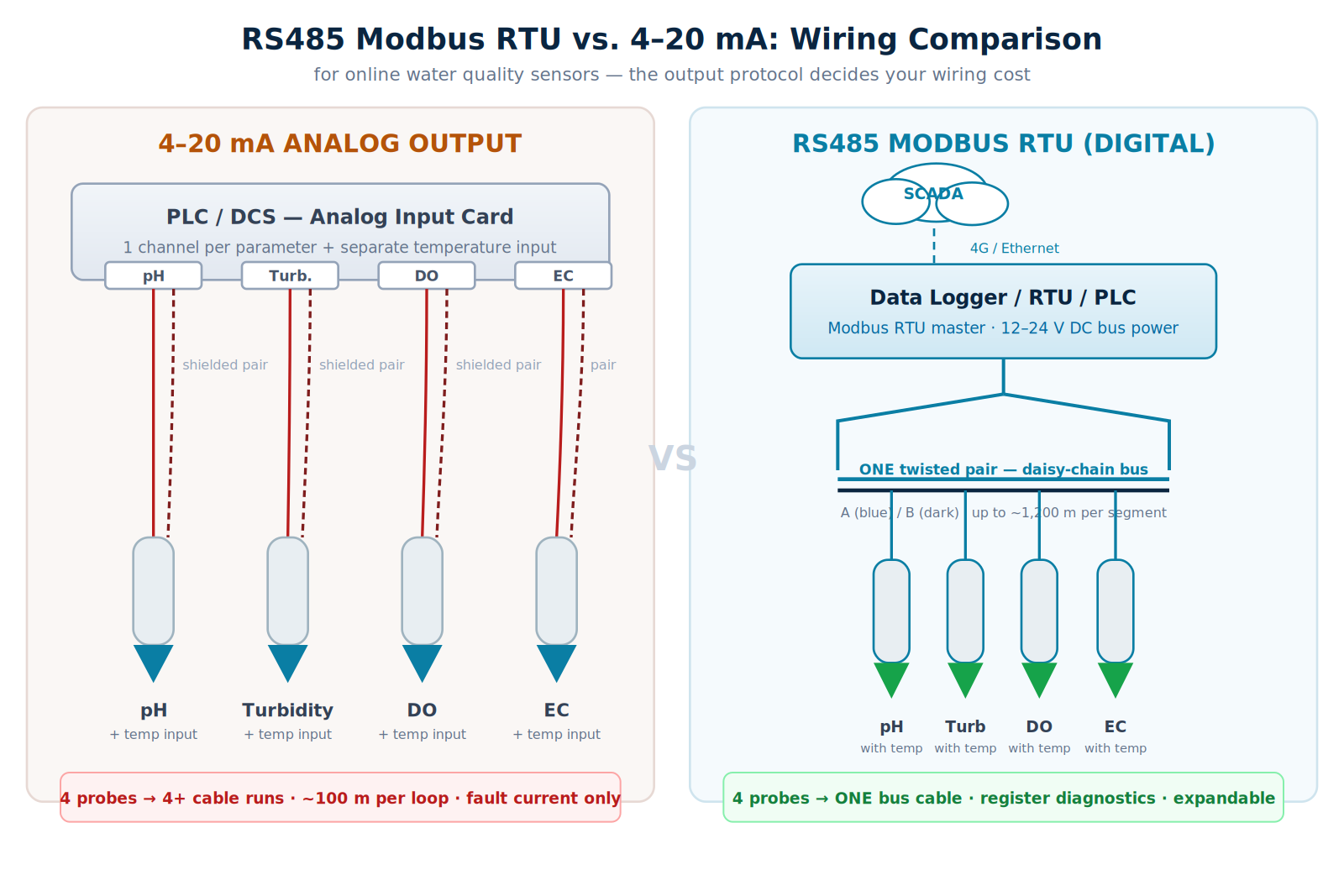
Recommendation: specify Modbus RTU as the primary interface on any new monitoring station and keep 4–20 mA only where your existing PLC has no serial card. Ask every bidder for the Modbus register map before the order — it is the fastest way to expose integration problems.
6. Matching Sensors to Applications
Different water types reward different parameter sets. The mapping below links each scenario to the sensing combination our engineers specify most often:
Wastewater treatment & industrial effluent — pH, ORP, fluorescence DO, UV254 COD, ammonium nitrogen and turbidity cover inlet load, aeration control and discharge compliance. Parameter-by-parameter selection is covered in our industrial wastewater monitoring guide.
Drinking water & distribution networks — turbidity, residual chlorine, pH and conductivity guard disinfection residual and water age. See our urban drinking water safety monitoring solution.
Aquaculture — dissolved oxygen is the parameter that decides survival; add pH and ammonium nitrogen for ponds and RAS. Full setup in our aquaculture monitoring solution.
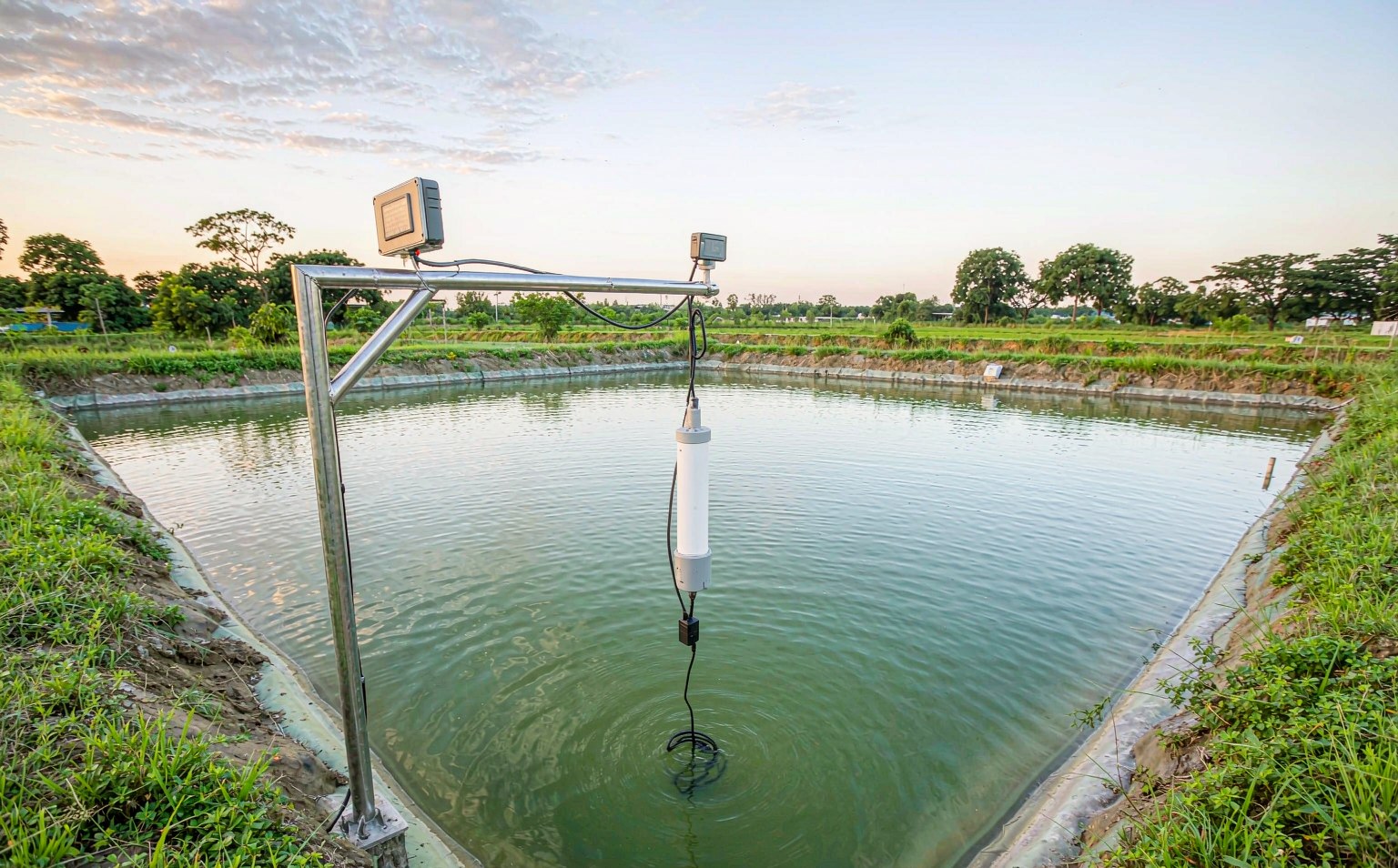
Agricultural irrigation — EC and pH protect soil structure and fertigation dosing. Details in our irrigation water quality solution.
Rivers, lakes and reservoirs — long-life optical DO, turbidity and level/flow instruments (radar level, Doppler flow) feed hydrology and environment platforms. Overview in our surface water monitoring solution.
Oil leak detection — fluorescence oil-in-water sensors protect produced water, condensate and cooling loops: YEX-S1PRO-OIL.
7. Five Common Buying Mistakes to Avoid
Buying on price per probe. A cheap probe without wipers, IP68 sealing or a public register map usually costs more within eighteen months in maintenance and rewiring.
Specifying a method that does not match the compliance requirement. An ISO 7027 turbidity sensor will not satisfy a US EPA 180.1 report, and a UV254 COD value is not automatically a regulatory dichromate value.
Choosing ranges by habit. A 0–500 mg/L COD range on a 30 mg/L effluent wastes resolution; a 0–10 mg/L ammonia range on a raw inlet will saturate. Match the range to the water, season included.
Underestimating fouling. In wastewater, an unwiped optical lens can drift within weeks. If the site cannot guarantee cleaning labor, specify automatic cleaning.
Ignoring integration cost. Proprietary protocols and undocumented registers turn a $300 sensor into a week of integration work. Open Modbus RTU with published registers is the safer total-cost choice.
8. Frequently Asked Questions
What is the difference between an online water quality sensor and a portable meter?
A portable meter measures a sample you bring to it — a snapshot in time. An online water quality sensor is installed permanently in the water and reports continuously, typically over RS485 Modbus RTU or 4–20 mA, enabling alarms, automatic dosing and SCADA records. Most serious projects use both: online for control, portable for spot verification.
Which water quality parameters should I monitor first?
For wastewater: pH, dissolved oxygen, turbidity, COD and ammonium nitrogen. For drinking water: turbidity, residual chlorine, pH and conductivity. For aquaculture: dissolved oxygen first, then pH and ammonium. Start with the two or three parameters that drive a control decision or a permit limit — then expand.
How accurate are online sensors compared with laboratory analysis?
Quality online sensors track lab methods within a few percent on clean matrices; on complex wastewater the practical accuracy depends on matrix effects and calibration discipline, which is why reagent-free surrogates (UV254 COD, ISE ammonium) should be correlated against lab results on site. Used for trending and control, online data is at least as valuable as the lab value — and far faster.
How often do online water quality sensors need calibration?
It depends on the parameter and the water. Typical intervals: pH every 1–3 months, fluorescence DO verified quarterly with an annual cap change, conductivity quarterly, ISE ammonium monthly. Fouling-heavy wastewater may need weekly checks. The correct method is to trend drift and adjust the interval from data.
Can one sensor measure multiple parameters?
Yes. Digital RS485 Modbus sensors commonly report the main parameter plus temperature from a single probe — our pH, ORP, EC, DO, turbidity, COD, ammonium and chlorine models all include temperature — and multi-parameter stations combine several probes on one bus into one monitoring platform.
What output signal should I choose — RS485 Modbus RTU or 4–20 mA?
Choose RS485 Modbus RTU for new multi-parameter, networked or solar-powered stations: one cable carries all readings and diagnostics. Keep 4–20 mA for legacy PLC analog inputs and single-loop control. When in doubt, buy a dual-output model and decide at commissioning.
9. Key Takeaways
An online water quality sensor converts a water parameter into a continuous signal for PLC/SCADA — the seven buying criteria are principle & standards, output protocol, housing, maintenance, installation, power and supplier support.
Match the measuring method to the reporting standard (ISO 7027 vs. EPA 180.1; UV254 vs. dichromate COD) before comparing prices.
RS485 Modbus RTU is the default interface for new multi-parameter stations; 4–20 mA remains the answer for legacy analog loops.
Maintenance and calibration are 40–60% of five-year cost of ownership — buy the probe that is cheap to keep, not just cheap to buy.
YexSensor manufactures a full IP68, RS485 Modbus RTU range — pH, ORP, EC/TDS, turbidity, fluorescence DO, UV254 COD, ammonium nitrogen, residual chlorine and oil-in-water — exported to 29+ countries.
Planning a monitoring project? Send us your parameter list, water matrix and control-system interface — our engineers will return a sensor selection, Modbus register map and quotation within one business day.



