


 Chinese
 Spanish
 French
 Russian
 German
 Portuguese
 Indonesian
 Thai
Thai Vietnamese
 Arabic

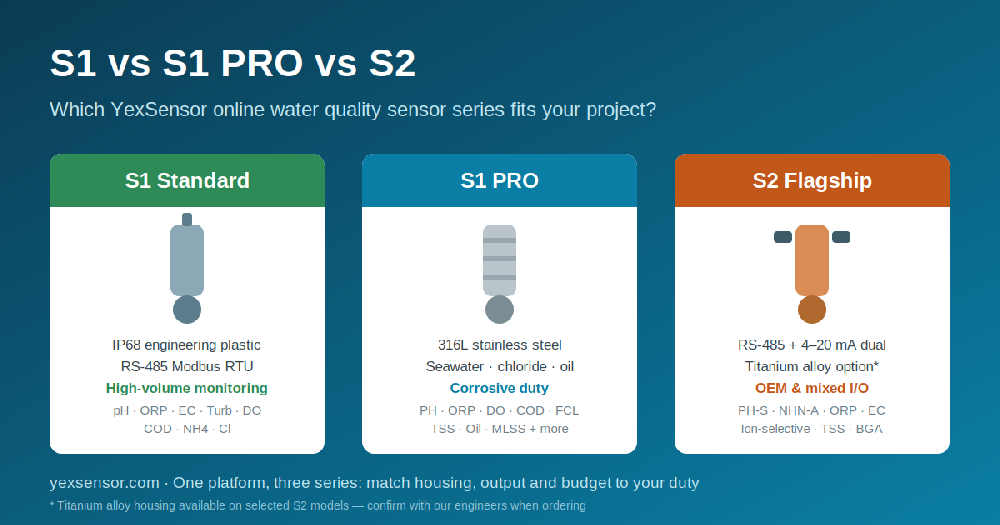
TL;DR: Choose the S1 standard series if you need the core water-quality parameters (pH, ORP, EC, turbidity, dissolved oxygen, COD, ammonium, residual chlorine) in an economical IP68 engineering-plastic housing with RS-485 Modbus RTU output. Choose the S1 PRO series when the water is seawater, high-chloride or oily — its 316L stainless-steel probes survive corrosive duty — or when you need specialty analytes such as oil-in-water, blue-green algae, chlorophyll or sludge concentration. Choose the S2 flagship series when your plant runs 4–20 mA analog loops and digital systems side by side — S2 probes output both from the same body — or when you need a titanium alloy housing, available as an option on selected S2 models. This guide compares all three series in one table, then walks through the decision logic with a buyer FAQ.
Customers comparing our online water quality sensor selection guide often ask the follow-up question: "The parameters look similar across your catalogue — what actually separates the S1, S1 PRO and S2 series?" The honest answer is that the three series are not three levels of the same product but three different engineering trade-offs: housing material, output architecture and cost per monitoring point. Pick the series first, then the parameter — not the other way round.
1. The Three Series at a Glance
| Attribute | S1 Standard | S1 PRO | S2 Flagship |
|---|---|---|---|
| Housing material | IP68 engineering plastic | 316L stainless steel | High-grade body for flagship duty; titanium alloy available as an option on selected models |
| Output | RS-485 (Modbus RTU) only | RS-485 (Modbus RTU) or 4–20 mA — select one | RS-485 + 4–20 mA simultaneously (dual interface) |
| Parameter coverage | Core 8: pH, ORP, EC, turbidity, DO, COD, NH4-N, residual chlorine | Core 8 + specialty: oil-in-water, blue-green algae, chlorophyll, MLSS, transparency, UV254 COD, FCL | Core + ion-selective (K, Ca, Cu, F), BOD, TSS and more |
| Water matrix | Municipal, industrial, agricultural fresh water | Seawater, high-chloride, oily and corrosive streams | Mixed digital/analog plants, OEM integrations |
| Best for | High-volume monitoring at the best cost per point | Harsh duty and specialty analytes | Projects that must feed both PLC analog loops and SCADA |
| Typical buyers | Municipal utilities, irrigation districts, process plants scaling up | Desalination, marine aquaculture, petrochemical, metal finishing | System integrators, OEM skid builders, retrofit projects |
2. S1 Standard Series — the Economical Workhorse
The S1 standard series is built for one job: reliable continuous monitoring of the eight core parameters across many monitoring points, at the lowest cost per point. Every S1 probe carries an IP68 engineering-plastic housing, a built-in temperature element with automatic compensation, and a digital RS-485 Modbus RTU interface powered from 12–24 V DC — one twisted pair per station is all the wiring a PLC, RTU or IoT gateway needs.
The line-up covers pH, ORP, conductivity (four switchable ranges plus a dedicated Modbus EC version), turbidity, fluorescence dissolved oxygen, COD, ammonium nitrogen and residual chlorine. If your duty is conventional municipal, industrial or agricultural water — treatment works, distribution networks, irrigation canals, aquaculture ponds — the S1 series is the right starting point, and plastic housings keep the budget realistic when a project needs twenty probes instead of two.
Rule of thumb: if the water would not attack a PVC pipe, it will not attack an S1 probe. Reserve metal housings for water that would.
3. S1 PRO Series — 316L Stainless Steel for Corrosive Duty
The S1 PRO series moves the housing to 316L stainless steel, the marine-grade alloy that resists chloride pitting and hydrocarbon films. Choose S1 PRO whenever the water matrix would chew through plastic: seawater intake and desalination pre-treatment, marine aquaculture, refinery and petrochemical effluent, metal-finishing lines, and high-salinity process loops.
On the interface side, S1 PRO is more flexible than the standard line: each probe can be specified with either RS-485 Modbus RTU or 4–20 mA output — one or the other, chosen at order time. That makes S1 PRO the right series when a corrosive-duty project has to feed a conventional analog loop, without stepping all the way up to the S2 flagship.
S1 PRO is also where the specialty optics live. The catalogue extends beyond the core eight parameters with free chlorine (FCL), oil-in-water, blue-green algae (BGA), chlorophyll, sludge concentration (MLSS), transparency, suspended solids (TSS) and UV254 COD — measurements that environmental monitoring and process-optimization projects need but that the standard line does not carry. Accuracy specifications are correspondingly tighter on the overlapping parameters.
4. S2 Flagship Series — Dual Interface for Mixed Architectures
The S2 flagship series answers a question the other two series cannot: what if the control system needs analog and digital at the same time? Many operating plants still run 4–20 mA loops into PID dosing controllers and analog indicators, while the data layer (SCADA, historians, IoT platforms) wants RS-485 Modbus RTU. An S2 probe serves both from one body — the dosing loop keeps its analog signal, and the data layer reads registers over Modbus, with no signal splitter and no second probe.
That makes S2 the natural choice for system integrators and OEM skid builders who cannot predict which control architecture the next project will use, and for retrofits where a legacy analog loop must keep working while the plant digitalizes around it. The series spans pH (S2-PH-S), ammonium nitrogen (S2-NHN-A), ORP, conductivity, turbidity, TSS, BOD, blue-green algae and ion-selective measurements such as potassium, calcium, copper and fluoride. Confirm the wiring configuration with our engineers when ordering, as the dual interface is configurable per model.
S2 is also the only tier that offers titanium alloy as a housing option. Titanium is a standard order-time selection on selected S2 models — specify it when your water is aggressive enough that even 316L is not enough, such as strongly oxidizing or highly saline streams, chlorinated brine, or processes where trace metal contamination must be avoided. Because availability is model-specific, tell our engineers the water chemistry when you enquire and we will confirm whether the model you need can be supplied in titanium.
5. Still Deciding? Four Questions, One Answer
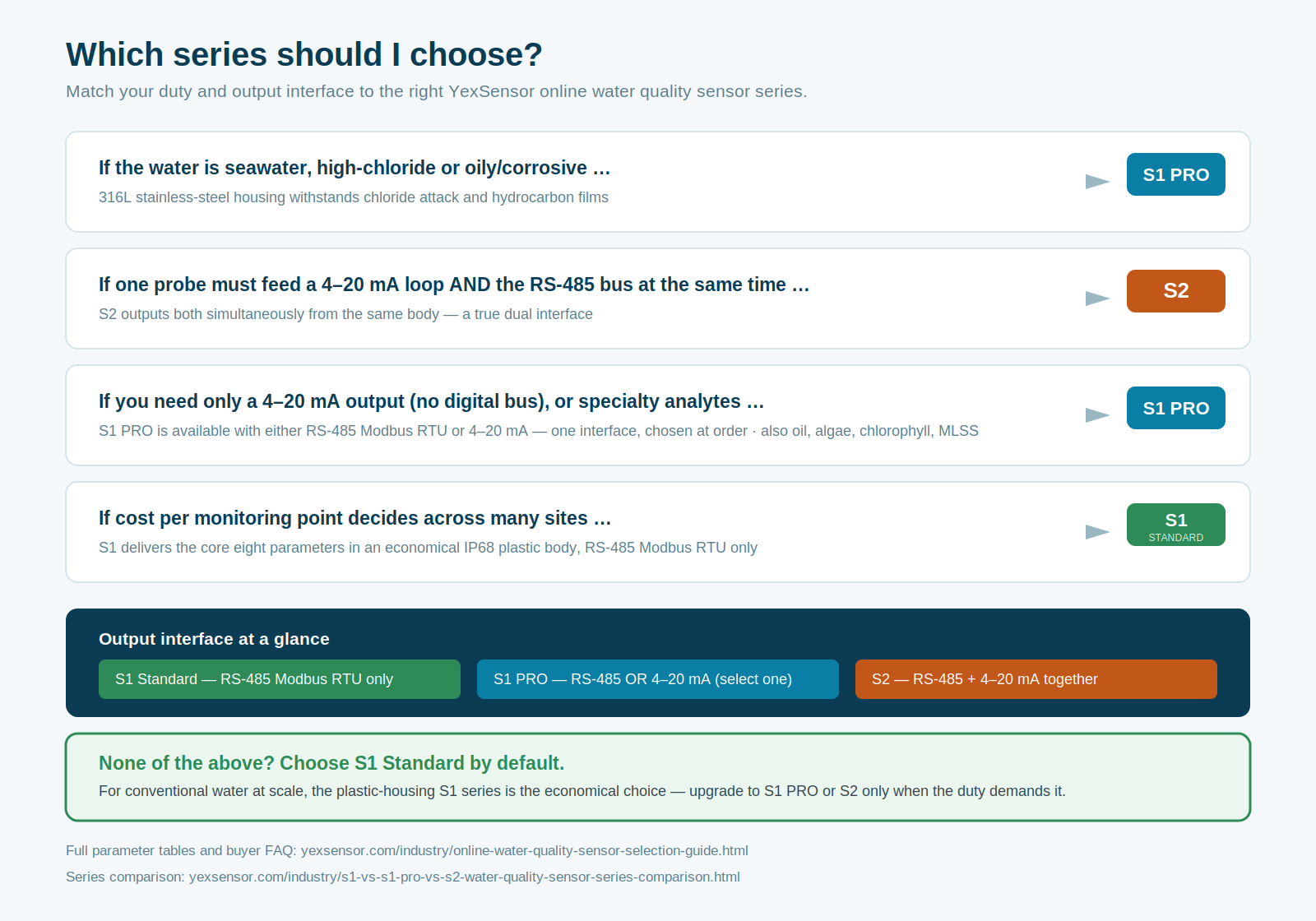
Is the water seawater, high-chloride or oily? Yes → S1 PRO (316L housing, or 4–20 mA output — pick one).
Must the same probe feed a 4–20 mA loop and the RS-485 bus at the same time? Yes → S2 (true dual interface). If you only need one of the two, S1 PRO can already deliver it.
Do you need specialty analytes — oil, algae, chlorophyll, MLSS, transparency? Yes → S1 PRO (specialty optics).
None of the above? Choose S1 Standard — it is the economical default for conventional water at scale, and you can step up later without changing your Modbus integration.
For the deeper layer — measuring principles, ISO 7027 vs. EPA 180.1 turbidity, UV254 vs. dichromate COD, calibration economics and installation geometry — continue with the full online water quality sensor selection guide.
6. Frequently Asked Questions
Is S1 PRO just a more accurate S1?
Accuracy is one difference, but the defining difference is the 316L stainless-steel housing and the wider parameter catalogue. If plastic survives your water matrix and you only need the core eight parameters, S1 already delivers professional-grade data; S1 PRO earns its premium in corrosive duty and specialty measurements.
Can S2 probes replace separate analog and digital instruments?
Yes — that is the series' reason for existence. One S2 probe feeds the 4–20 mA loop (control layer) and the RS-485 Modbus RTU bus (data layer) simultaneously, replacing the traditional two-instrument setup and eliminating splitter hardware and alignment drift between them.
Which series give me a 4–20 mA output?
S1 PRO and S2 — but in different ways, and S1 Standard does not offer it at all. The S1 standard series is RS-485 Modbus RTU only. Each S1 PRO probe can be ordered with either RS-485 Modbus RTU or 4–20 mA — one interface per probe, selected when you place the order. Only the S2 flagship can output RS-485 and 4–20 mA at the same time. So if your project needs an analog loop instead of a digital bus, S1 PRO already covers it; if it needs both simultaneously, that is the S2 use case.
Can I get a titanium alloy housing?
Yes — on the S2 flagship series, titanium alloy is a standard order-time selection available on selected models. Neither the S1 standard series nor S1 PRO offers it. Titanium is the right specification when 316L stainless steel is not corrosion-resistant enough or when trace metal contamination is unacceptable — for example strongly oxidizing streams, high-chloride brine and chlorinated process water. Availability is model-specific, so share your water chemistry and we will confirm which S2 model can be supplied in titanium, along with the lead time.
Do all three series use the same Modbus integration?
All YexSensor probes speak Modbus RTU over RS-485 with documented register maps, so your PLC or gateway integration carries over between series. The S2 series simply adds the 4–20 mA interface on top. We provide the register map and integration notes with every order.
Which series should an aquaculture project in coastal areas choose?
Coastal and brackish-water aquaculture should default to S1 PRO: seawater attacks plastic-reinforced bodies over time, and the series' fluorescence DO and chlorophyll/BGA options match aquaculture monitoring needs. Fully fresh-water ponds can run the economical S1 series.
Get a Series Recommendation for Your Project
Not sure which series fits? Send us your water matrix, parameter list and control-system interface — our engineers will confirm the series, model and configuration, and return a Modbus register map and quotation within one business day.



