Chinese
 Spanish
 French
 Russian
 German
 Portuguese
 Indonesian
 Thai
Thai Vietnamese
 Arabic


Products Description
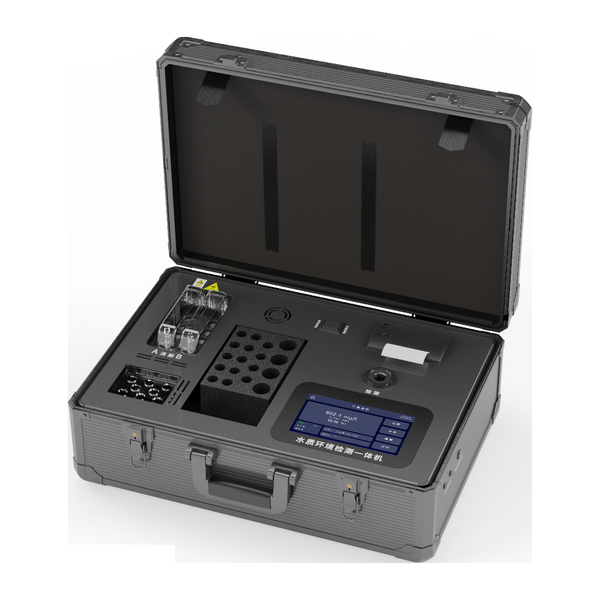
YEX-L1-WS Mobile Water Quality Workstation: bring digestion, measurement, printing, and recordkeeping to the sampling site
- Integrated field workflow: dual-zone digestion, forced-air cooling, photometric measurement, and real-time result printing are combined in one portable case.
- Broad test capability: the available menu covers 44 photometric parameters, including COD, ammonia nitrogen, total phosphorus, total nitrogen, disinfectants, and multiple metals.
- Designed for mobile work: a 12 V / 20 Ah lithium battery, IP65 protection, 7-inch color touchscreen, and storage for 10,000 records support on-site testing and emergency response.
Product Overview
The YexSensor YEX-L1-WS is a mobile water quality workstation for environmental monitoring, wastewater treatment, industrial field service, and emergency investigation. It combines digestion, rapid cooling, photometric measurement, record storage, and real-time printing in a rugged case for locations where a permanent laboratory is unavailable.
The integrated design reduces the number of separate instruments that must be transported and documented. A high-brightness quasi-collimated LED cool-light source, optimized optical design, dedicated reagent methods, and a 7-inch color touchscreen support consistent field operation.
Field Testing Risks Addressed by the Design
Sample transport can delay decisions and change sample condition
Temperature change, settling, volatilization, and ongoing chemical reactions can affect a sample between collection and laboratory analysis. Performing digestion and photometric testing near the sampling point shortens the path from collection to result. Project teams can decide sooner whether to repeat a test, expand the sampling area, or adjust a treatment process.
Separate instruments create fragmented workflows
A stand-alone digester, photometer, printer, and manual log each require setup. The YEX-L1-WS integrates these functions, stores up to 10,000 records, and supports real-time result printing, reducing equipment handling and manual transcription at the worksite.
Inconsistent digestion conditions reduce comparability
The digestion block has two independently controlled groups with four positions per group. Temperature is adjustable from 50 to 180 °C, with ± 0.1 °C control accuracy, ± 0.5 °C temperature tolerance, and a freely adjustable digestion time from 0 to 120 min. Each analyte can therefore follow its specified reagent method instead of being forced into one common temperature and time.
Key Engineering Advantages
Dual-zone digestion and rapid cooling
Eight digestion positions are divided into two independently controlled groups of four. Methods with different digestion conditions can be organized in parallel, while forced-air cooling reduces the waiting period after heating. This arrangement improves field throughput without removing the need to follow each reagent method.
Stable optical system with a long-life LED source
The optical system provides an absorbance range of 0–3.5 Abs, 0.001 Abs resolution, optical stability of ≤ 0.002 Abs / 30 min, and a stated light-source life of 100,000 h. The cool-light design helps limit source heating during measurement and supports consistent photometric operation.
Battery power and field protection
The workstation operates from its lithium battery or a DC 12 V adapter. The battery specification is 12 V / 20 Ah, rated power is 150 W, and the stated charging time is 10 h. IP65 protection supports dusty and wet field environments, but the instrument is not submersible. Power connectors, communication ports, the printer, and ventilation areas must remain clean and dry.
On-site records and result printing
Storage for 10,000 records and real-time printing help preserve sample identifiers, test times, and results at the worksite. The operator can review stored results and produce a printed record before leaving the sampling location.
Technical Specifications
| Parameter | Specification |
|---|---|
| Model | YEX-L1-WS |
| Absorbance range | 0–3.5 Abs |
| Measurement accuracy | ≤ ±5% |
| Repeatability | ≤ ±3% |
| Optical stability | ≤ 0.002 Abs / 30 min |
| Absorbance resolution | 0.001 Abs |
| Operational repeatability | ≤ ±0.005 Abs |
| Data storage | 10,000 records |
| Light-source life | 100,000 h |
| Power supply | Lithium battery or DC 12 V adapter; 12 V / 20 Ah |
| Rated power | 150 W |
| Charging time | 10 h |
| Protection rating | IP65 |
| Operating temperature | 0–50 °C |
| Relative humidity | 0–80% RH |
| Dimensions | 530 × 396 × 205 mm |
| Weight | 13.3 kg |
Digestion System
| Parameter | Specification |
|---|---|
| Simultaneous sample capacity | 8 samples; two groups of four with independently adjustable temperatures |
| Temperature setting range | 50–180 °C, freely adjustable |
| Temperature-control accuracy | ± 0.1 °C |
| Temperature tolerance | ± 0.5 °C |
| Tube diameter | 16 mm |
| Heating rate | 15 min to 165 °C |
| Digestion time | 0–120 min, freely adjustable |
Core Analyte Performance
| Analyte | Range | Detection limit | Digestion | Indication error | Repeatability |
|---|---|---|---|---|---|
| COD | 10–15000 mg/L | 3 mg/L | 165 °C, 20 min | ≤ ±5% or ±4 mg/L | ≤ ±3% |
| Ammonia nitrogen | 0.02–50 mg/L | 0.005 mg/L | No digestion | ≤ ±5% or ±0.1 mg/L | ≤ ±3% |
| Total phosphorus | 0.02–100 mg/L | 0.005 mg/L | 150 °C, 30 min | ≤ ±5% or ±0.04 mg/L | ≤ ±3% |
| Total nitrogen | 0.5–150 mg/L | 0.2 mg/L | 125 °C, 30 min | ≤ ±5% or ±0.4 mg/L | ≤ ±3% |
Available Measurement Menu
The manual lists the complete photometric menu below. The supplied test programs, ranges, reagents, detection limits, and accessories depend on the purchased configuration. Confirm every required parameter in the RFQ and order confirmation.
| No. | Parameter | Range mg/L | Detection limit mg/L | Lower limit mg/L |
|---|---|---|---|---|
| 1 | COD | 10–15000 | 3 | 10 |
| 2 | Permanganate index (CODMn) | 0.45–25 | 0.2 | 0.45 |
| 3 | Ammonia nitrogen (salicylate method) | 0.02–50 | 0.005 | 0.02 |
| 4 | Total phosphorus | 0.02–100 | 0.005 | 0.02 |
| 5 | Total nitrogen | 0.5–150 | 0.2 | 0.5 |
| 6 | Free chlorine | 0.05–12 | 0.02 | 0.05 |
| 7 | Total chlorine | 0.05–12 | 0.02 | 0.05 |
| 8 | Ozone | 0.05–2.5 | 0.02 | 0.05 |
| 9 | Chlorine dioxide | 0.05–5 | 0.02 | 0.05 |
| 10 | Dissolved oxygen | 0.5–20 | 0.2 | 0.5 |
| 11 | Phosphate | 0.02–2 | 0.005 | 0.02 |
| 12 | Nitrate | 0.5–40 | 0.25 | 0.5 |
| 13 | Nitrite | 0.01–0.3 | 0.005 | 0.01 |
| 14 | Urea | 0.5–20 | 0.1 | 0.5 |
| 15 | Total alkalinity | 5–3000 | 1 | 5 |
| 16 | Total hardness | 0.5–100 | 0.1 | 0.5 |
| 17 | Sulfide | 0.01–1 | 0.005 | 0.01 |
| 18 | Color | 70–500 | 40 | 70 |
| 19 | Cyanuric acid | 20–160 | 5 | 20 |
| 20 | Chloride | 8–500 | 3 | 8 |
| 21 | Formaldehyde | 0.02–1.5 | 0.01 | 0.02 |
| 22 | pH (reagent method) | 6.5–9.0 | 6.5 | 6.5 |
| 23 | Aniline | 0.02–2 | 0.005 | 0.02 |
| 24 | Volatile phenols | 0.1–5 | 0.05 | 0.1 |
| 25 | Fluoride | 0.05–2 | 0.02 | 0.05 |
| 26 | Cyanide | 0.01–0.5 | 0.005 | 0.01 |
| 27 | Sulfate | 8–200 | 2.5 | 8 |
| 28 | Aluminum | 0.02–0.5 | 0.005 | 0.02 |
| 29 | Total chromium | 0.02–3 | 0.01 | 0.02 |
| 30 | Hexavalent chromium | 0.02–3 | 0.01 | 0.02 |
| 31 | Total copper | 0.02–2 | 0.01 | 0.02 |
| 32 | Copper | 0.02–2 | 0.01 | 0.02 |
| 33 | Total iron | 0.02–3 | 0.01 | 0.02 |
| 34 | Ferrous iron | 0.02–3 | 0.01 | 0.02 |
| 35 | Total manganese | 0.5–20 | 0.1 | 0.5 |
| 36 | Manganese | 0.5–20 | 0.1 | 0.5 |
| 37 | Total nickel | 0.1–5 | 0.025 | 0.1 |
| 38 | Nickel | 0.05–5 | 0.01 | 0.05 |
| 39 | Total zinc | 0.1–5 | 0.02 | 0.1 |
| 40 | Zinc | 0.1–5 | 0.02 | 0.1 |
| 41 | Total cadmium | 0.03–1 | 0.01 | 0.03 |
| 42 | Cadmium | 0.03–1 | 0.01 | 0.03 |
| 43 | Silica | 0.02–100 | 0.01 | 0.02 |
| 44 | Lead | 0.5–6 | 0.1 | 0.5 |
Application Scenarios
Emergency pollution investigation
Perform rapid multi-parameter screening at an incident site, river section, or temporary sampling point to guide repeat testing and follow-up laboratory confirmation.
Wastewater process inspection
Compare influent, process-stage, and effluent samples for COD, ammonia nitrogen, total phosphorus, total nitrogen, and other configured parameters during operation or troubleshooting.
Industrial park and discharge-point verification
Select conventional pollutants or configured metal parameters for petrochemical, papermaking, pharmaceutical, printing and dyeing, textile, leather, brewing, electronics, and municipal applications.
Water-treatment commissioning and acceptance
Use on-site results to compare operating conditions during commissioning, while printed results and stored records support review with contractors, operators, and project owners.
Research, education, and mobile laboratories
Build a portable photometric testing platform for research institutes and universities while maintaining the reagent, calibration, quality-control, and waste-handling requirements of each method.
Installation and Operating Guidance
Place the case on a stable, ventilated surface protected from standing water, direct rain, and chemical splashes. When external power is used, connect the specified DC 12 V adapter. Keep power connectors, communication ports, the printer, and ventilation openings clean and dry. Before field work, verify battery charge, printer paper, 16 mm tubes, reagent validity, and suitable quality-control standards.
Follow the reagent instructions for sampling, dosing, blank preparation, and digestion. The digestion block can reach 180 °C, so use suitable heat-resistant and chemical PPE and allow hot tubes to cool before handling. Tube exteriors must be clean, dry, undamaged, and free of bubbles in the optical path. Verify performance with suitable standards after transport, cleaning, extended storage, or whenever results are critical.
Configuration and Selection Notes
The measurement menu and supplied consumables should be selected against the actual sample matrix and project method. Different parameters use different ranges, reagents, reaction conditions, and digestion settings, so the required test list should be confirmed item by item before delivery.
The 44-item menu describes available capability, not a guarantee that every reagent and accessory is included in the standard package. Specify sample matrix, target parameters, expected ranges, daily sample count, method standard, and required consumables. Configurations may include reagents, a micropipette, sample bottles, reagent tubes, and a tube rack, subject to the confirmed order.
Quality Assurance and After-Sales Information
YexSensor provides a one-year limited warranty from the date of purchase, subject to the sales agreement. Consumables, reagents, accessories, batteries, and damage caused by misuse are excluded unless otherwise agreed in writing. Reagents, tubes, batteries, and printer paper may require periodic replenishment or replacement; the final package contents must follow the confirmed delivery list.
Frequently Asked Questions
1. Which water quality parameters can the YEX-L1-WS measure?
The manual lists 44 photometric parameters, including COD, CODMn, ammonia nitrogen, total phosphorus, total nitrogen, disinfectants, nutrients, and multiple metals. Actual availability depends on the supplied programs and reagents; not every reagent is included by default.
2. What are the ranges for COD, ammonia nitrogen, total phosphorus, and total nitrogen?
COD is 10–15000 mg/L, ammonia nitrogen is 0.02–50 mg/L, total phosphorus is 0.02–100 mg/L, and total nitrogen is 0.5–150 mg/L. Samples outside a method range require an appropriate dilution or a different range according to the reagent procedure.
3. How does the dual-zone digestion system improve field throughput?
The eight positions are divided into two independently controlled groups of four. COD can use 165 °C for 20 min, total phosphorus 150 °C for 30 min, and total nitrogen 125 °C for 30 min, while the listed ammonia method requires no digestion. Follow the relevant reagent instructions for every batch.
4. What are the battery and charging specifications?
The workstation uses a 12 V / 20 Ah lithium battery or a DC 12 V adapter. Rated power is 150 W, and the stated charging time is 10 h.
5. How many records can the workstation store, and can it print results on site?
The workstation stores up to 10,000 records and supports real-time result printing. These functions help operators retain and review field results before leaving the sampling location.
6. Does IP65 mean the workstation can be submerged?
No. IP65 supports dust and water-jet protection but does not make the unit submersible. Protect the case from standing water and keep connectors, the printer, and ventilation openings dry.
7. Can any reagent brand or digestion tube be used?
The workstation uses 16 mm tubes with dedicated photometric programs and reagent methods. Reagents can differ in reaction conditions, blanks, curves, and safety requirements. Do not substitute reagents without method verification and technical review.
8. What information is required for a quotation?
Provide the sample matrix, target parameters, expected ranges, samples per day, applicable methods, field power conditions, consumable period, quantity, and destination. YexSensor can then verify the measurement menu, reagent package, digestion capacity, and delivery list.
Summary
The YEX-L1-WS suits projects that need field digestion, multi-parameter photometry, result printing, and data retention. Dual-zone temperature control, eight digestion positions, a 0–3.5 Abs range, 10,000-record storage, a 12 V / 20 Ah battery, and IP65 protection establish the mobile workflow. Select the 44-item menu against the actual project and reagent configuration.
For a configuration that can be put into service without gaps, send YexSensor the target parameters, sample matrix, ranges, daily batch count, method standards, and destination. We will use these inputs to verify test programs, digestion conditions, reagents and consumables, power planning, delivery contents, and acceptance boundaries.