


 Chinese
 Spanish
 French
 Russian
 German
 Portuguese
 Indonesian
 Thai
 Vietnamese
 Arabic


RO feed water monitoring should establish whether the incoming water and its measurements are ready for startup, not merely whether the PLC displays numbers. For equipment integrators, the practical deliverable is a verified measurement point, a defined response to invalid data and acceptance criteria agreed with the membrane-system designer.

RO feed water monitoring: separate measurement from permission to start
A sensor can report a plausible value while sampling a stagnant bypass. A conductivity channel can communicate correctly but use the wrong scale. A chlorine measurement can be below its reporting limit without proving that the membrane supplier's oxidant requirement has been met. These are different failures and need different tests.
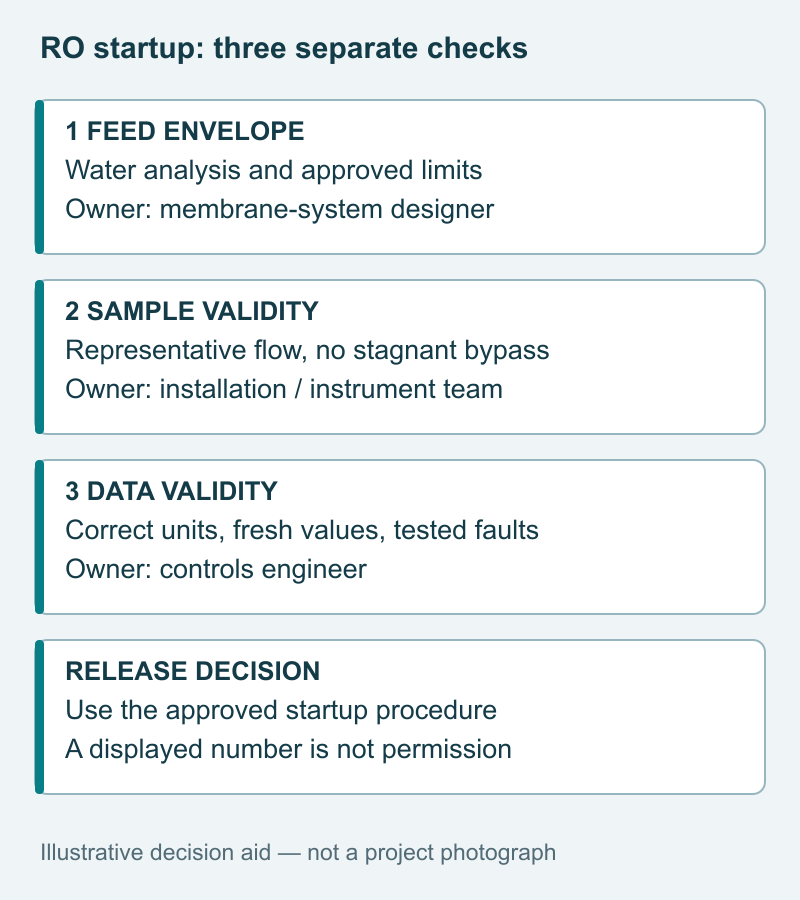
Before releasing the high-pressure stage, separate three questions: is the water within the approved feed envelope, is the sample representative, and is the measurement valid? The system designer must decide which conditions inhibit startup and which only generate an advisory. Sensor selection alone cannot establish a protective function.
Include sample-flow verification, isolation, drainage, host logic and reference sampling in the supply boundary where required. A probe-only quote may omit essential commissioning work.
Assign each parameter a specific decision
Conductivity helps identify changes in ionic loading and provides context for feed-water variability. It does not identify individual scaling ions, establish hardness or measure silica. Record temperature and compensation settings so a startup comparison does not confuse a changed calculation basis with changed water.
pH monitoring can support a defined dosing or feed-envelope check. Place the measurement where the sample represents the intended decision after mixing. A sensor beside an injection point may describe a chemical plume rather than the water approaching the membranes. Establish the required mixing and verification method during design.
Turbidity can reveal particulate changes, but it is not a direct replacement for a silt density index test. Include the laboratory or field tests specified by the membrane-system designer. Buying a high-resolution turbidity sensor does not remove those separate acceptance requirements.
Chlorine monitoring requires particular care when an oxidant-sensitive membrane is involved. Specify the required chlorine fraction, the threshold, method performance and sample conditions. An instrument described as a residual chlorine sensor must not be assumed suitable for every low-level membrane-protection duty.
The DuPont reverse osmosis technical resources explain why feed characteristics and operating conditions matter to membrane performance. Use the current documentation for the actual membrane element when defining limits; this article does not prescribe a universal startup threshold.
Verified product evidence and the limits of a catalog selection
The YexSensor YEX-S1-EC conductivity sensor is a candidate when its cell and materials match the feed. The specifications below follow the model's user manual and connect each parameter to a procurement decision.
| Specification | Manual specification | Purchase check |
|---|---|---|
| Model and principle | YEX-S1-EC; two-electrode conductivity | Check the selected cell against the expected sample. |
| Range options | 0–20, 0–200, 0–5000 µS/cm; 0–200 mS/cm | Select the span against normal readings, expected peaks and required uncertainty. |
| Output and supply | RS485 Modbus RTU; 12–24 V DC ±10% | Confirm host capability and voltage at the installed probe. |
| Protection and connection | IP68; immersion installation; NPT 3/4 | Verify the complete assembly before pressurized service. |
| Cable | Standard 5 m; other lengths customizable | Specify actual route, termination and approved extension. |
| Accuracy | Manual: ±1% F.S.; temperature ±0.3°C | Full-scale error makes span selection consequential at low readings. |
| Power and working limits | 0.2 W at 12 V; 0–50°C; pressure below 0.6 MPa | Check supply budget and the complete assembly's limits. |
| Materials | ABS/SUS316L (default)/PVC | Select wetted materials for feed chemistry and cleaning exposure. |
The YEX-S2-CL-S chlorine sensor manual specifies constant-voltage measurement, flow-cell installation, RS485 and optional 4–20 mA. Range options are 0–2.000 and 0–20.00 mg/L as HClO. A range alone does not establish performance at a particular membrane-protection threshold. Match the reporting basis and verified low-level performance to the membrane-system requirements before specifying a protective function.
Compare a monitoring point, a sample panel and a protective package
| Package | Appropriate purpose | What must be added or demonstrated |
|---|---|---|
| Single conductivity point | Observe feed variability | Matched span, temperature basis and representative installation. |
| Multichannel sample panel | Compare several feed-water measurements | Valid sample delivery, compatible cells, drainage and maintenance access. |
| Startup permissive package | Implement an approved release decision | Defined fault responses, validated measurements and documented logic testing. |
Do not equate more channels with greater protection. A second reading from the same blocked sample line can repeat the same error. Specify which common failures must be detected and which require an independent inspection or reference method. That requirement determines whether another instrument adds useful evidence.

Three startup situations integrators should design for
Packaged RO equipment supplied with municipal feed
The challenge is variation between the water used for workshop testing and the eventual site supply. Define the feed envelope, document the site sample and commission conductivity on a consistent temperature basis. The value to the equipment supplier is a traceable acceptance record instead of an argument based on unrelated factory and site readings.
Reuse-water polishing after pretreatment
The challenge is that upstream operating cycles may change particulate loading, chemistry and disinfectant carryover. Select measuring points after the relevant treatment step, retain required reference testing and document the response to invalid samples. The value is clearer responsibility between the pretreatment contractor and the RO package supplier, not a guarantee that sensors alone make reclaimed water acceptable.
Restart after shutdown or service
The challenge is stagnant sample lines, isolated valves and instruments left in maintenance mode. Establish a restart sequence that restores representative flow, checks valid updates and confirms approved release conditions. The value is avoiding a startup decision based on old water or a retained number. These are illustrative engineering situations, not claims of completed customer installations.
Commission the sample path and data path separately
Use this startup record; acceptance limits come from the approved project design, not this checklist.
| Check | Evidence to retain | Action and owner |
|---|---|---|
| Sample delivery | Valve positions, cell flow, return pressure | Installer clears blocked or stagnant sampling before acceptance. |
| Measurement agreement | Reference result, time, temperature basis | Instrument engineer resolves disagreement before release. |
| Host interpretation | Raw response, units, displayed value | Controls engineer corrects scaling and verifies each tag. |
| Invalid data response | Loss-of-sample and communication tests | Controls engineer verifies approved inhibit or alarm behavior. |
| Startup release | Feed limits, exceptions, signed record | Authorized operator releases only under the approved procedure. |
For conductivity comparisons, use synchronized measurements of the same sample with matching compensation settings. The separate conductivity temperature compensation guide explains why apparent disagreement may be a configuration issue. Do not calibrate away that mismatch before finding its cause.
Define the supply boundary before requesting a quote
Separate the probe, cell, pipework, valves, flow indication, controller programming and reference tests in the quotation. Ask who supplies the register map, verifies the panel and supports site acceptance. Confirm lead time, packing, shipping terms, spare parts and warranty responsibility in the commercial offer rather than assuming they are included.
Confirm customization and delivery effects. Stainless steel alone does not establish seawater suitability.
Project configuration review
Provide feed source and analysis, membrane model, approved feed limits, proposed measuring points, normal and upset ranges, temperature, pressure, sample route, host interface, quantity and delivery destination. Review the YEX-S1-EC configuration for the conductivity point and identify any measurements that still require method validation. Send Your Project Requirements to request a matched supply scope rather than a generic sensor bundle.

Frequently asked questions
Q1. Can RO feed water monitoring prove that startup is safe?
Not by itself. Online readings support a startup decision only when the sample, measurement performance and acceptance limits are valid. The membrane-system designer defines the required feed envelope and protective actions. Ask the equipment supplier to document which measurements enable startup, what invalid data does to that decision and which independent tests remain necessary.
Q2. Can conductivity replace hardness or silica testing?
No. Conductivity reflects the combined electrical response of dissolved ions, not the concentration of each scaling constituent. Different waters can have similar conductivity and different scaling risks. Use the water analysis required for membrane design, then select conductivity monitoring for its defined operational role. Include the expected span and temperature basis in the quotation request.
Q3. Is any residual chlorine sensor suitable for membrane protection?
No. Suitability depends on the required analyte, threshold, uncertainty, interference and sample delivery. A wide measuring range or several displayed decimals does not demonstrate reliable measurement near the release limit. Obtain method-specific performance evidence for the proposed water and compare it with the membrane supplier's requirements before approving a chlorine point for a protective function.
Q4. Should an integrator choose S1 or S2?
Choose the exact model and configuration by duty, not by a family ranking. YEX-S1-EC provides an RS485 conductivity option, while YEX-S2-CL-S has a different measurement purpose and flow-cell arrangement. An optional analog output on one model does not apply to every sensor. Confirm chemistry, range, installation and interface separately for each measuring point.
Q5. Does an IP68 probe belong directly in the high-pressure feed line?
Not unless the complete installed assembly is specifically rated for that service. IP68 describes ingress protection under specified conditions; it does not establish a process-pressure rating for the probe, fitting or cell. Submit maximum pressure, temperature and transients for review. A suitable controlled sample arrangement may be needed instead of direct installation.
Q6. Should the same conductivity range be used on feed and permeate?
Not automatically. The two streams can have substantially different conductivity levels, making one common span an unsuitable purchasing shortcut. Select each point against its normal values, upset conditions and required uncertainty. Confirm the actual cell and configuration with YexSensor, and retain separate tag names and acceptance records even when the external probe bodies look similar.
Q7. What should be demonstrated during factory acceptance?
Verify equipment identity, documents, wiring, register interpretation and the intended status logic. Demonstrate relevant communication faults and maintenance behavior without exposing the process to an unsafe condition. Factory testing cannot reproduce every site-water characteristic, so the purchase specification should reserve sample representativeness, reference comparisons and final feed-envelope confirmation for an agreed site acceptance stage.
Q8. What makes competing quotations comparable?
A common scope makes comparison possible. List sensors, cells, mounting, sample-flow components, cables, documentation, programming and commissioning responsibilities separately. Ask bidders to state exclusions and configuration assumptions. Include quantities, destination, delivery date and required spares so differences in shipping, support and service access are visible rather than hidden behind a single probe price.
Q9. How should a restart with invalid measurements be handled?
Follow the project's approved operating and protective logic rather than assuming that a plausible retained reading is acceptable. Restore the sample path, verify current timestamps and complete the required reference checks. Record the release decision and any authorized override. Procurement should require this behavior to be documented and tested before the package is handed over.

Summary
RO feed-water instrumentation is useful when every measurement supports an explicit startup or operating decision. Match the sample point, method and uncertainty to the approved feed envelope; do not use conductivity as a substitute for water analysis or assume a chlorine range proves membrane-protection capability. YEX-S1-EC and YEX-S2-CL-S are different candidates for different duties, subject to configuration review. Verify hydraulic sampling and PLC interpretation independently. An effective inquiry includes the membrane requirements, water analysis, installation conditions and supply boundary, allowing the equipment package to be assessed before purchase.


