


 Chinese
 Spanish
 French
 Russian
 German
 Portuguese
 Indonesian
 Thai
 Vietnamese
 Arabic


Residual chlorine sensor selection for a water reuse skid starts with the required chlorine measurement and sample conditions, not the communication port. Specify whether you need free chlorine, total chlorine or a species-sensitive signal, then confirm that the sensor and sampling arrangement can support that duty.

What the equipment buyer is actually trying to avoid
“Chlorine, Modbus, continuous monitoring” is incomplete. The sensor may measure a different fraction from the reference method. Sample transport or unstable flow can also alter the result while the PLC displays a plausible number.
Avoid commissioning disputes by defining the measurement basis, sample system and comparison procedure together before requesting competing quotations.
The process designer defines reuse acceptance; residual alone cannot establish suitability.
Residual chlorine sensor selection: define the analyte first
Free chlorine includes hypochlorous acid and hypochlorite ion; their distribution depends on conditions including pH. Total chlorine includes combined forms as well. An instrument described in terms of HClO, another notation for HOCl, cannot automatically be treated as a direct total-chlorine analyzer.
The EPA review of chlorine chemistry explains the free-chlorine species distinction. For procurement, the practical consequence is straightforward: identify what the quoted output represents, the conditions required for that interpretation and how it will be compared with the reference method.
If ammonia is present or chloramination is intentional, do not purchase a free-chlorine-oriented sensor merely because the project uses the word chlorine. Likewise, chlorine dioxide or another oxidant requires an explicitly matched analytical method. A connector and a familiar concentration unit do not establish chemical selectivity.
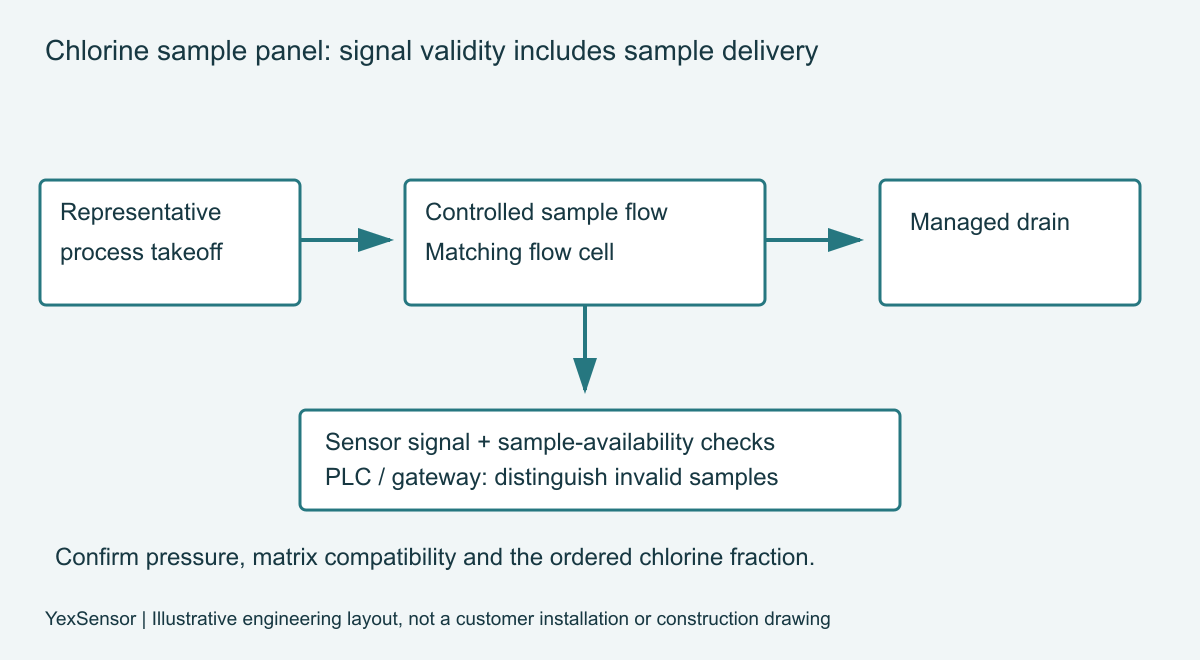
A YexSensor candidate and its evidence boundaries
YEX-S2-CL-S uses constant-voltage measurement, flow-cell installation, RS485 Modbus RTU and optional 4–20 mA. Its matching manual lists 0–2.000 and 0–20.00 mg/L as HClO. Specify the ordered range and reporting basis; do not assume every supplied unit covers both variants interchangeably.
| Item | Verified specification / source | Procurement check |
|---|---|---|
| Ranges / principle | 0–2.000 or 0–20.00 mg/L HClO; constant voltage | Specify analytical basis and ordered range. |
| Operating conditions | 0–60 °C; ≤0.2 MPa; pH 4–9 | Within-range operation does not prove matrix compatibility. |
| Sample flow | 30–60 L/h suggested in manual | Verify stable delivery through the matching flow cell. |
| Response / detection | T90 <90 s; detection limit 0.05 mg/L | Include sample delay; resolution is not detection capability. |
| Housing / installation | 316L; flow cell, 3/4 NPT | Review chemistry and complete panel compatibility. |
| Signal / supply / power | RS485; optional 4–20 mA; 12–24 V DC; 0.2 W at 12 V | Confirm output option and host scaling. |
| Protection / cable | IP68; supplied cable 5 m | Confirm jacket and connector sealing. |
| Accuracy | Manual entries require clarification | Obtain an explicit error basis before setting acceptance limits. |
The manual’s chlorine accuracy entries lack a clear common basis: ±5% for one range and ±0.05 without an explicit unit for the other. Do not convert these into a guaranteed error band. Obtain written clarification before defining acceptance limits. Operating limits alone do not establish interference tolerance in reclaimed water.
Confirm the ordered analog option and any simultaneous-output requirement. Do not describe every S2 unit as dual-output without verifying its configuration.
Compare electrode monitoring with a reagent analyzer
An electrode package suits continuous trending only when analyte, chemistry and flow match its validated operation. Compare cleaning, calibration and consumables; the principle alone does not establish a maintenance-free installation.
A colorimetric analyzer can be appropriate when its method measures the specified chlorine fraction and the project can support reagents, waste handling and scheduled service. It introduces its own sample and interference requirements. Method alignment is more important than comparing the number of digital interfaces.
Prompt grab-sample testing can verify the online result when both methods address the same chlorine fraction. Do not force unlike measurements to agree through calibration.
| Approach | When it fits | Decision boundary |
|---|---|---|
| Electrode package | Matched analyte and controlled sample conditions | Confirm flow, interference and maintenance requirements. |
| Colorimetric analyzer | Required fraction measured by a suitable method | Include reagents, waste and service access. |
| Grab-sample comparison | Independent verification at the same process stage | Match analyte and timing; not a continuous trend. |
Three reuse-project scenarios
These design examples require water-specific review; they are not reported customer results.
Tertiary-treated municipal reuse skid
Field challenge: residual may vary with treatment load and storage conditions. Integration approach: identify a representative takeoff after the specified process stage, review solids and ammonia, and validate the selected chlorine measurement against the agreed method. User value: the equipment supplier delivers a clearly defined residual trend instead of an ambiguous concentration tag.
Industrial cooling makeup from reclaimed water
Field challenge: incoming reclaimed water and site chemical treatment may introduce different oxidants or interferences. Integration approach: document the disinfectant and dosing sequence, then determine whether the proposed chlorine sensor responds to the required measurement. User value: purchasing avoids a chemically unsuitable sensor whose output appears credible but cannot support the intended decision.
Building-scale non-potable reuse equipment
Field challenge: intermittent operation and limited maintenance access can interrupt sample delivery. Integration approach: provide an accessible sample panel and an indication of sample availability, with host logic that distinguishes unavailable measurements from low residual. User value: remote operators can recognize a sampling fault without mistaking a held number for current water conditions.

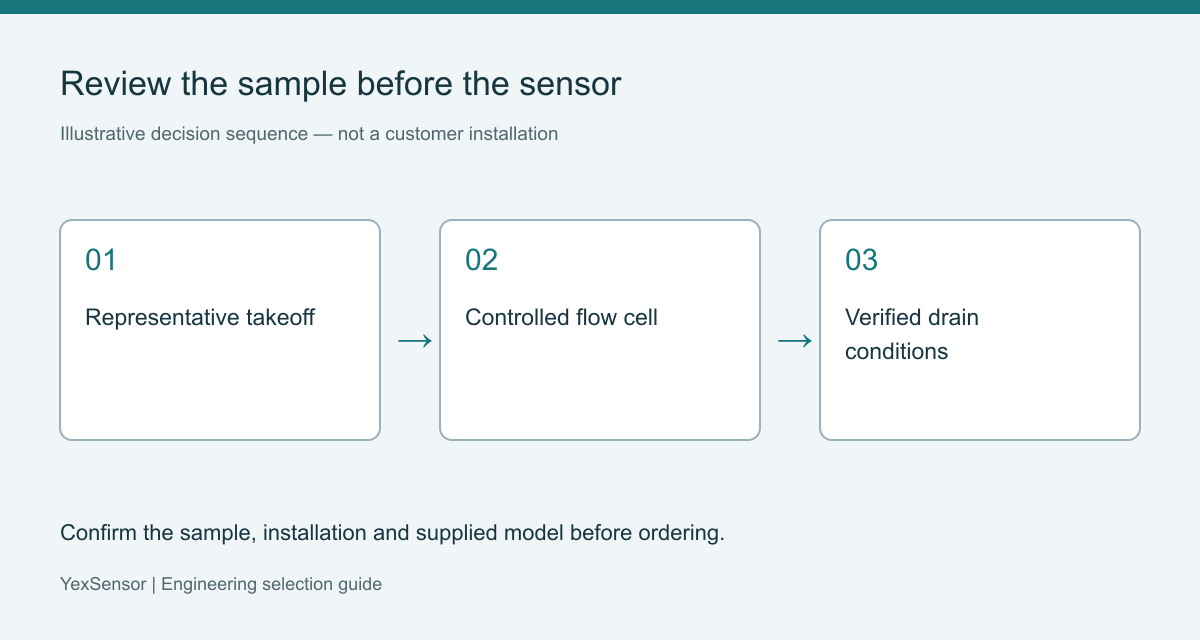
Design the sample path as part of the instrument
Choose a representative process stage. Incomplete mixing near injection can mislead; transport and chlorine demand also matter downstream. No universal takeoff distance replaces process review.
Evaluate sample residence time, deposits, air pockets, materials and service access. A short route still needs suitable conditions. Assess whether any proposed filter or conditioning step changes the analyte before installation.
The manual suggests 30–60 L/h through the matching flow cell. Check stable delivery and ≤0.2 MPa working pressure, including upset conditions. Include pressure management and drainage as required; IP68 does not rate the complete sample panel.
Test sample delivery and interruption detection during commissioning. Communication alone cannot confirm fresh sample delivery; the host must distinguish invalid sampling from valid concentration readings.
Integrate the sensor without hiding sample faults
For RS485 Modbus RTU, confirm the supplied register map, address, serial settings, units, scaling and data types. Where instrument status registers are available, interpret them separately from concentration. If no required sample-status information is available from the probe, the panel design may need a separate means of detecting sample loss.
For optional 4–20 mA, specify the ordered span and determine how faults are represented by the supplied hardware. Do not assume every invalid condition produces a particular current. Document the analog-input scaling and test both normal values and agreed fault cases before connecting the signal to operational decisions.
Record calibration and maintenance periods. An isolated flow cell must not appear to provide fresh process data; agree invalid-measurement responses with the control designer.
Compare complete quotations and acceptance scope
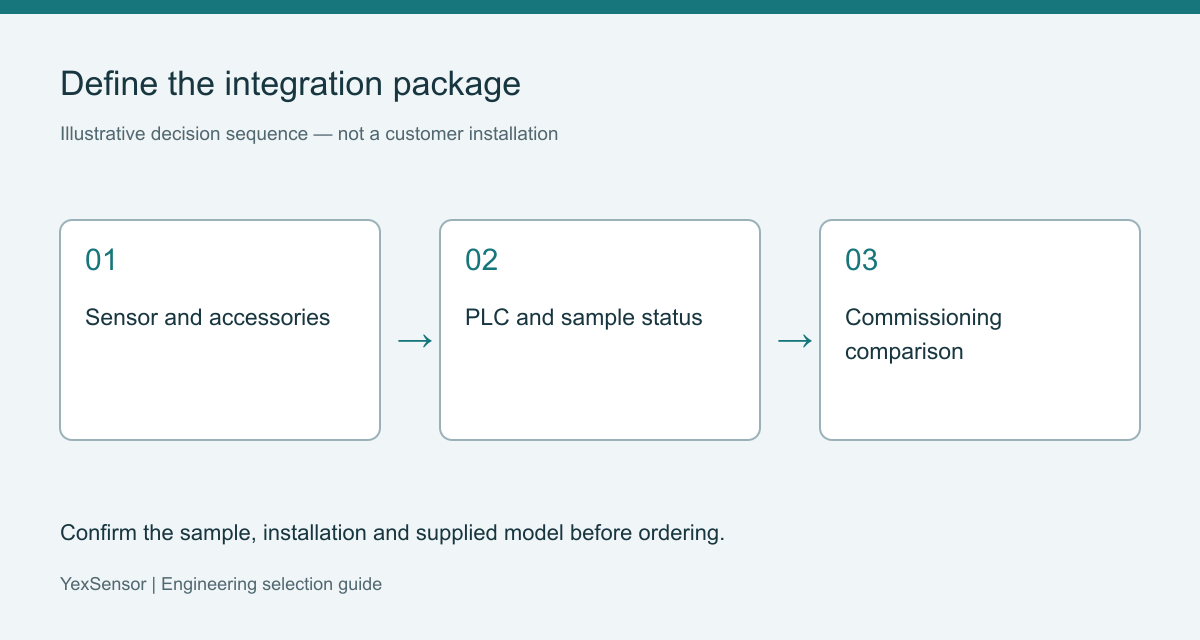
Ask for separate identification of the sensor, flow cell, sample accessories, cable, power requirements, documents and commissioning support. Include any required comparison equipment, reagents or consumables in the project budget. Clarify who provides sample plumbing and who owns the final analytical acceptance.
Confirm destination, quantity, delivery, packaging, spares and service terms. Name required certificates or reports explicitly; photographs and catalog wording do not establish certification.
Review your configuration before ordering
For the YEX-S2-CL-S chlorine sensor, send the disinfectant identity, required chlorine fraction, expected concentration, sample pH and temperature, solids and ammonia information, takeoff drawing, flow conditions, host interface and reference method. Include quantity and installation responsibilities. Send Your Project Requirements so the suitability review covers the sample panel as well as the probe.
Sources: official YEX-S2-CL-S page and the matching model User Manual, technical specifications and installation/communication sections; reviewed October 23, 2026. Confirm reuse-water suitability in a configuration-specific technical agreement.
Frequently asked questions
Q1. What comes first in residual chlorine sensor selection?
Define the disinfectant, required chlorine fraction and reference method before selecting the interface. A project requiring total chlorine cannot automatically use a sensor described around HClO response. Provide the water matrix and expected pH conditions with the inquiry, then ask the supplier to confirm exactly what the delivered concentration output represents and under which conditions.
Q2. Is HClO the same as total chlorine?
No. HClO, also written HOCl, is hypochlorous acid, one component of free chlorine. Total chlorine additionally includes combined chlorine forms. If a product range is labeled HClO, clarify the measurement and any compensation before comparing it with a total-chlorine result. Specify the required analytical fraction explicitly in the order and commissioning procedure.
Q3. Does Modbus communication prove that the sample is valid?
No. A responsive device can continue transmitting while sample flow is interrupted or the flow cell is isolated. Define the available instrument status and any separate sample-flow indication required by the panel. During acceptance, test how the host distinguishes invalid sampling from a genuine low residual before the value is used for operational decisions.
Q4. Can YEX-S2-CL-S be selected for any reclaimed water?
No. The official description provides a starting point, not blanket approval for every reclaimed-water matrix. Confirm the disinfectant, analyte, interference risks and sample operating limits with a matching technical document. For water containing substantial ammonia, solids or changing chemicals, request a suitability review and representative comparison testing before committing to repeat orders.
Q5. When should an integrator consider a colorimetric analyzer?
Consider it when a suitable method measures the required chlorine fraction and the project can maintain its sample system, reagents and waste handling. Do not choose solely because a sensor is smaller or an analyzer looks more complete. Compare method compatibility, service workload and acceptance evidence for the actual water before selecting the package.
Q6. Is the higher chlorine range automatically available?
No. The YEX-S2-CL-S manual lists 0–2.000 and 0–20.00 mg/L as HClO, but this does not establish interchangeable ranges in every supplied unit. Specify the ordered configuration, normal residual and expected excursions. Obtain written clarification of the accuracy basis and calibration requirements before approving the instrument against the project’s acceptance criteria.
Q7. What should a chlorine monitoring quotation include?
It should identify the sensor configuration, flow cell, sample accessories, cable, interface, documentation and support scope. Add consumables and reference testing where required by the selected method. Clarify exclusions, lead time, packaging and service terms so a bare sensor price is not compared with a complete sample panel as though they were equivalent deliveries.
Q8. How should site acceptance be performed?
Compare the online measurement with the agreed reference method using representative, timely samples that address the same chlorine fraction. Record sample flow, pH, temperature, instrument settings and operating state. Test communication and sample-loss handling separately. Define acceptance limits and responsibilities before commissioning rather than changing calibration until two unlike measurements happen to match.
Q9. Does an acceptable residual prove reuse compliance?
No. A residual measurement addresses one part of a treatment and monitoring strategy, not every chemical or microbiological requirement. The process designer must establish the applicable reuse criteria and verification methods. Keep the chlorine instrument's scope explicit, and purchase additional measurements only where they support a defined treatment, alarm or acceptance decision in the project.
Summary
Select a reuse-water chlorine package around the analyte, sample and acceptance method. YEX-S2-CL-S offers a constant-voltage option with RS485 and an optional analog interface, but its HClO labeling, ordered range and application limits require confirmation. Compare electrode and colorimetric approaches by measurement fit and service scope, not communication alone. Include the flow cell, sample plumbing and validity checks in integration planning. A useful inquiry supplies water chemistry, process stage, expected residual and reference method, enabling a defensible suitability decision before the equipment is ordered.


