Chinese
 Spanish
 French
 Russian
 German
 Portuguese
 Indonesian
 Thai
 Vietnamese
 Arabic


Dissolved oxygen sample handling determines whether a bench result answers the original question. A benchtop meter measures the sample in front of its probe; it cannot reconstruct oxygen gained or lost during collection, transport or pouring. Use a bench meter when the approved procedure permits that handling and the result represents the intended sample condition. If the decision concerns water at its source, assess an appropriate source-point method before buying laboratory equipment. Then qualify the actual probe, vessel and recording procedure together.
Air exchange and sample reactions are separate risks
Opening a bottle, pouring into a beaker or drawing air into a sample line creates opportunities for gas exchange. Water below air-equilibrium oxygen can gain oxygen; supersaturated water can lose it. Temperature, pressure and salinity affect that equilibrium. Consequently, exposure does not always move DO upward, and a bubble is neither a known oxygen addition nor a predictable correction.
Closing the bottle addresses only part of the problem. Microorganisms can continue consuming oxygen, chemical reactions can consume it, and photosynthetic organisms under suitable light can produce it. EPA's archived monitoring guidance describes oxygen production and consumption mechanisms that explain why a sealed sample can still change. Record elapsed time, temperature and relevant light exposure rather than treating a full bottle as preserved indefinitely.
The purchasing risk is accepting a repeatable instrument result for an unsuitable sample. A stable display and successful calibration address the measurement system under their test conditions. Neither establishes that the sample retains the source-point DO. Define which condition the reported number must represent before setting the acceptance margin.
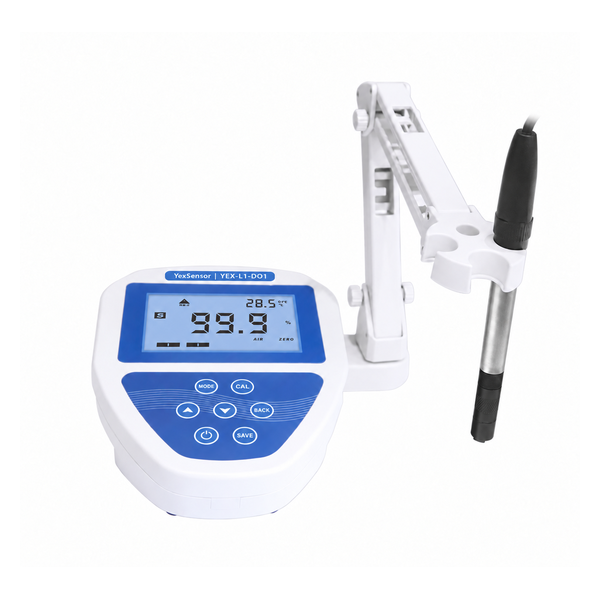
YEX-L1-DO1 limits that affect dissolved oxygen sample handling
The YEX-L1-DO1 benchtop dissolved oxygen meter provides concentration and percentage-saturation displays. They are two expressions of DO, not separate analytes. Its Version 1.00 English manual gives the following limits. Assess the complete sample procedure alongside them.
| Model and manual source | Documented value | Condition | Purchase implication |
|---|---|---|---|
| YEX-L1-DO1, manual Section 3 | 0.00–40.00 mg/L; 0.01 mg/L resolution; ±0.2% F.S. indication error | Prepared, calibrated probe and suitable sample conditions | Evaluate the decision margin; display resolution does not establish trace-oxygen suitability. |
| YEX-L1-DO1, manual Sections 3 and 5 | 0.0–400.0% saturation; 0.1% resolution; ±0.2% F.S. indication error | Temperature, pressure and salinity influence the mode relationship | Specify reporting units and retain compensation inputs. |
| YEX-L1-DO1, manual Sections 3–5 | 0.0–50.0 °C temperature measurement; ±0.2 °C indication error; automatic compensation | Probe and sample must equilibrate | Use the sample-temperature limit, rather than the wider host-environment range. |
| YEX-L1-DO1, manual Sections 3 and 4.3 | Manual pressure input 600–1400 mbar | Representative local atmospheric pressure | Provide a pressure source; the input is not an atmospheric-pressure measurement. |
| YEX-L1-DO1, manual Sections 3 and 4.3 | Manual salinity input 0.0–40.0 g/L | Representative sample salinity | Specify how salinity will be obtained and entered. |
| YEX-L1-DO1, manual Section 2 and safety instructions | 256 local records; body not waterproof or explosion-proof | Dry, suitable laboratory bench | Plan sample identification externally; do not assume USB export or wet-site deployment. |
Compare five measurement paths before selecting equipment
| Path | Useful result | Acceptance evidence and equipment decision |
|---|---|---|
| Open bench vessel | Sample condition at laboratory measurement, where the method permits it | Document transfers, opening time, immersion and endpoint. DO1's ordinary immersion procedure does not guarantee source-point preservation. |
| Validated closed or limited-headspace vessel | Measurement with restricted gas exchange | Demonstrate probe fit, sensing-area immersion, seal, cleaning and method suitability. No DO1 closed-vessel or BOD-bottle accessory is established by the available documents. |
| Validated flow-through arrangement | Water delivered through a qualified sample path | Test transit delay, air ingress, bubbles and compatible temperature/pressure conditions. A DO1 flow cell, pressure rating and minimum flow are not documented. |
| Appropriate source-point measurement | Water at the specified location, depth and time | Select suitable field equipment and reproduce the sampling position. DO1 battery power does not make its body waterproof. |
| Method-specific field fixation and laboratory titration | A result obtained through the selected Winkler-type procedure | Supply its prescribed reagents, containers and quality controls. Chemical fixation is not a DO1 probe function or permission to hold untreated samples. |
Choose the path from the result's purpose. For a source-point decision, transport may be the problem to remove. For an accepted laboratory sample-state measurement, an open bench can be appropriate. Closed and flow-through proposals need demonstrated compatibility; neither stops every sample reaction. The field DO meter selection guide addresses the separate field-equipment decision.
Three sample paths that lead to different purchase decisions
A low-oxygen sample is poured for bench measurement
Suppose an operator collects low-DO process water and pours it through the air into a beaker. Oxygen uptake could raise the reading, concealing the condition that prompted sampling. This is a hypothetical risk, not a customer result. During qualification, compare an appropriate immediate source observation with the proposed handling route, retaining collection, transfer and readout times. Include the actual vessel and operator. If the route cannot meet the method owner's agreed comparison criteria, select a suitable source-point method instead of compensating the bench number by an assumed offset.
A sealed sample continues reacting
Consider wastewater containing active biomass. A closed bottle limits exchange with ambient air but does not stop oxygen consumption. In a sample containing photosynthetic organisms, light history can also matter. Run the proposed route using representative samples and the actual queue, alongside the method's reference observation. Retain temperature and handling history. Agreement on one easy sample does not qualify every matrix. The procurement response may be shorter delivery and immediate analysis, or a different accepted method; a tighter cap alone does not settle the issue.
The decision concerns water at the collection point
Suppose an engineer investigates oxygen at a particular process depth during an operating transition. A later bottle result represents a different time and potentially a changed sample. Specify the field location, depth and event time, then compare measurements made under equivalent conditions before investigating a bench discrepancy. Where laboratory titration is selected, use that method's field-fixation procedure. EPA's archived monitoring guidance distinguishes this route from probe measurement. Its method-specific preservation instructions are not a general holding allowance for untreated DO samples.
Control probe movement, vessel fit and the sample record
Set the DO1 on a dry, level bench and secure the stand and cable. With power off, connect the matching probe to its dry input. Test the actual vessel opening and depth: the complete sensing area must be immersed without touching the wall or bottom. Include the temperature-sensing location in that inspection. A holder gripping the probe does not establish a seal or suitable fluid contact.
Follow the delivered probe's movement instructions. Where movement is required, provide it gently and consistently while avoiding vigorous aeration. Inspect for trapped bubbles and avoid a vortex or stirring-induced temperature change. Do not copy another probe's rotational speed. The available DO1 documentation does not identify the supplied probe's sensing principle, minimum flow or stabilization time; those requirements belong with the supplied probe and validated procedure.
Separate calibration from sample handling. The manual permits one-point AIR or two-point AIR/ZERO calibration using the specified conditions and manufacturer-approved zero medium. Verify before critical work. An air-saturation calibration condition does not authorize aerating the original sample.
Retain sample ID, location/depth, collection, closure, opening, transfer and readout times as applicable, temperatures, probe ID, units, pressure/salinity inputs, calibration/check result and unusual bubbles or handling. Assign each saved DO1 record to that worksheet. Local memory alone does not establish an export interface.

RFQ checklist for the sample and measurement path
- Result purpose, applicable method, sample matrix, expected DO band, temperature and decision margin.
- Collection-to-readout sequence, peak queue, vessel dimensions, closure and any proposed flow path.
- Actual probe model, immersion/movement requirements, matrix compatibility and itemized accessories.
- Calibration/check materials, replenishment, acceptance criteria and responsibility for a failed comparison.
- Sample identification and record handover; any required electronic transfer demonstrated separately.
Specify the laboratory measurement task
Provide the sample matrix, result purpose, temperature, vessel and handling sequence, acceptance criteria and record needs for a YEX-L1-DO1 laboratory configuration.
Frequently asked questions
Q1. Can a benchtop DO reading recover the oxygen level at the original sampling point?
A1. No. It measures the sample under the conditions present at the probe. Gas exchange, continuing reactions and temperature history can separate that condition from the source. Closing a bottle restricts exchange but does not stop all reactions. Set acceptance criteria for dissolved oxygen sample handling against an appropriate method reference before using bench results for source-point decisions.
Q2. Does faster stirring always produce a better dissolved oxygen result?
A2. No. The required movement depends on the actual probe. DO1 instructions call for gentle, consistent movement when its probe requires it, with complete sensing-area immersion and removal of trapped bubbles. Vigorous aeration can change the sample; stirring can also change temperature. Obtain the supplied probe's instructions and test the arrangement rather than specifying a universal rotational speed or copying another instrument's procedure.
Q3. Can automatic temperature compensation correct oxygen introduced during pouring?
A3. No. Compensation applies to measurement under the current temperature conditions; it cannot remove oxygen already exchanged or reconstruct earlier sample chemistry. DO1 still requires temperature equilibration and stable readings. Record the transfer and temperature history, investigate the handling route, and repeat through the accepted procedure when necessary. Adjusting an instrument setting to match an expected source value would conceal the sampling problem.
Q4. When should a laboratory choose a bench meter rather than field measurement?
A4. Choose a bench workflow when the intended result concerns the laboratory sample state, or the applicable method permits a demonstrated collection-to-bench procedure. If the decision requires DO at a source location and transport changes the sample, evaluate appropriate field measurement. Assess the actual route and operator workload before ordering. DO1's battery option does not extend its dry-bench safety requirements to wet field deployment.
Q5. Can the YEX-L1-DO1 probe be used in a BOD bottle or closed flow cell?
A5. The available DO1 documents do not establish that compatibility. Obtain the actual probe dimensions, sensing and temperature-element positions, connection details and proposed vessel or cell specification. Demonstrate immersion, sealing, cleaning, movement and applicable temperature/pressure conditions before purchase acceptance. Another brand's bottle adapter is not evidence of fit. A DO meter also does not, by itself, supply a complete BOD test method.
Q6. Can a Winkler-fixed sample be measured by a bench probe as the original sample?
A6. Do not combine the methods that way. Fixation uses chemical reactions within a specified titration procedure; the treated liquid is not the untreated sample for a direct probe reading. Select the accepted method before buying containers, reagents or probe accessories. Follow that method's fixation, handling and analytical controls, and keep its preservation conditions separate from any untreated sample procedure proposed for the DO1.
Q7. What must the RFQ say about the vessel, probe and reporting package?
A7. Describe the matrix, result purpose, expected DO and temperature, handling sequence, vessel geometry and required record fields. Itemize the supplied probe, accessories and calibration/check materials. Require evidence for any closed or flow-through proposal. DO1 documents 256 local records but no specified export interface. Demonstrate any mandatory export requirement before ordering. An external worksheet is an alternative only when the receiving laboratory accepts its format, required fields and manual-entry controls.
Q8. What should an acceptance test demonstrate before routine sample measurement?
A8. Test the measurement system and sample route separately. First document calibration and the agreed verification outcome. Then demonstrate immersion, bubble control, temperature stability and identifiable records with representative samples through the intended handling route. Compare against the method's reference under agreed conditions. Set tolerances, repeat observations and responsibilities before testing; retain failures and their disposition instead of treating one successful demonstration as universal approval.
Summary
A bench DO result is useful when its sample condition matches the intended decision. Manage gas exchange, continuing reactions and probe-required movement separately. YEX-L1-DO1 can be assessed for a suitable laboratory procedure within its documented ranges; closed-vessel fit and electronic export require separate evidence. Purchase against the actual sample path, probe/vessel arrangement, calibration/check plan and identifiable records, with acceptance criteria owned by the laboratory.