


 Chinese
 Spanish
 French
 Russian
 German
 Portuguese
 Indonesian
 Thai
Thai Vietnamese
 Arabic

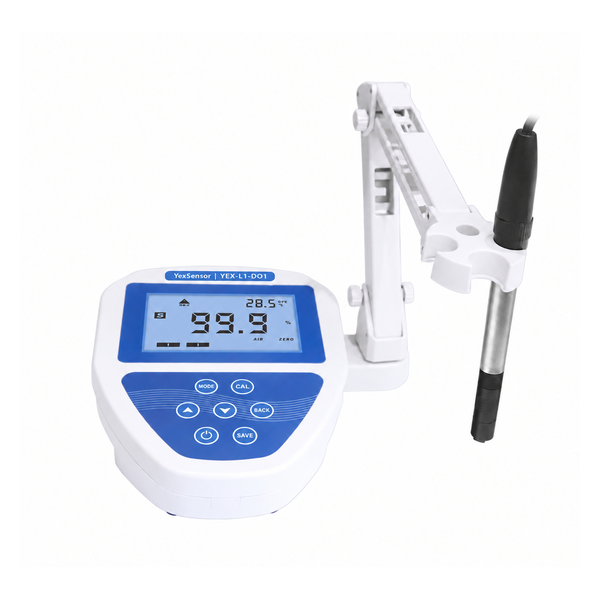

Products Description
SEO description: YexSensor YEX-L1-DO1 is a benchtop dissolved oxygen meter for laboratory measurement in percentage saturation and mg/L, with automatic temperature compensation, manual pressure and salinity correction, one-point or two-point calibration, and storage for 256 records.
Keywords: YEX-L1-DO1 benchtop dissolved oxygen meter, laboratory DO meter, dissolved oxygen saturation meter, mg/L dissolved oxygen analyzer, pressure and salinity compensated DO meter, water quality laboratory instrument
Product Overview
YEX-L1-DO1 Benchtop Dissolved Oxygen Meter: control compensation and calibration variables before they become reporting errors.
- Two dissolved oxygen result modes: view percentage saturation from 0.0 to 400.0% or oxygen concentration from 0.00 to 40.00 mg/L without treating them as separate sensors.
- Condition-aware correction: automatic temperature compensation is combined with user-entered atmospheric pressure from 600 to 1400 mbar and salinity from 0.0 to 40.0 g/L.
- Repeatable laboratory workflow: one-point or two-point calibration, clear stabilized readings, one-button mode switching, and local storage for 256 measurement records support routine sample work.
The YexSensor YEX-L1-DO1 is designed for laboratories that need dissolved oxygen results with a traceable operating routine rather than a single unchecked display value. It brings measurement, compensation settings, calibration control, temperature observation and local record review into one benchtop instrument. The meter can present the dissolved oxygen result as percentage saturation or oxygen concentration in mg/L, while the operator controls the pressure and salinity values that influence the relationship between those two displays.
Typical users include water and wastewater laboratories, environmental monitoring teams, aquaculture laboratories, research institutes, drinking-water facilities, universities and process-quality laboratories. The instrument is most useful where samples are brought to a stable bench, the probe can be prepared and immersed correctly, and the method requires verification of calibration and compensation settings before results are accepted.
Selection Considerations and Measurement Boundaries
Choose YEX-L1-DO1 when the primary requirement is benchtop dissolved oxygen measurement over the documented ranges, with temperature compensation and manually entered pressure and salinity corrections. Percentage saturation and mg/L are two presentations of the same dissolved oxygen condition. They should not be counted as two independent analytes, and their relationship changes with temperature, atmospheric pressure and sample salinity.
The atmospheric pressure and salinity functions are correction inputs. The meter does not independently measure barometric pressure or salinity. Before measurement, enter values representative of the actual location and sample whenever they differ from the defaults of 1013 mbar and 0.0 g/L. Incorrect entries can bias the displayed dissolved oxygen result even when the probe is otherwise clean and calibrated.
The manual does not define a universal probe principle, a fixed probe package, a specific IP rating, or a digital communication interface. It does not specify USB export, RS-485, Modbus, Ethernet, wireless networking or cloud connectivity. The 256-record function is local meter memory for later review. Confirm the required probe type, calibration media, accessories, power option and any data-transfer requirement in the quotation before ordering. The meter body is not waterproof or explosion-proof and is intended for a dry, controlled benchtop environment.
Key Technical Advantages
Wide dissolved oxygen presentation ranges. Percentage saturation covers 0.0 to 400.0%, while oxygen concentration covers 0.00 to 40.00 mg/L. This gives the laboratory one instrument interface for routine waters and higher-oxygen conditions within the documented limits.
Compensation variables remain visible and controllable. Temperature compensation is automatic. Atmospheric pressure can be set in 1 mbar increments from 600 to 1400 mbar, and salinity can be set in 0.1 g/L increments from 0.0 to 40.0 g/L. The operator can therefore align the calculation with the actual measurement condition instead of relying on an unverified default.
Calibration matched to routine and critical work. One-point calibration uses the AIR point in the probe-specified air-saturation condition. Two-point calibration adds a ZERO point using a manufacturer-approved zero-oxygen medium. This supports efficient routine checks while retaining a fuller calibration option for demanding methods or post-maintenance verification.
Stable benchtop handling. The large backlit display supports reading in normal laboratory lighting. The electrode stand can be installed on either side and positions the probe near 90 degrees for controlled immersion. Battery or adapter power allows either a cable-free bench setup or continuous operation near a power outlet.
Local traceability for routine batches. Up to 256 measurement records can be stored for on-instrument review. This is useful for checking a sample sequence or recording a result before it is transferred into the laboratory's approved worksheet or information system.
Technical Specifications
| Measured Quantity | Measurement Range | Display Resolution | Accuracy / Indication Error | Interpretation Note |
|---|---|---|---|---|
| Percentage saturation | 0.0–400.0% | 0.1% | ±0.2% F.S. | A dissolved oxygen result mode, not a separate sensor. |
| Oxygen concentration | 0.00–40.00 mg/L | 0.01 mg/L | ±0.2% F.S. | A dissolved oxygen result mode affected by temperature, pressure and salinity. |
| Temperature | 0.0–50.0 °C | 0.1 °C | ±0.2 °C | Supports automatic temperature compensation. |
| Item | Specification |
|---|---|
| Model | YEX-L1-DO1 |
| Power source | Four AAA batteries or adapter with 100–200 V AC input |
| Battery life | >500 hours |
| Operating environment | −5–60 °C; relative humidity <90% |
| Data storage | 256 measurement records |
| Dimensions / weight | 150 x 200 x 60 mm (W x L x H); 660 g |
Specification note: Display resolution describes the smallest displayed increment; it is not the same as indication error. Evaluate suitability using the documented range, indication error, sample conditions, compensation inputs, calibration practice and probe configuration together.
Compensation Settings and Result Interpretation
| Function | Documented Setting | Engineering Use and Boundary |
|---|---|---|
| Temperature compensation | Automatic; temperature measurement range 0.0–50.0 °C | Corrects the dissolved oxygen result after the probe and sample reach temperature equilibrium. |
| Atmospheric pressure correction | 600–1400 mbar; 1 mbar increment; default 1013 mbar | User-entered correction value. The meter does not measure atmospheric pressure. |
| Salinity correction | 0.0–40.0 g/L; 0.1 g/L increment; default 0.0 g/L | User-entered correction value. The meter does not measure salinity. |
For freshwater near standard atmospheric conditions, the default values may be close to the actual method conditions, but they should still be checked. At elevated sites, under unusual weather pressure, or in brackish and saline samples, the correct entries become more important. Record the values used with the measurement result so another operator can reproduce the calculation basis.
A difference between percentage saturation and mg/L trends is not automatically an instrument fault. First confirm the selected display mode, temperature equilibrium, pressure entry and salinity entry. Then inspect immersion depth, trapped bubbles, sample movement and probe condition. These checks separate calculation-input errors from probe or sample problems.
Application Scenarios
Drinking-water and wastewater laboratories. Measure dissolved oxygen in collected samples for process review, aeration checks, treatment verification and method development. Use a consistent holding time and sample-handling procedure because oxygen can change during transport and exposure to air.
Environmental monitoring and research. Review field or experimental samples under controlled laboratory conditions. The two display modes help researchers report either saturation behavior or concentration, provided that pressure, salinity and temperature conditions are documented.
Aquaculture and pool-water testing. Check oxygen status in representative samples while controlling sample movement and minimizing delay. Salinity correction is especially relevant when the sample is not freshwater.
Industrial and municipal quality laboratories. Support testing in petrochemical, papermaking, pharmaceutical, food, agricultural, power, textile, leather, brewing, electronics and municipal applications. Suitability depends on sample compatibility with the selected probe and the laboratory's method, not only on the meter's numerical range.
Universities and training laboratories. Demonstrate the practical relationship among oxygen concentration, percentage saturation, temperature, pressure and salinity. The instrument's visible settings and two-point calibration sequence make method variables easier to teach and review.
Installation and Routine Measurement
Place the meter on a stable, level and dry bench away from direct sunlight, heat sources, strong electromagnetic interference, vibration and corrosive vapors. Install the electrode stand on the side that provides the safest sample access, and position the probe vertically at approximately 90 degrees. Keep the meter, adapter, battery compartment, connectors and cable dry.
With the meter switched off, connect the selected dissolved oxygen probe securely. Install four AAA batteries with correct polarity or use the specified adapter. Remove the probe protective cap and prepare the sensing end according to the instructions supplied for the purchased probe. Because the manual does not define one universal probe package, probe-specific preparation and storage instructions remain part of the approved method.
Before each batch, confirm the current calibration status and enter the actual atmospheric pressure and sample salinity. Rinse the probe with clean water between samples. Immerse the complete sensing area, keep it away from the vessel wall and bottom, and remove trapped air bubbles. Where the probe instructions require sample movement, provide gentle and consistent movement without creating excessive aeration.
Allow both the temperature and dissolved oxygen reading to stabilize before recording the result. Select either percentage saturation or mg/L according to the reporting method. Save the result to local memory when a meter-side record is needed, and separately follow the laboratory's controlled documentation procedure.
Calibration and Quality Control
One-point calibration. Prepare the AIR condition specified for the selected probe, such as water-saturated air or air-saturated water. Confirm the pressure and salinity settings, enter calibration with the front-panel control, select the AIR point and wait for a stable reading before confirmation. This is the efficient choice for routine work when the method and verification criteria permit one-point calibration.
Two-point calibration. Complete the AIR point first. Then prepare a manufacturer-approved zero-oxygen calibration medium, observe its handling and safety instructions, rinse the probe as required, select the ZERO point and wait for stability. Confirm the point, rinse thoroughly and verify both calibration points before sample measurement.
Recalibrate after probe maintenance or replacement, long storage, a large change in pressure or salinity conditions, or an unacceptable verification result. For critical measurements, verify the meter in a known air-saturation condition before the sample batch. If verification fails, inspect cleanliness, bubbles, immersion, connector condition and probe preparation before repeating calibration.
Calibration media, sample containers and rinsing practice should be included in the laboratory method. A technically capable meter cannot correct for an exhausted zero-oxygen medium, a contaminated probe, temperature drift or oxygen exchange caused by inconsistent sample handling.
Records, Modes, and Operating Controls
| Function | What the Operator Can Do | Control Boundary |
|---|---|---|
| DO result mode | Switch between percentage saturation and oxygen concentration in mg/L | Both are presentations of dissolved oxygen, not separate analytes. |
| Temperature compensation | Use automatic compensation after temperature stabilization | Correct immersion and equilibrium are still required. |
| Pressure and salinity | Enter actual correction values when conditions differ from defaults | They are manual inputs and are not measured by the meter. |
| Calibration | Run one-point AIR or two-point AIR and ZERO calibration | Media and probe preparation must follow the approved method. |
| Local storage | Save and review up to 256 measurement records | Storage does not imply an external data-export interface. |
| Power | Use four AAA batteries or the specified adapter | Keep the power connection and battery compartment dry. |
| Electrode stand | Install on either side and hold the probe near vertical | Final position must avoid wall contact, bottom contact and cable strain. |
The operating sequence should be written into the local standard procedure: select mode, verify compensation inputs, verify calibration, rinse, immerse, remove bubbles, stabilize, record, rinse again and store the probe correctly. This reduces operator-to-operator variation more effectively than relying on a display value alone.
Maintenance and Troubleshooting
Rinse the probe after each sample and clean it only with methods compatible with the selected probe. Do not scratch, press or wipe a sensitive sensing surface unless the probe instructions specifically allow it. Inspect connectors and cable strain points, and store the probe with the required protective condition after use. Remove batteries before extended storage if the instrument will not be used.
For an unstable reading, first remove bubbles, confirm complete immersion, provide consistent sample movement when required, check the connector and allow additional stabilization time. For a value that is unexpectedly high or low, confirm pressure and salinity entries, repeat calibration, inspect contamination and repeat the measurement under stable conditions.
If calibration fails, use fresh suitable calibration media, verify the AIR or ZERO condition, remove bubbles and inspect the probe for damage. If the temperature value is incorrect, allow more equilibration time and confirm that the temperature-sensing area is properly immersed. When percentage saturation and mg/L appear inconsistent, check mode, temperature, pressure and salinity before assuming a hardware fault.
If a stored result cannot be found, confirm that the save operation was completed and repeat the measurement if necessary. Local records support review, but the laboratory should still maintain its required controlled records outside the meter.
Configuration and RFQ Checklist
To receive a configuration that matches the real method, send YexSensor the intended sample type, expected dissolved oxygen range, temperature range, approximate salinity, site elevation or pressure conditions, daily sample count, preferred calibration practice and required power arrangement. Also state whether the reporting unit is percentage saturation, mg/L or both.
Identify chemicals, oils, suspended solids, disinfectants or aggressive components that may affect probe compatibility or maintenance frequency. If the laboratory requires electronic export, remote communication or integration with a LIMS, PLC or other system, state that requirement explicitly because the manual does not document such an interface for YEX-L1-DO1.
For method transfer, provide the current standard, acceptance criteria, calibration frequency, verification material and sample-handling sequence. This lets the supplier check whether the instrument range and documented indication error are suitable and whether the requested probe configuration can support the matrix.
Order Confirmation, Supply Boundary, and After-Sales Information
| Confirmation Item | What to Specify | Why It Matters |
|---|---|---|
| Meter model | YEX-L1-DO1 | Prevents confusion with other benchtop or portable instruments. |
| Measurement requirement | Expected % saturation and mg/L range, temperature and sample type | Confirms that the documented ranges suit the method. |
| Probe configuration | Required probe type, cable and sample compatibility | The manual does not define one universal probe package. |
| Compensation conditions | Site pressure or elevation and sample salinity | These values affect dissolved oxygen result correction. |
| Calibration supplies | AIR method, ZERO medium and verification materials | Supports the selected one-point or two-point procedure. |
| Power arrangement | AAA battery operation, adapter operation, or both | Aligns the delivered setup with the laboratory bench. |
| Accessories and consumables | Requested stand, probe items, media and replacement parts | Prevents assumptions about items not universally specified. |
| Documentation and service | Required certificates, language, service scope and warranty terms | Warranty coverage and service are governed by the applicable sales agreement. |
The final supplied components must follow the signed sales order and final packing list. Do not assume that every pictured accessory, probe consumable or calibration medium is included. On receipt, inspect the meter, display, connector, stand, probe and ordered accessories before use. For support, provide the model, serial number, purchase information, probe type, calibration method, pressure and salinity settings, verification result and a clear description of the problem.
Frequently Asked Questions
1. What does the YEX-L1-DO1 measure?
It measures dissolved oxygen and displays the result as percentage saturation from 0.0 to 400.0% or oxygen concentration from 0.00 to 40.00 mg/L. It also measures temperature from 0.0 to 50.0 °C for automatic temperature compensation. Atmospheric pressure and salinity are entered correction values, not separately measured outputs.
2. Are percentage saturation and mg/L separate probes or separate analytes?
No. They are two presentations of the dissolved oxygen result produced from the same measurement workflow. Temperature, atmospheric pressure and salinity affect the relationship between the two values, so the selected mode and correction settings should be recorded with the result.
3. How are temperature, atmospheric pressure and salinity compensation handled?
Temperature compensation is automatic after the probe and sample reach equilibrium. Atmospheric pressure is entered manually from 600 to 1400 mbar in 1 mbar increments, with a default of 1013 mbar. Salinity is entered manually from 0.0 to 40.0 g/L in 0.1 g/L increments, with a default of 0.0 g/L. Use values representative of the actual measurement conditions.
4. When should one-point or two-point calibration be used?
Use one-point AIR calibration for routine work when the laboratory method and verification criteria allow it. Use two-point calibration when the method requires both an AIR and ZERO point, after significant probe service, or when verification indicates that one point is insufficient. The ZERO point requires a fresh manufacturer-approved zero-oxygen medium and correct handling.
5. Why can percentage saturation and mg/L appear inconsistent?
First check whether the intended display mode is selected and whether temperature has stabilized. Then confirm atmospheric pressure and salinity entries, complete immersion, bubble removal and any required sample movement. Because the two displays describe dissolved oxygen under condition-dependent calculations, an incorrect correction input can change their relationship without indicating a meter failure.
6. Does 0.01 mg/L resolution mean the meter accuracy is ±0.01 mg/L?
No. Resolution is the smallest displayed increment. The documented indication error for oxygen concentration is ±0.2% F.S.; percentage saturation is also ±0.2% F.S., while temperature indication error is ±0.2 °C. Procurement and method decisions should use the documented indication error, sample matrix, calibration practice and compensation conditions together.
7. Can the 256 stored records be exported through USB, RS-485 or Modbus?
The manual documents storage for 256 measurement records for local review but does not specify USB export, RS-485, Modbus, Ethernet or wireless data transfer. If electronic export or system integration is mandatory, include the required interface, receiving system and data format in the RFQ so compatibility can be confirmed before purchase.
8. What information should be included in an RFQ for YEX-L1-DO1?
Provide the sample type, expected dissolved oxygen and temperature ranges, salinity, site pressure or elevation, reporting unit, daily sample volume, calibration and verification method, power preference, probe and cable needs, chemical compatibility concerns, required documents and service expectations. This information allows YexSensor to confirm the measurement boundary and define the supply package without hidden assumptions.
Summary
YEX-L1-DO1 is a practical choice for laboratories that need benchtop dissolved oxygen measurement in both percentage saturation and mg/L, with automatic temperature compensation, explicit pressure and salinity correction inputs, one-point or two-point calibration and local storage for 256 records. Its decision boundary is equally important: pressure and salinity are manually entered rather than measured, the body is not waterproof or explosion-proof, and the manual does not document an external data interface or one universal probe package.
For a defensible selection, match the documented ranges and indication errors to the sample matrix, then define probe compatibility, calibration media, compensation conditions, power and accessories in the order. Send YexSensor a representative sample description, expected range, pressure or elevation, salinity, reporting method and current quality-control procedure. That project information is the shortest route to confirming whether YEX-L1-DO1 fits the method and what must be included in the final supply package.

