


 Chinese
 Spanish
 French
 Russian
 German
 Portuguese
 Indonesian
 Thai
 Vietnamese
 Arabic


A chlorine sensor reading low should trigger a check of the sample, measurement basis and signal path before recalibration. For disinfection equipment integrators, the immediate task is to distinguish genuinely low chlorine from an invalid comparison or sampling fault, without increasing chemical dosing solely to compensate for an unverified reading.

Chlorine sensor reading low: establish what is being compared
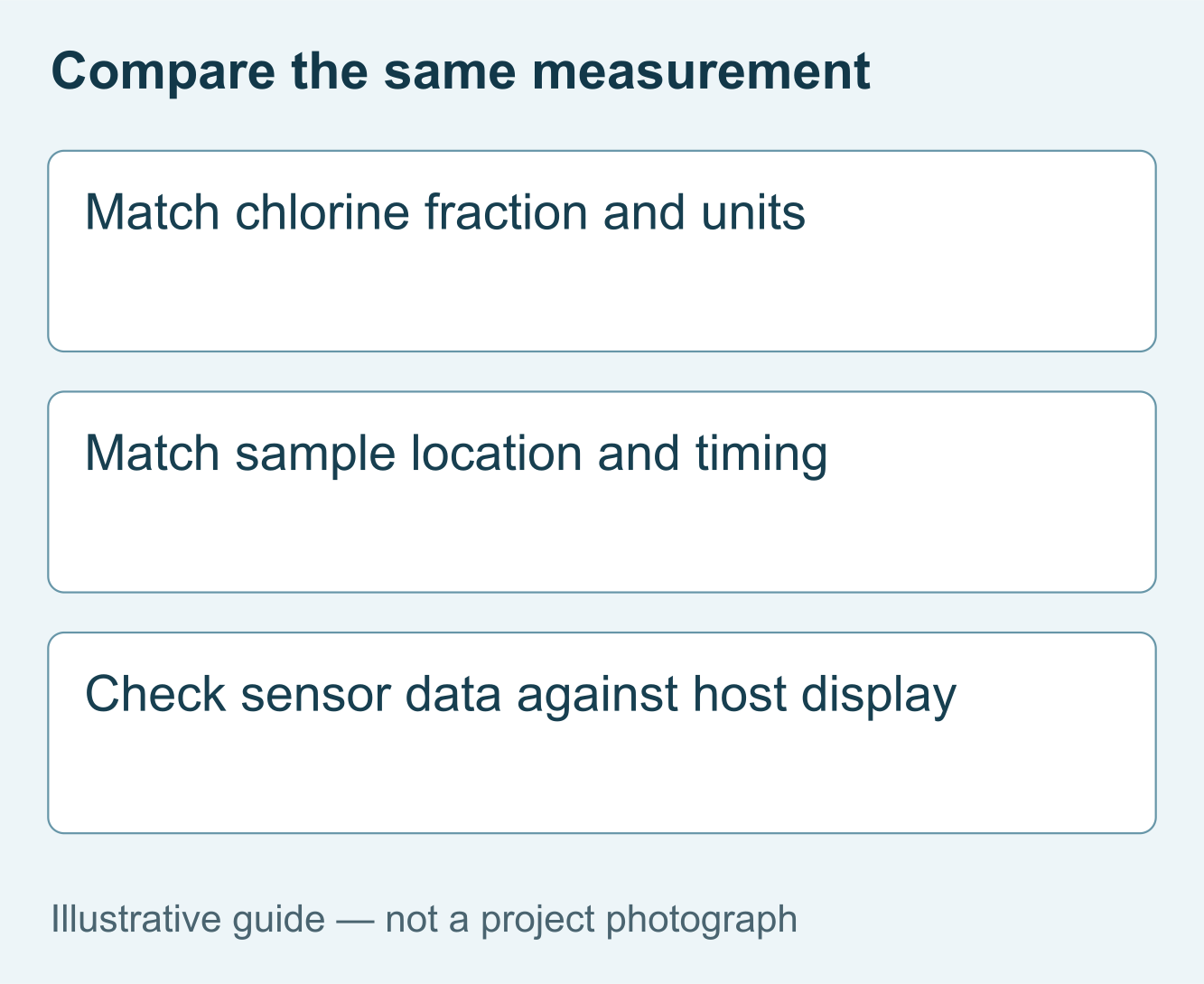
An online value and a handheld result are comparable only when they refer to the same quantity, water and time. Check whether each instrument reports hypochlorous acid, free chlorine or total chlorine. A matching mg/L unit does not make different chlorine fractions equivalent. Record the configured reporting basis alongside the displayed number.
For the YEX-S2-CL-S, the manual expresses its ranges as HClO. Do not relabel that value as total chlorine in a PLC or assume that every free-chlorine reference result should match it directly. Temperature compensation also does not establish automatic correction for every change in sample chemistry or pH.
Separate three observations: the sensor response, the host display and the reference measurement. If the PLC is lower than the sensor response, investigate decoding or analog scaling. If both are lower than the reference, investigate sample delivery, measurement basis and sensor condition. This distinction prevents calibration from concealing a software error.
Use a diagnostic sequence rather than a replacement guess
| Symptom | Next check | Record |
|---|---|---|
| Low value after a pump or valve change | Actual flow through the measuring cell | Flow, valve positions and event time. |
| Online and reference samples disagree | Location, timing and chlorine fraction | Paired samples and method details. |
| PLC lower than instrument response | Units, scale and register interpretation | Raw data and displayed engineering value. |
| Reading changes after cleaning | Deposits and sample-path condition | Before-and-after checks without calibration changes. |
| Low reading follows storage or replacement | Model-specific activation procedure | Preparation record and stabilized comparison. |
Follow the approved response to an unavailable measurement. Do not defeat interlocks or increase dosing to force a normal display. The operating authority decides how the process continues during maintenance.
Change one variable at a time and record the result before proceeding.

Check sample delivery before adjusting calibration
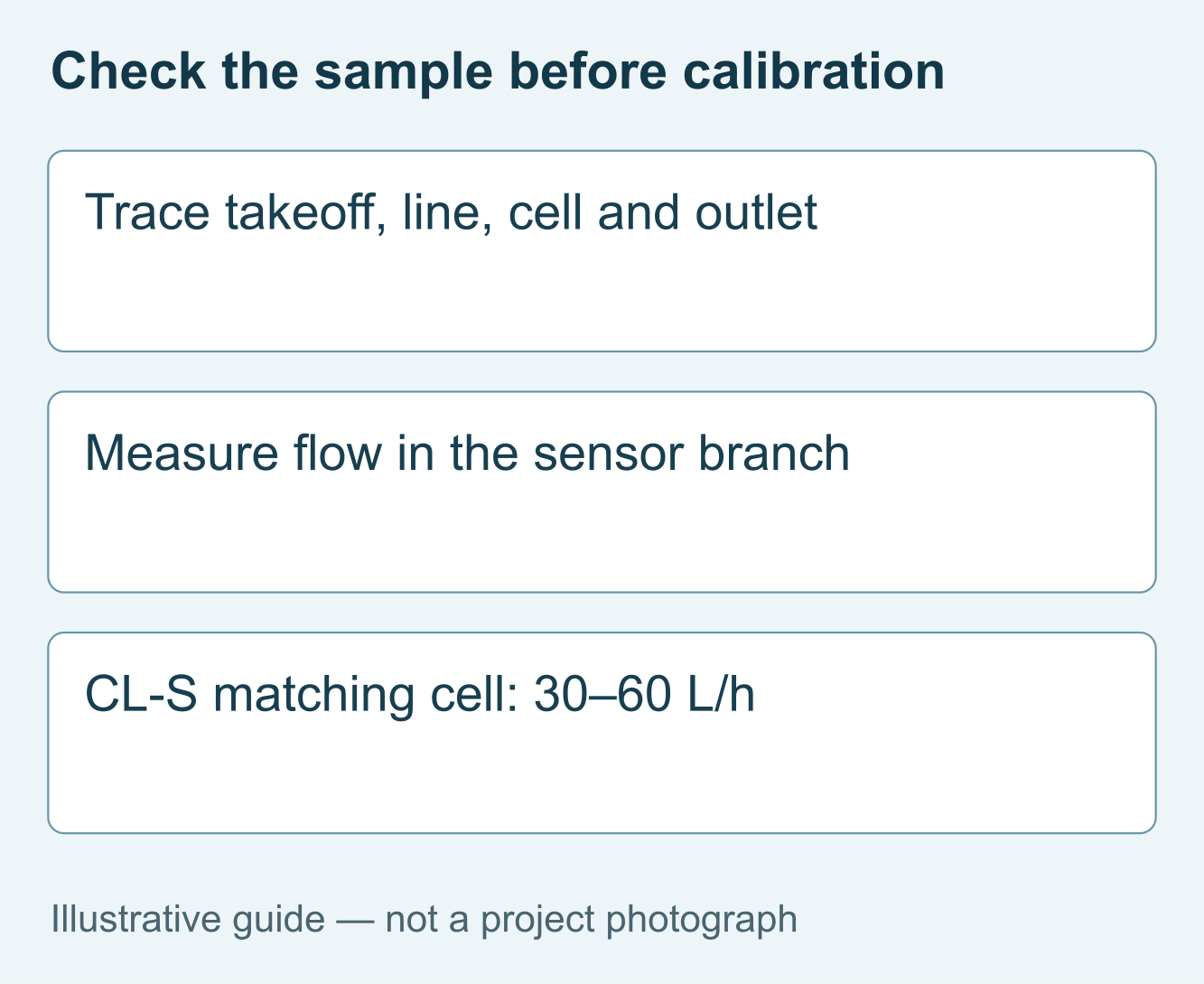
Trace the water from the takeoff to the flow cell and outlet. Look for an isolated valve, blocked line, trapped gas or a changed return pressure. Flow elsewhere in the panel does not prove flow through the measuring chamber. Check the branch containing the sensor, including the outlet and any shared drain arrangement.
The YEX-S2-CL-S manual recommends 30–60 L/h through its matching circulation cell. This is a model-specific installation recommendation, not a universal flow requirement for chlorine sensors. Verify the actual delivered flow rather than treating a valve's position or a pump's running status as measurement evidence.
Sample transport can also change the water before it reaches the electrode. Review long residence times, stagnant sections and reactions along the sample path. Compare with a reference taken at the relevant location and time. A reference collected upstream is not necessarily a valid explanation of what the flow cell receives later.
See the flow-through and immersion comparison for installation selection.
Manual specifications that affect troubleshooting and selection
The YexSensor YEX-S2-CL-S uses constant-voltage measurement with a matching flow cell. Its user manual, pages 4–6, defines specifications, installation and preparation checks.
| Parameter | Manual value | Buyer check |
|---|---|---|
| Range and resolution | 0–2.000 mg/L HClO, 0.001; or 0–20.00 mg/L HClO, 0.01 | Match the ordered range and reporting basis. |
| Detection limit | 0.05 mg/L | Do not infer validated lower-level performance from display decimals. |
| Response | T90 below 90 s | Add sample transport and host update behavior when evaluating delay. |
| Sample conditions | 0–60°C; ≤0.2 MPa; pH 4–9 | Check actual sample conditions, not nominal process labels. |
| Interface | RS485 Modbus RTU; optional 4–20 mA | Test the ordered signal path and its scaling. |
| Supply and power | 12–24 V DC; 0.2 W at 12 V | Verify voltage at the installed device under load. |
| Construction and installation | 316L shell; flow cell; 3/4 NPT; IP68 | Review all wetted components and the complete assembly. |
| Cable and calibration | Supplied 5 m cable; two-point calibration | Plan termination and competent reference preparation. |
The detection limit is not an accuracy guarantee at that concentration. Likewise, T90 is not the total time between a process change and the PLC's response. Select the instrument against the actual operating decision and required uncertainty. A trace-level protective duty may require a different validated measuring arrangement.
Compare cleaning, recalibration and replacement
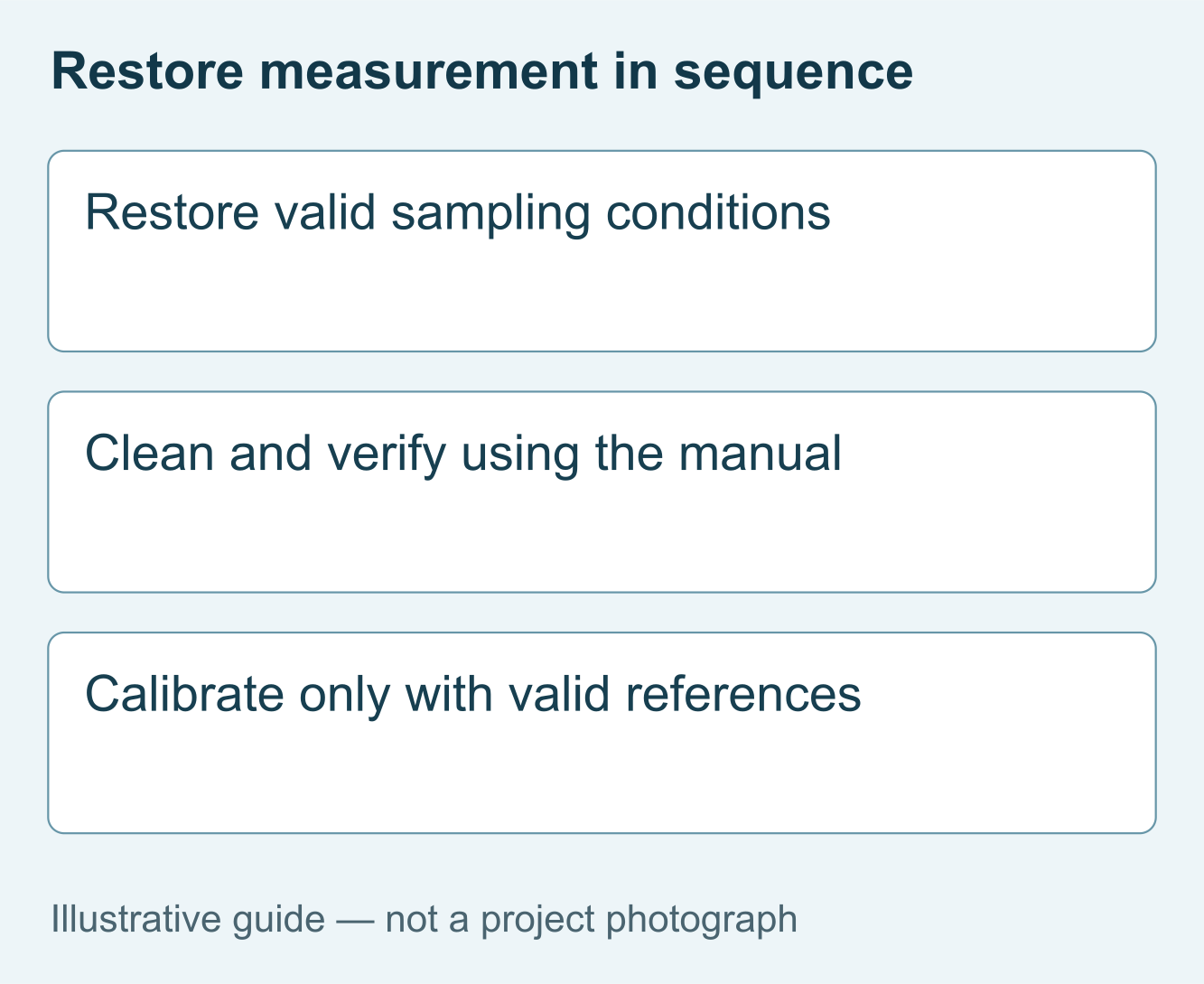
Cleaning addresses contamination; calibration adjusts measurement against suitable references; replacement addresses a failed or unsuitable device. They are not interchangeable remedies. Inspect and restore the sample path first, then follow the model's maintenance instructions and repeat the comparison before deciding that calibration has changed.
For new or long-stored electrodes, the YEX-S2-CL-S manual specifies activation in tap water for 24 hours before use. Record completion of the prescribed preparation. That preparation does not replace subsequent stabilization, valid sampling or the checks required before returning the measurement to an operating control loop.
Perform zero and slope calibration only with appropriate procedures and competent reference preparation. The manual describes chlorine-free water for zero calibration and a suitable HClO reference in the flow cell for slope calibration. Do not treat an unstable process sample or an expired reference reagent as a calibration standard.
If disagreement persists, retain the evidence for technical assessment. Identify the failed component before ordering; do not attempt an undocumented repair.
Three situations equipment integrators should recognize
Reuse-water skid after a maintenance outage
The challenge is a restored electrical connection with an incompletely restored sample path. Check isolation, branch flow and stale data before recalibration. The value is a documented restart that distinguishes a communication success from a valid chlorine measurement and avoids carrying maintenance conditions into normal operation.
Disinfection panel compared with a handheld method
The challenge is an unmatched chlorine fraction or sample timing. Pair the measurements, record pH and temperature, and verify method suitability. The value is a defensible comparison rather than repeated adjustment to a number produced under different conditions. Laboratory agreement must be defined before it becomes an acceptance criterion.
Replacement probe connected to an existing PLC
The challenge is copied scaling, register assumptions or an incorrect output option. Compare the raw response with the configured display and retain the model's register map. The value is avoiding a false low alarm caused by integration. These situations illustrate engineering decisions; they are not claims of measured customer outcomes.
Specify support and acceptance in the purchase scope
Require the exact model, range, cell, output option and reference procedure. Include sample-flow components, cable termination and the division of responsibility for PLC configuration. The RS485 diagnostic guide addresses connection failures; valid communications still require correct units and data interpretation.
During acceptance, check the measurement and invalid-data response separately. Record flow, pH, temperature, reference method, time and displayed values. Confirm the treatment of communication loss and maintenance mode. Agree delivery, spare parts, packaging, warranty diagnosis and commissioning support rather than assuming these are included in a probe-only price.
Project configuration review
For a YEX-S2-CL-S measuring-point review, send the chlorine reporting basis, normal and low readings, comparison method, pH, temperature, pressure, measured cell flow and sample-line layout. Add the host model, output option, quantity and required delivery date. Send Your Project Requirements with the fault record so the proposed solution addresses the cause rather than only replacing hardware.
Frequently asked questions
Q1. What should I check first when a chlorine sensor reading low seems incorrect?
Check actual sample delivery and whether the online and reference measurements report the same chlorine fraction. Then compare the instrument response with the PLC display. A low number alone does not identify a failed electrode. Provide paired readings, flow and method details before requesting replacement, and follow the approved process response while the measurement is uncertain.
Q2. Can low sample flow cause an apparently low result?
It can affect measurements for flow-dependent chlorine arrangements, so verify the requirement for the specific model. The YEX-S2-CL-S manual recommends 30–60 L/h in its matching circulation cell. Measure the relevant branch rather than relying on pump status. Include flow indication and a suitable invalid-sample response when specifying a panel used for operational decisions.
Q3. Why can the DPD result differ from the online reading?
The results may represent different chlorine fractions, sampling times or water conditions. Check the exact DPD procedure and online reporting basis before comparing values. For HClO-based ranges, a free- or total-chlorine result is not automatically equivalent. Procurement should define the comparison method and acceptable uncertainty so commissioning does not depend on forcing unrelated measurements to agree.
Q4. Should I select the lower range for every low-chlorine application?
No. Range and displayed resolution alone do not demonstrate adequate performance at the required decision level. The YEX-S2-CL-S manual states a 0.05 mg/L detection limit. Compare the complete method capability with the actual application, particularly for trace-level protection. Specify the minimum relevant concentration and acceptance requirement before choosing a range or purchasing an instrument.
Q5. Does automatic temperature compensation remove the need to check pH?
No. Temperature compensation does not establish that an instrument corrects every pH-related change or reports every chlorine fraction. The YEX-S2-CL-S manual specifies a pH operating range of 4–9. Record the sample pH and measurement basis during comparisons, and select a documented configuration that matches the chemistry instead of assuming compensation from a generic product description.
Q6. Should I recalibrate whenever the reading drops?
No. First investigate genuine process changes, sample delivery, contamination and host interpretation. Recalibration may hide a sampling fault and create further error once normal flow returns. Follow the model's preparation and reference procedure only after establishing valid conditions. Ask the supplier to review persistent disagreement with the original settings and paired test evidence available.
Q7. What information should accompany a technical support request?
Provide the model, range, output option, cell arrangement, sample flow, pH, temperature and pressure. Include online and reference results with sampling times and methods, plus recent maintenance or process changes. Add a raw transaction or analog scaling record where relevant. This helps the responsible team distinguish measurement problems from installation and integration faults before recommending parts.
Q8. What should be included when buying a replacement measuring point?
Identify the probe, matching cell, mounting, sample-flow components, cable and host configuration responsibilities. Confirm reference checks, commissioning support, delivery, spares and warranty assessment in writing. A new sensor alone will not correct a blocked sample line or a mismatched chlorine fraction. Quote the complete corrective scope rather than assuming every low-reading case requires identical hardware.
Q9. Is a stable reading sufficient to return the channel to automatic service?
No. Stagnant water or a retained host value can also appear stable. Verify representative flow, current data and a suitable reference comparison, then follow the authorized release procedure. Record the accepted settings and fault-response tests. The operating authority should approve restoration of automatic control; a stable display by itself is not evidence of a valid measurement.
Summary
Investigate low chlorine readings by separating the sample, measured quantity, sensor condition and host interpretation. For YEX-S2-CL-S, use the manual's HClO ranges, flow-cell recommendation and operating limits to define a valid test, without treating resolution as proof of trace-level capability. Restore sampling before calibration, compare compatible reference measurements and retain fault evidence. A useful inquiry includes the reporting basis, sample conditions, cell layout and integration details, allowing YexSensor and the integrator to assess whether maintenance, configuration changes or replacement is appropriate.


