


 Chinese
 Spanish
 French
 Russian
 German
 Portuguese
 Indonesian
 Thai
 Vietnamese
 Arabic


Reservoir intake depth monitoring should compare active and candidate openings at surveyed elevations during the same operating window. Use paired fixed probes when conditions change during a traverse. With a movable probe, revisit the first elevation before deciding. A downstream sample taken after the switch answers a separate question about delivered water.

Why elevation and time belong together
A cable mark gives a distance below its support. It does not automatically identify a gate elevation. As the water level changes, a probe suspended from a floating platform may move relative to the opening. A second error arises if the deep point is read in the morning and the shallow point in the afternoon. The apparent depth difference then includes a change in time.
Which specifications matter for reservoir intake depth monitoring?
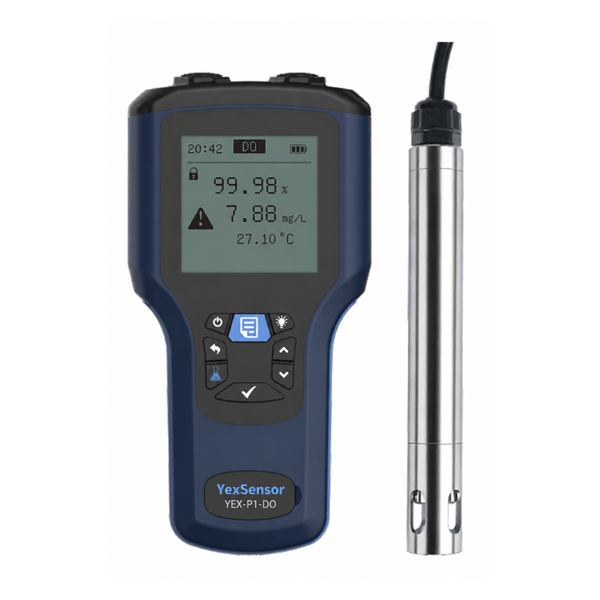
An oxygen reading is a point observation, so location and time are part of the result. A depth below the surface is not automatically a gate elevation, and a moved probe does not provide simultaneous data. The YEX-S1-RDO can supply an optical oxygen channel, while civil positioning, retrieval and the treatment decision require their own evidence.
| Parameter | YEX-S1-RDO | Engineering and purchase implication |
|---|---|---|
| Principle | Fluorescence quenching | The oxygen result belongs to water at the optical surface and its measurement conditions. |
| Range | 0–20.00 mg/L | Confirm required performance at the operating and alarm points. |
| Output | RS485 Modbus RTU | Verify channel identity and the delivered data interpretation with the host. |
| Supply | 12–24 V DC | Include power and cable arrangements in the package. |
| Protection / mounting | IP68 / immersion, NPT 3/4 | Obtain assembly-specific submergence and support limits before finalizing deployment. |
These model-specific values come from the YEX-S1-RDO official product page. Review the delivered configuration and its documents against the proposed installation.

Reservoir oxygen monitoring: fixed stations or a depth profile?
| Option | What it provides | What to specify |
|---|---|---|
| Two fixed DO stations | Compare two elevations at the same time | Obtain mounting and cable drawings for each gate and a separate channel identifier for each elevation. |
| One profiling probe | Survey several elevations during a visit | Record the time and settling criterion at each stop. Select this approach when the gate decision can wait for the survey. |
| Conduit sample after switching | Check the water delivered to treatment | Record gate position, flow and sample transport delay. This point cannot reconstruct the earlier vertical profile. |
Choose fixed points where the operator needs a simultaneous gate comparison. Use profiling when a staffed survey fits the decision window. Keep the downstream conduit check in both plans: a point beside an intake describes that location, while the delivered water also depends on the active opening and withdrawal conditions.
Intake gate elevations, profiling time and seasonal levels
Work from the opening back to the suspension point
Suppose the water surface is at 110 m and the gate centre is at 100 m on the same datum. The head belongs 10 m below the surface. After a 2 m drawdown it belongs 8 m below the surface. A head left hanging 10 m below a float now measures 2 m below the intended elevation. Use the vertical distance to the sensing face and account for freeboard and cable angle before marking the suspension line.
The elevation of the oxygen probe locates one observation. Water entering the gate can come from a thicker layer. The thickness depends on the withdrawal rate, stratification and intake geometry. A profile taken with one pump running may therefore predict delivered water poorly after a second pump starts. US Bureau of Reclamation, withdrawal layer considerations.
| Decision | Evidence available | Operator action |
|---|---|---|
| Compare openings | Known head elevations, comparable times and stable pump duty. The observed difference exceeds the uncertainty of the comparison. | Assess the candidate against the treatment objective and the other required water-quality parameters. |
| Repeat the profile | The return reading at the active gate shifts by roughly the apparent difference between gates, or pump duty changes mid-survey. | Hold the switching decision. Repeat under steady duty or compare synchronized fixed stations. |
| Verify the switch | The gate has moved and sufficient time has elapsed for new water to reach the conduit sampling point. | Compare the delivered sample with the expected change. Record actual flow, gate position and sample time with the result. |
A floating support follows seasonal water-level change
The probe may remain at a constant distance below the surface while moving relative to the gate. Record water level and survey datum with the channel position. Use a tower-fixed support where a fixed elevation is essential, subject to the approved mounting and retrieval design.
A gate change is needed during a staffed survey
A profile can support the comparison if the operating conditions remain sufficiently stable while depths are visited. Log each stopping position, time and settling criterion. If the decision window demands concurrent values, specify fixed channels at the relevant elevations and retain profiling as a periodic check.
Commission intake switching verification and retrieval
Carry a unique identifier from civil gate and probe elevation through cable, powered sensor and Modbus logger. The 12–24 V DC sensor signal must be interpreted with the delivered communication documents. Store water level, gate state and pump operation with the observations. A gateway provides any required remote transmission; it does not infer the water source unless the gate and location information are included.
Use the same elevation datum on the civil drawing, the instrumentation schedule and the operator display. Record whether the probe is supported from the tower or a float. Route cables away from moving gates, allow retrieval for cleaning and obtain written pressure and cable-length limits for the delivered assembly. Verify channel identity by lifting or testing one probe at a time during a maintenance window.
During the switching trial, record the time, active gate, gate opening, reservoir level and pump state. Keep the pre-switch profile intact in the historian. Estimate when changed water could first reach the sampling tap from the actual route and flow, then test that estimate in the field. Flag readings from a probe in air or in transit so they cannot be interpreted as a water-layer event.

Time the delivered-water check from the gate movement and any intervening change in withdrawal rate. A conduit sample taken at the instant of switching can still contain water admitted through the previous opening. Estimate transit from the occupied volume and actual withdrawal flow, account for mixing, and retain the switch and sample times separately. If the delivered change differs from the near-gate observation after turnover, review the withdrawal zone and concurrent gate positions before attributing the difference to probe drift.
RFQ scope for reservoir probe retrieval and deployment
- Gate elevations and drawing datum
- Seasonal water levels
- Minimum and maximum deployed depths
- Retrieval method
- Gate switching sequence
- Target parameters
- Cable route and logger
- Conduit sample location and travel time
The principal installation costs can include cable routing, civil access and safe retrieval as well as sensor quantity. Provide seasonal levels and proposed deployment limits before asking for a final configuration. Obtain written submergence, pressure and assembly limits for the delivered probe and cable. Require a marked-up drawing and an acceptance timetable that identifies who supplies the downstream verification data.
Project inputs for a configuration review
Include these project inputs when requesting the YEX-S1-RDO.
- Gate elevations, reference datum, seasonal levels and switching timetable
- Required parameter set and deployment depth with retrieval constraints
- Time-synchronized station records and the downstream verification procedure
Frequently asked questions
Q1. Which elevation reference should reservoir intake depth monitoring use?
A1. Use the surveyed datum shared by the gate elevations and water-level record. A probe hanging from a float moves vertically as the reservoir level changes, while a tower-mounted gate stays at its surveyed elevation. Record the reference point, water level and probe location with each survey. Ask the integrator to reconcile civil drawings, instrument tags and the operator display before approving the depth schedule.
Q2. Does low dissolved oxygen identify the cause of a water-quality problem?
A2. Dissolved oxygen describes one condition at a particular point and time. It cannot identify a specific contaminant or establish all treatment consequences of selecting that layer. Use the oxygen profile alongside the parameters and analyses required by the treatment objective. The RFQ should state which decision each parameter supports and identify the separate checks needed before a gate change is authorized.
Q3. When should the downstream sample be taken after switching gates?
A3. Take the verification sample after water from the changed intake can reach the actual sampling point, then confirm the timing in the field. Gate flow, pump operation and the route’s retained volume affect that arrival. Keep timestamps and pre-switch data so the observations remain interpretable. Require the supplier’s commissioning procedure to show how sample transport is established under the intended operating conditions.
Q4. Should every intake opening have its own fixed DO sensor?
A4. Provide separate fixed channels where simultaneous comparisons are needed within the operator’s decision window. A periodic profile may be adequate for infrequently used openings when conditions change slowly enough. Consider cleaning access and retrieval cost as well as instrument count. Ask bidders to show which gate choices their arrangement can support immediately and which require a staffed survey before a decision.
Q5. Can one multiparameter probe represent several elevations?
A5. An integrated probe can measure several parameters at its current location, but it does not provide simultaneous measurements at different depths. Moving it creates a time sequence that must include position and settling records. Choose fixed stations, profiling or a combination according to the switching timetable. Quote the deployment and data-registration arrangement explicitly, including how invalid measurements during movement are flagged.
Q6. How should autumn cooling or seasonal drawdown change the plan?
A6. Repeat the relevant depth comparison when local water temperatures, levels or withdrawal conditions change. If the two intake elevations now give similar oxygen readings within the field comparison uncertainty, oxygen alone offers little support for choosing between them. Continue checking the other treatment objectives. Give the supplier local operating records and seasonal level limits so the survey window reflects the reservoir rather than a generic calendar.
Q7. What civil and deployment information is needed before procurement?
A7. Provide as-built gate elevations, the reference datum, seasonal water levels, fixing points, gate movement and safe cable and retrieval routes. Obtain written submergence, pressure and cable-assembly limits for the proposed installation; IP68 alone does not define deployment depth. Assign responsibility for reconciling the civil and instrument drawings before fabrication. Include the cleaning method and require the supplier to identify unresolved limits before the installation configuration is approved.
Q8. What does a useful site acceptance test include?
A8. Verify each channel’s identity against its physical elevation, confirm timestamps and witness a gate change with a downstream check. Record water level, gate position, pumping and the times of sample collection. Test the display during probe retrieval and communication loss. The owner should accept the connection between a particular reading and a particular water source, rather than merely accepting that the logger displays changing numbers.
Summary
Use fixed channels for simultaneous gate comparisons and profiling for surveys that fit the decision timetable. Confirm the YEX-S1-RDO deployment limits and tie each channel to an elevation. Include local water levels, operating states, cable and retrieval drawings, and a timed conduit check in the RFQ before treating a depth profile as a switching decision.


