Chinese
 Spanish
 French
 Russian
 German
 Portuguese
 Indonesian
 Thai
Thai Vietnamese
 Arabic

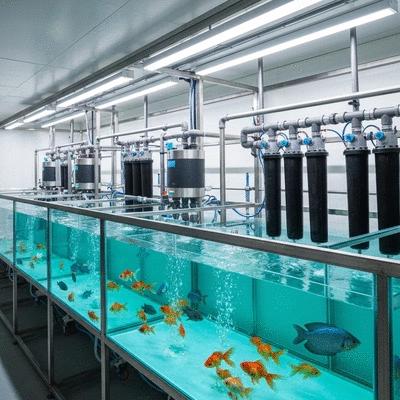
Choose Sensors Around the Production Risk
Intensive fish farming sensors provide continuous readings for selected water quality parameters in high-density tanks and recirculating aquaculture systems (RAS). Dissolved oxygen and ammonium are a focused starting point for assessing oxygen availability and nitrogen loading; pH, temperature and turbidity add context when their readings support a defined operating decision.
The monitoring plan should follow the species, life stage, biomass, feeding schedule and treatment arrangement. Use site-specific operating targets and response procedures. A probe measures one parameter at its installation point, so the farm team needs a clear method for interpreting the value and checking an abnormal trend.
Parameter Priorities Under High Feeding Loads
Fish respiration and biological treatment both contribute to oxygen demand in a recirculating system. Feeding and production records help explain the timing of water-quality changes. Review sensor trends alongside the oxygen-supply state, water circulation, feed events and maintenance records.
| Parameter | Operating question it supports | Selection requirement |
|---|---|---|
| Dissolved oxygen (DO) | Follow oxygen availability through feeding periods and changes in oxygen supply or circulation. | Define targets for the species and life stage, with a representative point and the required working range. |
| Ammonium / nitrogen channel | Track a documented nitrogen result during changes in feed loading or biofilter operation. | Confirm the chemical form, unit, low-range performance and reference method. |
| pH and temperature | Interpret water-chemistry changes and the ammonia–ammonium balance. | Use relevant water conditions; verify compensation and the channels supplied. |
| Turbidity | Investigate changes in optical water clarity and solids-removal operation. | Establish a site baseline; NTU does not directly measure ammonia or feed mass. |
Interpret Ammonium with pH and Temperature
Ammonium (NH4+) and un-ionized ammonia (NH3) are different forms whose balance depends on pH and temperature. An ammonium result alone does not state the NH3 concentration or the complete risk to fish. Record whether the nitrogen channel reports NH4+, NH4-N, total ammonia nitrogen or a compensated NH3 result, and retain the corresponding unit.
For an ammonium ISE, select the working range around the expected concentrations and the intended alarm decision. Confirm accuracy at the low end, calibration requirements and interfering-ion conditions. Display resolution alone does not establish the accuracy needed to identify a small but important change.
If the controller derives an NH3 value, confirm the input chemical form, unit conversion, pH and temperature data, and the calculation used. Label measured and calculated results clearly. Verification should use the agreed reference method and samples representing the same water conditions.
Use Turbidity as Process Context
A turbidity trend can prompt an inspection of solids removal or a change in water clarity. Interpret it with feeding records, filtration activity and the culture system’s normal conditions. Bubbles and fouling can also change an optical reading, so check the probe and sample point before assigning a cause.
Turbidity in NTU is a different quantity from a suspended-solids concentration. Use a documented site relationship if the application requires a concentration estimate. The TSS and turbidity selection guide explains this measurement distinction.
Connect Trends to a Defined Inspection
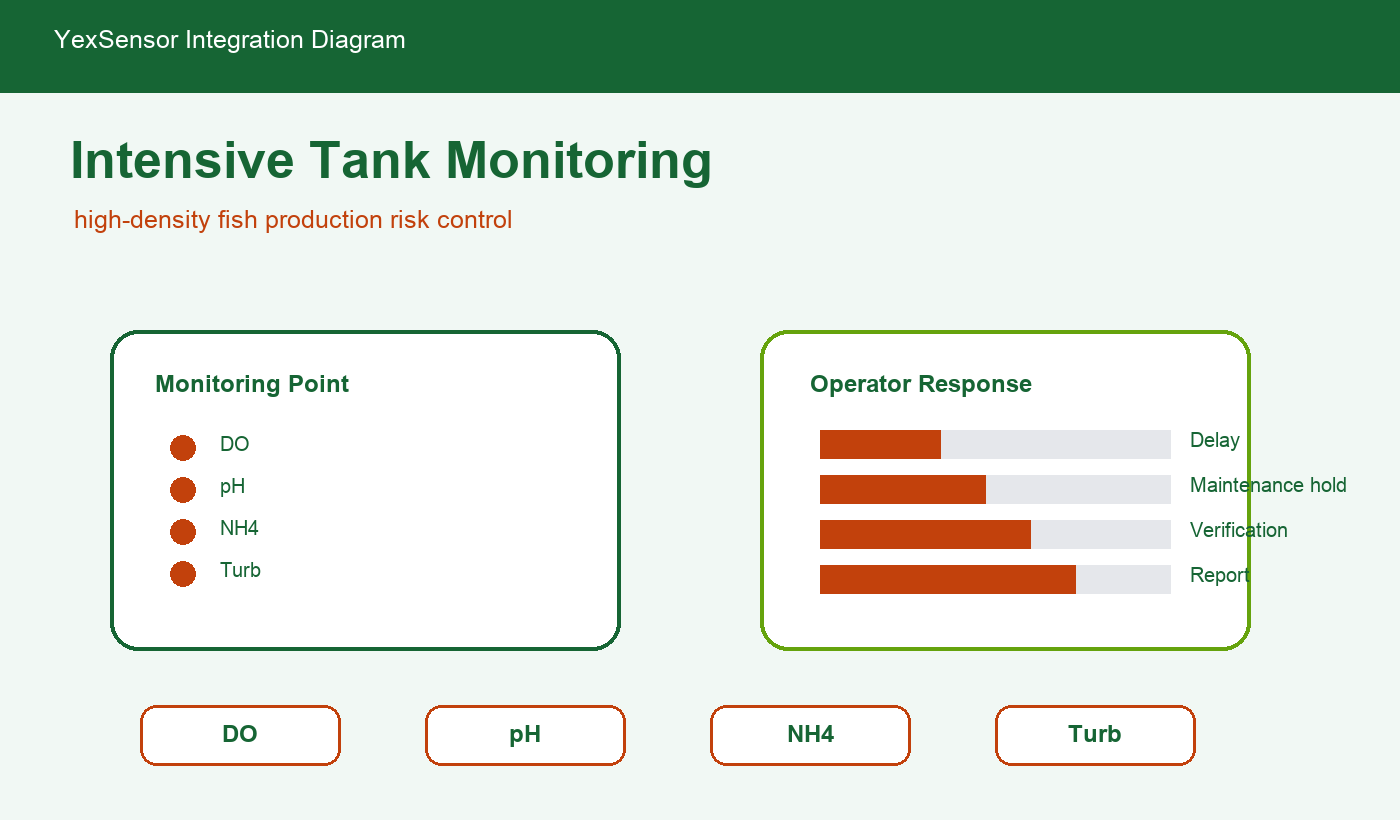
The illustration summarises monitoring channels and operator-response considerations. Set the actual alarm limits, delays and maintenance behavior for the farm’s operating plan.
| Observed trend | Data to review together | First inspection to define |
|---|---|---|
| DO falls around a feeding period | DO, temperature, feed time, oxygen-supply and circulation status. | Check oxygen delivery, water movement and the probe condition against the farm’s response procedure. |
| The nitrogen channel rises | Reported nitrogen form and unit, pH, temperature, feed events and biofilter operation. | Verify the reading and review treatment conditions before attributing the rise to a single cause. |
| pH changes after water exchange or dosing | pH trend, source-water change, temperature and available reference or alkalinity checks. | Confirm the value and inspect the water change or dosing event with the responsible operator. |
| Turbidity rises | NTU trend, filter operation, feeding, bubbles and cleaning history. | Inspect solids removal and the optical measurement point; compare with the normal site baseline. |
YexSensor Models for the Selected Parameters
The following models are measurement options for the selected channels. Confirm the current model configuration, performance at the intended working concentrations and maintenance requirements before choosing a package.
| Sensor to review | Measurement and interface | Selection point |
|---|---|---|
YEX-S1-RDO Optical Dissolved Oxygen Sensor | Optical DO measurement with RS485 Modbus integration. | Match the working range and response to the tank alarm plan; include access for cleaning and cap service. |
YEX-S1-NHN Online Ammonium Nitrogen Sensor | Ammonium ion-selective electrode (ISE) measurement with RS485 Modbus. | Confirm the reported chemical form and units. Check low-range accuracy, calibration and interference requirements for the water. |
YEX-S1-PH Industrial Online pH Sensor | pH measurement with RS485 Modbus output. | Keep reference checks and electrode maintenance in the operating plan. pH is a separate measurement from alkalinity. |
YEX-S1-TS Online Turbidity Sensor | Optical turbidity measurement with RS485 Modbus output. | Use the expected NTU range and a representative point. Review bubbles, optical fouling and water changes when the trend shifts. |
Verify the Data Before Using It for Control
Compare the field result with the controller or PLC value, including chemical form, engineering unit and scaling. Confirm the communication settings and register map for the supplied models without reusing settings from another sensor. Identify a communication fault separately from a normal water-quality reading.
Use sensor outputs through a compatible controller, PLC or data logger. Remote 4G, Ethernet or cloud access requires the corresponding gateway or data-logging equipment. Automatic equipment action also requires suitable control outputs, fault handling and a tested operating procedure.
Keep cleaning, calibration, sensor removal and reference checks visible in the trend history. Record the tank or circuit, feeding event and equipment state when investigating a change. The indoor aquaculture monitoring system guide covers controller and package planning, while the tank sensor placement guide covers physical measurement locations.
Frequently Asked Questions
Which parameters should be prioritised in intensive fish farming?
Choose parameters around the farm’s operating risks and response plan. DO and a clearly defined nitrogen channel can support oxygen and biofilter-related checks; pH and temperature help interpret water chemistry. Add turbidity when changes in water clarity or solids removal affect a real decision.
Why should readings be reviewed around feeding times?
Feed events provide context for production-related oxygen and nitrogen trends. Record their timing together with oxygen supply, circulation and treatment operation. A coincident change is a reason to investigate, rather than proof that feeding caused the reading.
Can an ammonium ISE report the ammonia toxicity risk directly?
Interpret the ammonium channel using its documented chemical form and unit. NH3 interpretation depends on pH and temperature. Any calculated NH3 result needs a verified calculation and suitable input data, and should be labelled separately from the measured channel.
What matters when selecting a low-range ammonium sensor?
Check accuracy at the expected working concentration, useful resolution, calibration and interfering-ion conditions. Agree on a reference check and the alarm decision the reading must support. A narrow range alone does not establish suitability.
Does a rising turbidity value show that ammonia is rising?
Turbidity measures an optical water-clarity property. It is not an ammonia concentration. Review the nitrogen channel separately and inspect filtration, bubbles and probe fouling when a turbidity trend changes.
What alarm limits should the controller use?
Set limits with the farm team for the species, life stage and operating conditions. Define the response, delay, reset behavior and handling of sensor or communication faults. Test the logic safely during commissioning.
Can one common-return measurement represent every fish tank?
A common-return reading describes that point in the water circuit. Differences in tank loading, mixing and oxygen supply may require additional measurements. Use site comparisons and the consequences of a missed alarm to decide the point count.
What information is needed for a sensor quotation?
Provide species and production stage, tank and water-circuit details, expected parameter ranges, nitrogen reporting units, required output, existing controller, mounting conditions, cable lengths, quantity and delivery country. Include the planned reference checks and maintenance access.
Prepare a Monitoring Specification
Send the production conditions and the decisions each channel should support. For nitrogen monitoring, specify the required chemical form, unit and working concentration. Identify local and remote monitoring requirements, then request a quotation that separates sensors, mounting parts, controller functions and service materials.
Additional checks for alkalinity, nitrite or carbon dioxide may be needed under the farm’s monitoring plan. Include those requirements explicitly when discussing the scope of an intensive aquaculture project.