


 Chinese
 Spanish
 French
 Russian
 German
 Portuguese
 Indonesian
 Thai
 Vietnamese
 Arabic


TSS sensor calibration should connect representative online readings with laboratory results from the same water and time. For wastewater integrators, a factory configuration is only the starting point. Define the sample pairing, operating range and acceptance method before buying a sensor or promising agreement across changing solids conditions.
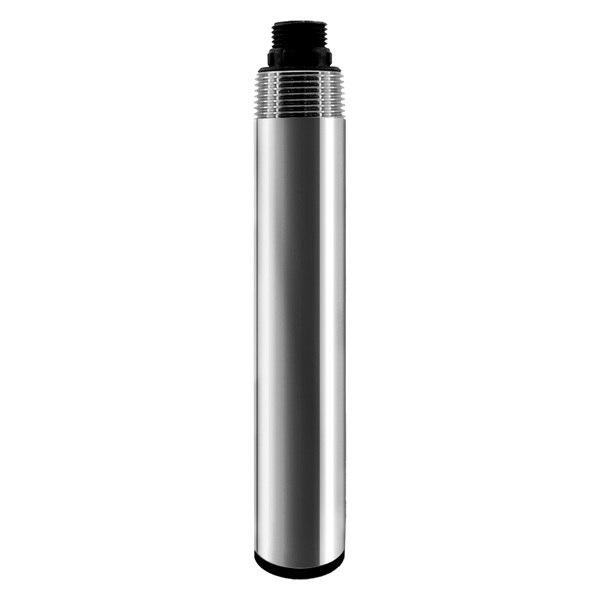
Define TSS sensor calibration as a project deliverable
An optical suspended-solids sensor responds to how particles interact with light. A gravimetric laboratory method determines retained solids mass using a defined procedure. The online result can be useful for continuous operation, but the relationship depends on the actual water and particles.
For an equipment supplier, calibration and acceptance therefore need a scope, not just a checkbox marked complete. State whether the channel supports a process trend, operational warning or a specific quantitative decision. Different uses can justify different performance expectations.
Do not promise that one calibration transfers unchanged between unrelated streams. Changes in particle size, composition or color may affect the relationship. Establish the conditions under which the accepted configuration remains valid and the events that trigger a new comparison.
Pair samples with the water actually seen by the probe
Take the reference sample as close as practical to the representative measurement location and record the corresponding online value. Account for transport delay if the sensor is in a bypass. A grab sample upstream of a long line may not describe the water reaching the probe at that timestamp.
Follow the chosen laboratory sampling and handling method. Settling or poor mixing can make sample portions unrepresentative. Agree responsibilities with the laboratory; preservation and holding times are method-specific.
Record location, operating state, time, probe cleanliness and unusual bubbles or debris. Fitting cannot repair a mismatch between sampled and measured water.
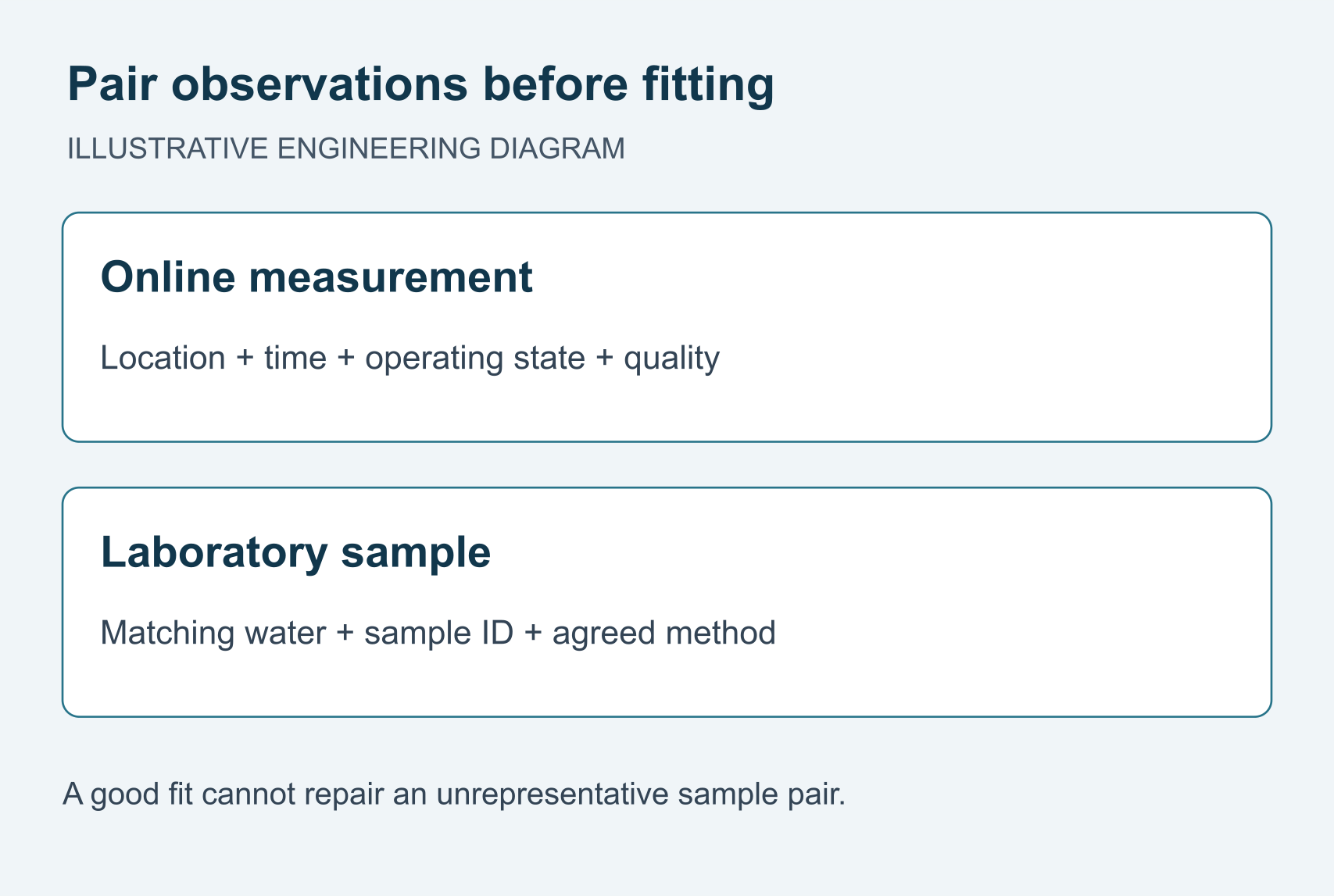
Shortlist the model against the actual requirement
All three listed TSS models have a documented standard span of 0–2000 mg/L. A series change alone does not extend it.
| Need | Candidate | Boundary |
|---|---|---|
| RS485 with compatible POM/ABS | S1-TSS | Verify the two-point calibration procedure and actual chemistry. |
| Compatible non-seawater installation | S1PRO-TSS | Evaluate its specific housing and interface configuration. |
| Optional analog interface required | S2-TSS-S | Confirm the option and exact matching manual. |
| Higher solids or marine exposure | Separately confirmed configuration | Do not infer capability from any series label. |
The specification table below applies only to S1PRO-TSS. Do not transfer its accuracy to the other candidates. Keep S2-TSS-S separate from the differently named TSS-8S documentation.
| Parameter | Documented specification | Procurement check |
|---|---|---|
| Standard range | 0–2000.0 mg/L; customization listed | Confirm an alternative range in writing if the duty exceeds this span. |
| Accuracy | ±5% of reading | Clarify test conditions; agree field comparison criteria separately. |
| Response | 15 s published | Confirm convention and match sample timestamps to system delay. |
| Supply and consumption | 12–24 V DC; approximately 0.4 W | Include logger, telemetry and accessories in the power budget. |
| Output | RS485 Modbus RTU or optional 4–20 mA | Specify one ordered version and verify host scaling. |
| Housing and protection | 316L + ABS; IP68 | Check the stream and cleaning chemistry for compatibility. |
| Mounting and cable | Immersion; NPT 3/4; 5 m shielded four-core cable | Confirm jacket specification and representative installation. |
| Operating limits | 0–50°C, nonfreezing; pressure <0.2 MPa | Evaluate maximum service exposure before field trials. |
Review S1-TSS for compatible RS485 applications.
Review the S2-TSS-S alternative and request its matching manual.
Specification source: YEX-S1PRO-TSS official product page. Confirm the current ordered configuration and manual before purchase.
Design a sampling campaign that can support acceptance
Collect pairs across the operating conditions relevant to the decision. A cluster of similar samples cannot establish excursion performance; do not create unsafe conditions just to widen the dataset.
| Record | Why it matters | Acceptance use |
|---|---|---|
| Sample ID, time and location | Connects the laboratory result with the measured water. | Reject unmatched pairs before fitting. |
| Process state and sample delay | Distinguishes stable operation from transitions. | Review transition samples separately. |
| Cleaning and quality status | Prevents maintenance readings entering the dataset. | Exclude invalid observations with recorded reasons. |
| Online and reference values | Allows error to be reviewed across the range. | Assess bias near the action level. |
| Adjustment or validation designation | Separates fitting from subsequent checking. | Use independent validation where practical. |
Agree sample count, laboratory responsibilities and tolerances beforehand. Preserve excluded pairs and reasons for review.
Use a sample comparison record, not only a correlation score
Record sample ID, location, collection time, process state, online value, laboratory result, method and any maintenance event for each pair. Keep transition samples identifiable rather than mixing them silently with stable observations.
Calculate the difference as online minus laboratory result in mg/L. Relative difference is that difference divided by the laboratory result, multiplied by 100%; do not use it at zero. For example, illustrative values of 110 and 100 mg/L differ by +10 mg/L and +10%. This is arithmetic, not a product performance claim or acceptance tolerance.
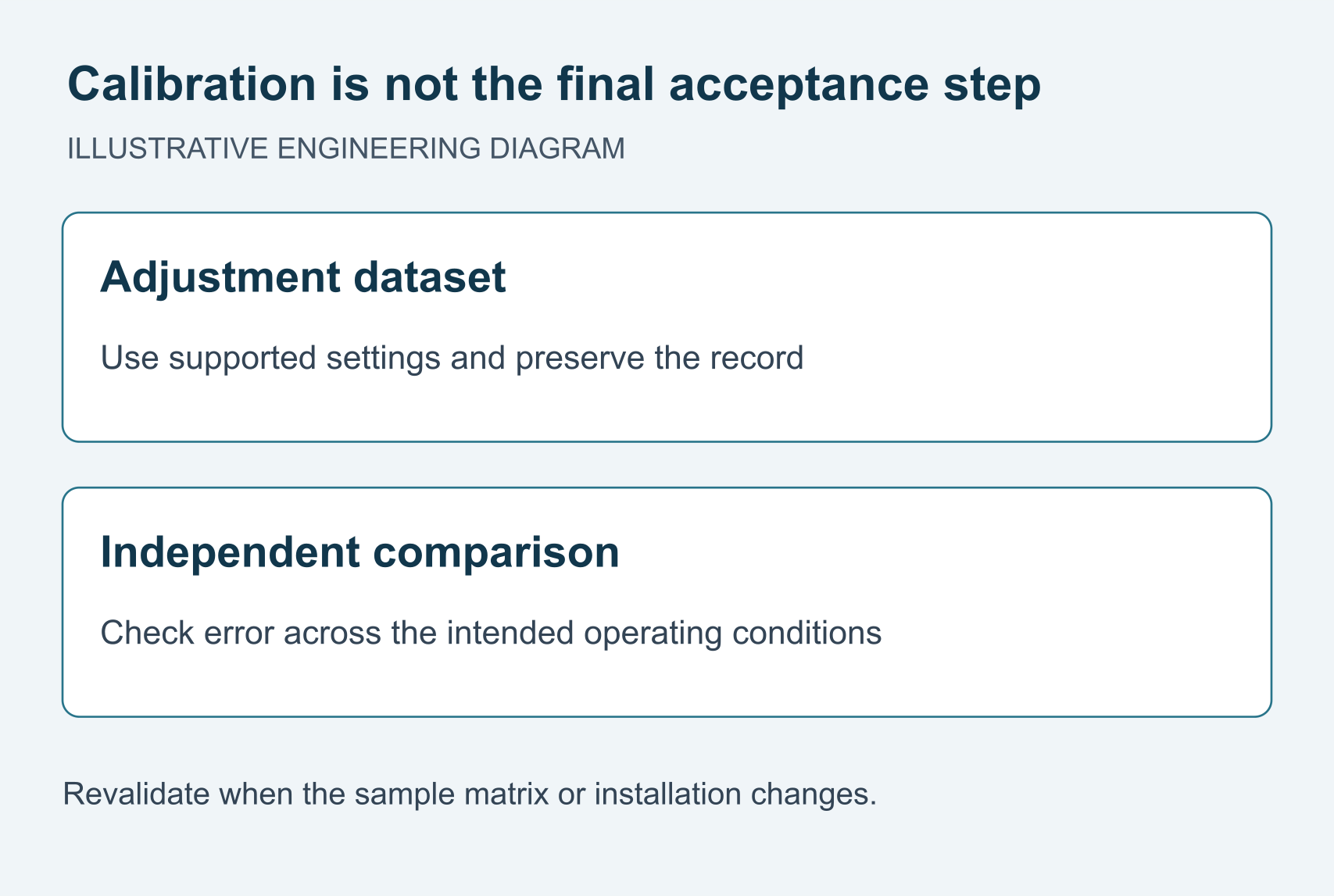
Review error around the action level and across the intended range. A strong correlation can coexist with bias. Agree the tolerance and independent validation samples before adjustment; apply only the routine supported by the matching manual.
Three applications need different acceptance boundaries
These are illustrative project arrangements, not reported installations. At a clarifier outlet, low solids and short carryover events may both matter. The integrator should review low-level capability and transient handling rather than relying only on mid-range samples. The value is a clearly bounded warning channel.
In industrial reuse pretreatment, changes in production can change particle characteristics. Pair comparisons with the relevant production states and define when a new matrix requires review. This helps prevent an old relationship from being carried into a different stream unnoticed.
For a packaged wastewater skid serving variable influent, the equipment builder should define the range and conditions it can support. Do not apply the standard range automatically to concentrated sludge or MLSS duties. Request a suitable documented configuration when the expected solids exceed the proposed instrument’s limits.
Integrate measurement, maintenance and sample records
For RS485 Modbus RTU, obtain the current map and verify the measurement register, type, scale and units. A host may label a value correctly while scaling it incorrectly. Compare the device reading and engineering value before analyzing laboratory agreement.
The YEX-S1PRO-TSS page offers digital or optional analog output as a selection. Confirm the ordered interface. For an analog version, document the configured span at both ends and the host behavior for unavailable data; do not invent diagnostic currents.
Store a maintenance flag with the time series. Readings during cleaning or removal should not enter the calibration dataset as normal process observations. Include time synchronization and sample identifiers in the handover so laboratory results can be matched to the correct online interval later.
Specify commissioning support and revalidation triggers
A useful quotation separates hardware from field validation. Clarify who collects samples, pays for laboratory analysis, reviews comparisons and authorizes configuration changes. Include brackets, any bypass arrangement, cables, cleaning accessories and the documentation needed by the host-system supplier.
Define revalidation triggers such as relocation, significant process changes, replacement sensing components or persistent comparison drift. A calendar check can supplement these triggers, but the interval should reflect field experience and the consequences of an incorrect decision.
Use an agreed laboratory procedure as the reference. EPA Method 160.2 describes a gravimetric suspended-solids method; citing it does not make an optical sensor a compliant laboratory substitute. Where reporting obligations apply, the project team must confirm the accepted method independently of the control system’s operational trend.
Technical references
Review the measurement package
Share the concentration range, particle conditions, interface and laboratory method. Request a comparison of S1, S1PRO and S2 against the same duty, including field-validation responsibilities, quantity and installation requirements.
S1-TSS · S1PRO-TSS · S2-TSS-S. Send Your Project Requirements.
Frequently Asked Questions
Q1. Does TSS sensor calibration require wastewater samples?
Representative samples are needed when the project requires a field relationship between the optical reading and laboratory suspended-solids results. Factory settings alone do not demonstrate that relationship for every matrix. Define the sample location, method and operating conditions with the supplier and laboratory before committing to a quantitative acceptance promise for the installed channel.
Q2. Why can an optical sensor disagree with a laboratory result?
The methods measure different underlying properties, and the sample pair may also be unrepresentative. Particle characteristics, settling, bubbles, surface contamination and timing differences can affect agreement. Review those factors before changing settings. Ask the commissioning team to document sample handling and host scaling so a calibration adjustment does not conceal a sampling or integration problem.
Q3. Is a high R-squared value enough to pass acceptance?
No. Correlation can be strong while bias or error near the action level remains unacceptable. Review paired differences across the intended range and use independent checks where practical. Agree suitable absolute or relative criteria with the project team before testing, including how low laboratory values and uncertainty will be treated in the acceptance decision.
Q4. When is a different TSS range necessary?
Choose a different documented range when normal operation or credible excursions exceed the proposed span, rather than assuming a series upgrade extends coverage. Check low-level performance as well as the maximum. Give the supplier representative concentration data and particle conditions, then require a matching specification and a field-validation plan for the selected model.
Q5. When should an integrator choose S1-TSS?
Consider S1-TSS when the required concentration stays within its documented 0–2000 mg/L span, RS485 suits the host and its POM/ABS wetted components are compatible with the stream. Confirm the two-point calibration procedure and validate representative samples. Compare other configurations for a demonstrated interface or material requirement, not because their series designation sounds more advanced.
Q6. Should I select TSS or turbidity for this decision?
Choose according to the required result and demonstrated application. TSS reporting concerns suspended-solids mass under a defined method, while turbidity describes an optical property. An online optical TSS channel needs a validated relationship for its intended use. Specify the decision and reference method first, rather than treating NTU and mg/L as universally interchangeable units.
Q7. Who should be responsible for calibration during commissioning?
Assign responsibilities explicitly among the supplier, integrator, operator and laboratory. Identify who samples, analyzes, reviews data, approves changes and signs acceptance. Include the cost and schedule of that work in the quotation. This prevents a hardware delivery from being mistaken for a completed field-validation service and gives each party a defined handover obligation.
Q8. What must a commissioning quotation say about laboratory work?
State who collects samples, selects the reference method, pays for analysis and reviews the paired data. Identify whether repeat sampling after an unsuccessful trial is included. Agree how configuration changes and independent validation are approved. These scope items matter when comparing sensor-only pricing with a measurement package that includes field commissioning and documented acceptance support.
Q9. Can online TSS replace laboratory compliance testing?
Do not assume so. An operational sensor trend and an accepted reporting method serve different purposes, even when their results correlate in a trial. The project must confirm the applicable analytical and reporting requirements. Position the online channel as operational evidence unless substitution is explicitly permitted and the proposed method has the necessary documented acceptance.
Summary
TSS sensor calibration requires representative samples, a defined reference method and acceptance based on error. S1-TSS is a candidate when its RS485 interface, range and POM/ABS wetted construction match the duty. Compare S1PRO and S2 for specific unmet requirements; their listed standard spans do not automatically extend coverage beyond 2000 mg/L. Match documentation to each model and exclude unapproved seawater exposure. Verify host scaling, sample pairing and independent validation before acceptance, then agree maintenance and recheck responsibilities.


