


 Chinese
 Spanish
 French
 Russian
 German
 Portuguese
 Indonesian
 Thai
Thai Vietnamese
 Arabic


Products Description
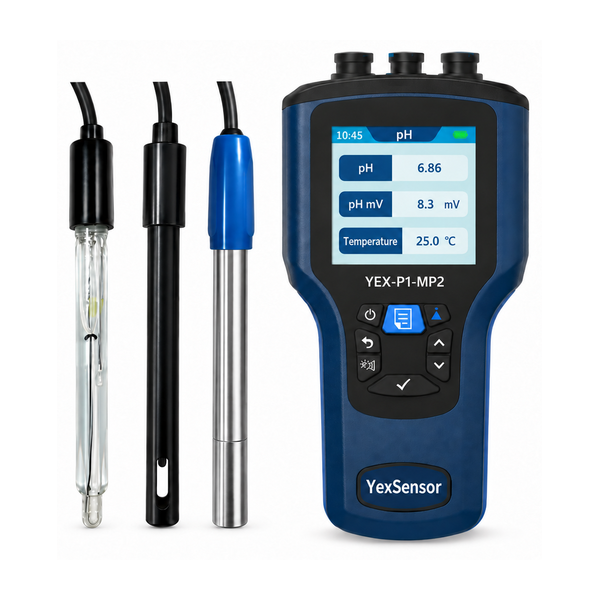
YEX-P1-MP2 Portable Multiparameter Water Quality Meter: one configurable platform for field measurement, calibration control and traceable records
- Configurable multiparameter measurement: Supports ordered probes for pH, ORP, conductivity, TDS, salinity, fluorescence dissolved oxygen, oxygen saturation, turbidity and temperature.
- Field-ready workflow: A 3.5-inch color display, GPS coordinates, automatic interval storage and sensor-specific history support organized measurement campaigns.
- Local data export: Up to 4000 records per electrode or sensor can be exported through the Type-C data connection in a consolidated HISTORY.XLS file.
Product Overview
YexSensor YEX-P1-MP2 is a portable multiparameter water quality meter for field technicians, laboratories, environmental teams, industrial water users and system integrators that need several water-quality measurements on one handheld platform. With the appropriate ordered probes, the instrument measures pH, oxidation-reduction potential, conductivity, total dissolved solids, salinity, fluorescence dissolved oxygen, oxygen saturation, turbidity and temperature. Typical uses include surface-water surveys, secondary water-supply checks, industrial water testing, laboratory comparison, emergency response and routine water-quality assessment.
The platform combines three probe sockets with a 3.5-inch TFT color LCD, GPS coordinate functions, automatic interval storage and Type-C data export. Its commercial boundary must remain clear: probes, calibration solutions and some power accessories depend on the ordered configuration. The product should therefore be selected as a defined meter-and-probe system rather than assumed to include every measurement module shown in photographs or described in the manual.
Selection Considerations and Measurement Boundaries
Specify the required parameters before selecting probes
The handheld meter accepts different electrodes and digital sensors through a 6-pin socket, BNC socket and 4-pin socket. pH and ORP use the BNC connection, while the pH temperature signal and conductivity electrode use the 6-pin connection. Fluorescence dissolved oxygen and turbidity sensors use the 4-pin digital connection. Procurement teams should state the exact parameter combination, expected ranges, required cable lengths, sample conditions and number of simultaneous connections so YexSensor can confirm the compatible configuration.
Separate instrument capability from ordered supply
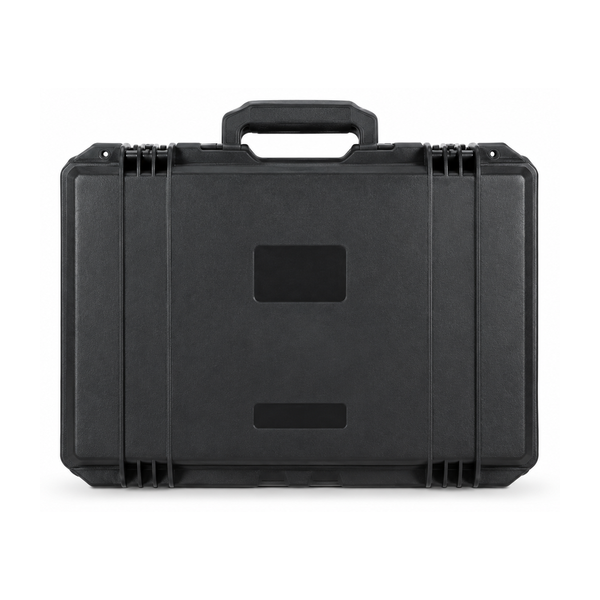
The pH electrode, ORP electrode, conductivity electrode, dissolved oxygen sensor, turbidity sensor and calibration materials are listed as optional items. The standard list identifies the handheld meter, user manual and product certificate, while the portable carrying case is complimentary. Power accessories vary between the built-in lithium-battery version and the four-AA-cell version. The signed sales order and final packing list, not a generic product photograph, define the delivered system.
Portable data collection is not online industrial control
The meter enclosure is IP65 and must not be immersed. The specified Type-C connection provides data export on both power versions and battery charging only on the lithium-battery version. The manual does not specify RS-485, Modbus, Bluetooth, Wi-Fi, cloud, LIMS or SCADA connectivity. Projects requiring continuous online control, remote telemetry or direct PLC integration should select a compatible online analyzer or define a separate data workflow before purchase.
Key Technical Advantages
Multiple electrochemical and optical methods on one platform
The available probes cover glass-electrode pH measurement, platinum ORP measurement, two-electrode graphite conductivity measurement, fluorescence-quenching dissolved oxygen measurement and 90-degree light-scattering turbidity measurement. This allows one handheld user interface to support several field and laboratory workflows while each parameter retains its own range, calibration process, materials and maintenance requirements.
Parameter-specific calibration and compensation
pH supports one-, two- or three-point buffer calibration using either pH 4.00/6.86/9.18 or pH 4.01/7.00/10.01 groups. Conductivity supports zero, 1408 μS/cm standard and sample-coefficient calibration, with adjustable TDS and temperature coefficients. Dissolved oxygen supports zero-oxygen, full-oxygen, sample and temperature calibration together with salinity and barometric-pressure compensation. Turbidity uses a three-point sequence based on zero, Standard 1 and Standard 2.
Traceable records with GPS context
Each electrode or sensor stores up to 4000 measurement records. GPS coordinate query and automatic coordinate storage can add location context when a valid outdoor position is available. Sensor-specific history and calibration records help operators review the active measurement channel, while USB export consolidates stored records for archiving and further analysis.
Two power configurations for different field routines
The built-in lithium-battery version uses the supplied USB-C cable and 5 V adapter for charging and data transfer. The AA version uses four cells and supports rechargeable NiMH or ordinary alkaline batteries; its Type-C port is for data export only, and rechargeable cells must be removed for charging in the AA charger. Confirm the required version and destination plug before order placement.
Technical Specifications
| Parameter | Specification |
|---|---|
| Handheld Meter | |
| Display | 3.5-inch TFT color LCD |
| Dimensions | 200 × 101 × 36 mm |
| Weight | Approximately 420 g |
| Interfaces | 6-pin socket, BNC socket, 4-pin socket and Type-C port |
| Data storage | Automatic interval storage; selectable interval 0-120 min; up to 4000 records per electrode or sensor |
| Languages | English / Chinese |
| GPS | Coordinate query and automatic coordinate storage |
| Enclosure protection | IP65; handheld meter must not be immersed |
| Power | Built-in lithium battery or four AA cells, depending on configuration |
| Operating environment | -5 to 50 °C; 10-85% RH, non-condensing |
| Composite pH Electrode | |
| Principle / measured values | Glass electrode method; pH and temperature |
| Ranges | pH 0.00-14.00; temperature 0.0-60.0 °C |
| Resolution | pH 0.01; temperature 0.1 °C |
| Accuracy / repeatability | ≤ ±0.05 pH / ≤ ±0.05 pH |
| Response time | T90 ≤ 20 s |
| Operating temperature | 5.0-40.0 °C |
| Materials | Glass and PC |
| Dimensions / cable | Ø27 × 167 mm; 1.5 m standard cable, customizable |
| Protection | IP68 |
| ORP Electrode | |
| Principle / measured value | Oxidation-reduction potential method; ORP |
| Range | -2000.0 to 2000.0 mV |
| Resolution | 0.1 mV |
| Accuracy / repeatability | ≤ ±15 mV / ≤ ±15 mV |
| Response time | T90 ≤ 20 s |
| Operating temperature | 5.0-40.0 °C |
| Materials | Platinum and PC |
| Dimensions / cable | Ø27 × 167 mm; 1.5 m standard cable, customizable |
| Conductivity TDS and Salinity Electrode | |
| Principle / measured values | Two-electrode graphite method; conductivity, TDS, salinity and temperature |
| Ranges | Conductivity 0.00-20.00 mS/cm; TDS 0.00-20.00 g/L; salinity 0.00-12.00 ppt; temperature 0.0-60.0 °C |
| Resolution | 0.01 mS/cm; 0.01 g/L; 0.01 ppt; 0.1 °C |
| Accuracy / repeatability | ≤ ±1% / ≤ ±1% |
| Response / temperature compensation | T90 ≤ 15 s / ≤ ±1% |
| Materials | 316L stainless steel and ABS |
| Dimensions / cable | Ø26 × 165 mm; 5 m standard cable, customizable |
| Protection | IP68 |
| Fluorescence Dissolved Oxygen Sensor | |
| Principle / measured values | Fluorescence quenching; DO concentration, oxygen saturation and temperature |
| Ranges | DO 0.00-20.00 mg/L; saturation 0.0-200.0%; temperature 0-60 °C |
| Resolution | 0.01 mg/L; 0.1%; 0.1 °C |
| Accuracy / repeatability | ≤ ±0.3 mg/L / ≤ ±0.3 mg/L |
| Response time | T90 ≤ 60 s |
| Temperature-compensation accuracy | ≤ ±0.3 mg/L |
| Material | 316L stainless steel |
| Dimensions / cable | Ø34.2 × 185 mm; 5 m standard cable, customizable |
| Protection | IP68 |
| Turbidity Sensor | |
| Principle / measured value | 90° light-scattering method; turbidity |
| Range / resolution | 0-1000 NTU / 0.01 NTU |
| Repeatability | ≤ 2% |
| Zero drift / span drift | ≤ ±1% F.S. / ≤ ±1% F.S. |
| Linearity error | ≤ ±5% F.S. |
| Material | 316L stainless steel |
| Dimensions / cable / weight | Ø16 × 178 mm; 1.5 m standard cable, customizable; approximately 100 g |
| Protection | IP68 |
Calibration and Quality Control
| Parameter | Available calibration | Quality-control requirement |
|---|---|---|
| pH | One, two or three points; pH 4.00/6.86/9.18 or pH 4.01/7.00/10.01; temperature and sample calibration | Use fresh buffers, rinse between points and recalibrate after changing the buffer group |
| ORP | Single-point calibration from -2000 to 2000 mV | Use a fresh standard and calibrate when drift is measurable or the quality procedure requires it |
| Conductivity | Temperature, zero, 1408 μS/cm standard and sample-coefficient calibration | Confirm the cell constant, TDS factor, temperature coefficient and selected salinity unit |
| Dissolved oxygen | Zero oxygen, full oxygen, sample coefficient and temperature calibration | Use a valid zero medium and oxygen-saturated water or water-saturated air; verify salinity and local pressure |
| Turbidity | Three-point sequence: 0.00 NTU, Standard 1 and Standard 2; typical standards 20 and 800 NTU | Keep the fixture, optical face, immersion depth and orientation consistent and verify with an independent standard |
| Records | Latest sensor-specific calibration information and optional coordinates | Record standards, lot, expiry, operator, time, temperature, compensation settings and acceptance result |
Calibration quality depends on the probe condition, standard preparation, temperature stability, connector integrity and sample handling. Restore functions clear calibration and setup values for the active sensor, while a meter factory reset restores system settings. Export required records and document the active calibration status before using either reset.
Application Scenarios
Surface water surveys and environmental inspection
A configured MP2 can combine electrochemical and optical checks during river, lake, reservoir and watershed surveys. GPS coordinates and automatic interval storage help associate readings with sampling locations. Select probes and cable lengths according to the sampling method, and define whether measurements are made directly in water, in a flow cell or in collected samples.
Industrial water and treatment-process checks
pH, ORP, conductivity, dissolved oxygen and turbidity can support process comparisons, troubleshooting and verification at intake, treatment and discharge points. The portable meter is intended for inspection and data collection; it is not a substitute for an online control loop when continuous PLC or SCADA feedback is required.
Secondary water supply and emergency response
The handheld format, carrying case, interchangeable probes and local record storage support rapid deployment across multiple sites. Before field dispatch, verify calibration, battery status, probe condition, standards, rinsing water, storage solutions, sample containers, protective equipment and the selected record interval.
Laboratory comparison and method verification
The instrument can support comparison checks, teaching and routine laboratory measurements when the selected probe, calibration system and sample procedure are suitable. Use traceable references and independent check samples where results inform release, compliance or engineering decisions.
Aquaculture and general water-quality assessment
Configured pH, conductivity and fluorescence dissolved oxygen channels can support water-quality assessment where salinity, temperature, biological activity and daily operating conditions affect interpretation. The operator should confirm compensation settings and measurement depth and avoid comparing results collected under different methods without qualification.
Probe Connection and Routine Measurement
Switch off the meter before connecting or removing a probe. Confirm that the plug and socket are clean and dry, align the pins, holes, keyway and limit marks, push the connector straight into the correct socket and tighten the retaining nut. Support the cable so its weight and twisting force are not carried by the connector. To disconnect, loosen the nut first and pull the connector body straight out; never pull the cable.
Before each measurement series, confirm the date, time, active parameter, unit, range where applicable, temperature and compensation settings, calibration status, storage interval and GPS state. Prepare the probe according to its method, remove bubbles and contamination, wait for the required stability and save the result with enough project context to support later review. Fit protective caps to unused connectors and clean and dry probes after use.
Data Logs USB Export and System Functions
| Function | Available control | Project use |
|---|---|---|
| Automatic storage | 0-120 min; 0 disables automatic storage | Set a documented interval before the measurement campaign |
| Record capacity | Up to 4000 records per electrode or sensor; oldest record is overwritten after the limit | Export before a long campaign or before the record limit is reached |
| GPS | Coordinate query and automatic coordinate storage when enabled outdoors | Confirm a valid position before relying on stored coordinates |
| Reading lock | Off, manual or automatic fast, medium or slow | Use one stability rule for comparable measurements |
| USB export | Export Records creates or overwrites HISTORY.XLS on the removable drive | Copy and verify the file before clearing records or repeating the export |
| Display settings | Screen-off time, brightness, key tone, language and temperature unit | Standardize settings across operators and projects |
| Power management | Automatic power-off: Off, 5 min, 10 min or 20 min | Balance field continuity and battery conservation |
| Reset functions | Meter factory reset or sensor-specific Restore | Export data and document calibration status before resetting |
Use a USB-to-Type-C data cable and wait until the export message closes before opening the removable drive. Do not operate the meter during export. Repeating the export overwrites the existing HISTORY.XLS file on the meter drive, while Clear Records permanently removes stored history. The Type-C connection is a local data interface and is not specified as an industrial communication protocol.
Maintenance and Troubleshooting
Store the meter in a cool, dry environment. Recharge the lithium version promptly and approximately every 1-2 months during long storage; remove AA cells during long storage and inspect the compartment for leakage. Rinse, clean and condition each probe according to its method. Protect pH glass, platinum ORP surfaces, graphite conductivity surfaces, the dissolved oxygen fluorescence membrane and the turbidity optical face from impact, scratches and incompatible cleaners.
If readings are absent or abnormal, check battery condition, cable integrity, connector seating, probe cleanliness, bubbles, calibration standards, calibration sequence, compensation values and the expected service life of consumable electrodes or sensing caps. Stop use and contact YexSensor if the enclosure, connector, cable, battery, sensor body, optical surface, glass bulb or fluorescence membrane is damaged, or if acceptable calibration cannot be restored after correct cleaning and setup.
Configuration and RFQ Checklist
For a technically useful quotation, provide the required parameters, sample source, expected ranges, reporting units, minimum detection and accuracy needs, temperature, salinity, pressure or altitude conditions, direct-immersion or collected-sample method, daily workload, cable lengths, GPS requirement, record interval, data-export workflow, power preference, destination, plug type and quantity.
Also identify the required pH, ORP, conductivity, dissolved oxygen and turbidity probes; calibration buffers and standards; storage and cleaning solutions; carrying cases; power accessories; spare electrodes or sensing caps; certificates and acceptance documents. YexSensor will confirm socket compatibility, supplied quantities and the final packing list against the sales order.
Standard Packing List and Ordered Configuration
| Item | Quantity | Configuration note |
|---|---|---|
| YEX-P1-MP2 handheld meter | 1 | Standard |
| Composite pH electrode | 1 | Optional |
| ORP electrode | 1 | Optional |
| Conductivity electrode | 1 | Optional |
| Fluorescence dissolved oxygen sensor | 1 | Optional |
| Turbidity sensor | 1 | Optional |
| USB-C data cable | 1 | Lithium-battery configuration |
| 5 V power adapter | 1 | Lithium-battery configuration |
| Rechargeable AA batteries | 4 | AA-battery configuration |
| AA battery charger | 1 | AA-battery configuration |
| Screwdriver | 1 | AA-battery configuration |
| pH buffer solutions, 25 mL × 3 | 1 set | Optional |
| Conductivity calibration solution, 25 mL | 1 bottle | Optional |
| ORP standard reagent, powder | 1 sachet | Optional |
| Portable carrying case | 1 | Complimentary |
| User manual | 1 | Standard |
| Product certificate | 1 | Standard |
Inspect the shipment against the confirmed sales order before use. Report any incorrect quantity, mismatched model, physical damage, leakage or missing item. Optional probes and calibration materials are supplied only when listed in the order, and power accessories must match the selected lithium-battery or AA-battery configuration.
Quality Assurance and After Sales Information
The standard warranty period is one year from the purchase date unless the sales contract states otherwise. Keep the warranty card, proof of purchase, product certificate, model and serial number. Lifetime maintenance support is available after the warranty period subject to the applicable service and parts charges.
The warranty excludes damage caused by installation, operation, charging, calibration, cleaning, storage or transport contrary to the manual; unauthorized disassembly, modification, repair or adjustment; force majeure and impact damage; products outside the warranty period; and consumables or normal wear including electrodes, sensing caps, batteries, solutions and cables unless the sales contract states otherwise.
Frequently Asked Questions
1. Which parameters can the YEX-P1-MP2 measure?
With the appropriate ordered probes, it measures pH, ORP, conductivity, TDS, salinity, fluorescence dissolved oxygen, oxygen saturation, turbidity and temperature. These parameters use different electrodes, sockets, ranges and calibration methods. The quotation should identify the exact parameter combination instead of assuming that every probe is included.
2. Are all probes included with the handheld meter?
No. The manual lists the composite pH electrode, ORP electrode, conductivity electrode, fluorescence dissolved oxygen sensor and turbidity sensor as optional. The handheld meter, user manual and product certificate are standard, and the portable carrying case is complimentary. Power accessories depend on the selected battery version. The final sales order and packing list define the delivered configuration.
3. How is pH calibrated?
The pH electrode supports one-, two- or three-point calibration in any order. Select either pH 4.00, 6.86 and 9.18 or pH 4.01, 7.00 and 10.01. Rinse with distilled water between buffers, wait for a stable reading and recalibrate after changing the buffer group. Temperature and sample calibration are also available within the ranges specified in the manual.
4. How are conductivity, TDS and salinity configured?
The conductivity electrode measures conductivity, TDS, salinity and temperature. Calibration options include temperature, zero, a fixed 1408 μS/cm standard and a sample coefficient. The TDS factor is adjustable from 0.400 to 1.000, the temperature coefficient from 0.00 to 5.00%/°C, and salinity can be displayed as ppt or %. Document the selected factors and units before comparing results.
5. What compensation is available for dissolved oxygen?
The fluorescence dissolved oxygen sensor supports temperature, salinity and barometric-pressure compensation. Enter salinity from 0.00 to 60.00‰ and local absolute atmospheric pressure from 0.00 to 150.00 kPa. Use measured salinity rather than conductivity and local absolute pressure rather than a value corrected to sea level. Verify compensation whenever the sample matrix, altitude or weather changes.
6. How is the turbidity sensor calibrated?
Use the three-point sequence: zero, Standard 1 and Standard 2. The manual identifies pure water or 0.00 NTU for zero and gives 20 NTU and 800 NTU as typical standards for the two slope segments. Clean the fixture and optical face, mix without persistent bubbles and keep position, immersion depth and orientation consistent. Verify the result with an independent standard when required.
7. How are records stored and exported?
Each electrode or sensor stores up to 4000 records at a selectable interval from 0 to 120 minutes. GPS coordinates can be stored when enabled and available. Use Export Records through a USB-to-Type-C data cable to create HISTORY.XLS on the removable drive. Copy and verify the file before clearing records or repeating the export because a repeated export overwrites the existing file.
8. What information is required for a quotation?
Provide the parameters, sample type, expected ranges, units, accuracy requirements, temperature, salinity and pressure conditions, cable lengths, measurement method, daily workload, record interval, GPS and export requirements, battery version, destination, quantity, calibration materials, spare parts and documents. YexSensor can then confirm probe compatibility, power accessories and the complete packing list.
Summary
YEX-P1-MP2 is suited to trained teams that need a configurable handheld platform for several water-quality parameters, parameter-specific calibration, GPS context, automatic records and local USB export. The important decision boundaries are that probes are ordered by application, the IP65 handheld meter is not immersed, each sensor has its own technical limits, and the manual does not specify RS-485, Modbus or wireless integration.
For a configuration matched to the actual project, send YexSensor the required parameters, sample matrix, ranges, accuracy targets, environmental conditions, cable lengths, calibration plan, workload, data requirements, power preference, destination and complete accessory list. These inputs allow the meter, probes, standards, power accessories, spares and acceptance approach to be confirmed before shipment.

