


 Chinese
 Spanish
 French
 Russian
 German
 Portuguese
 Indonesian
 Thai
 Vietnamese
 Arabic


Batch wastewater pH monitoring follows changing water conditions through a release, transfer and mixing cycle. In an industrial equalization system, a process vessel may discharge intermittently into a collection sump, a pump may transfer that water in stages, and other streams may enter the same tank. A single spot reading can miss how these conditions develop.
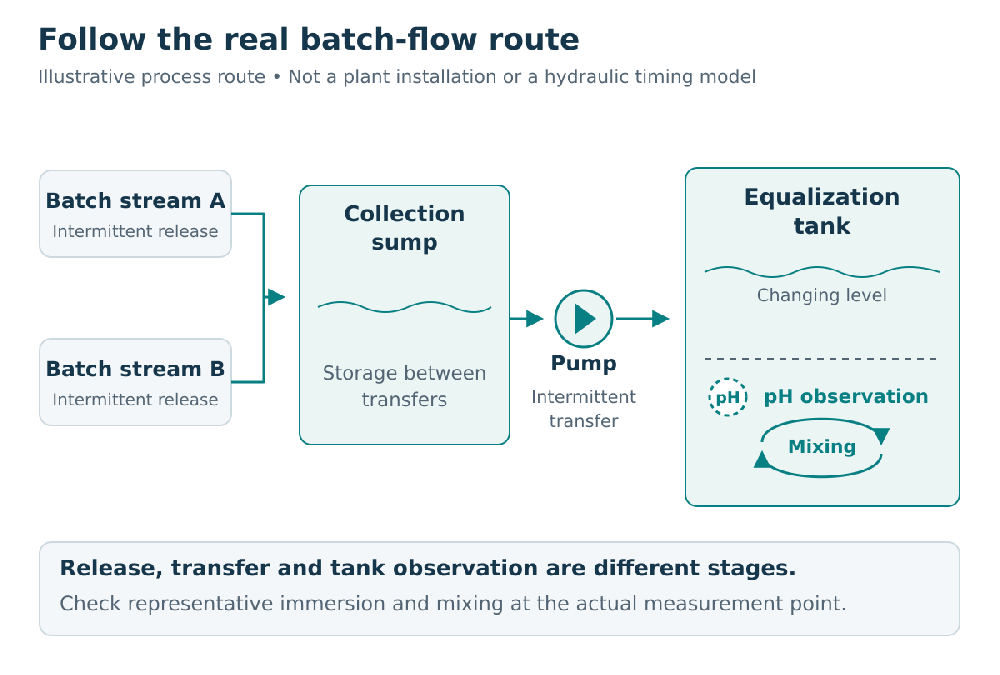
Conceptual batch-flow route; storage, pumping and mixing affect the water observed at a pH point.
The monitoring need is practical: see incoming changes, observe the mixed tank and retain enough operating context to interpret the trend. The useful measurement location depends on which of these questions matters. Continuous pH measurement does not, by itself, identify a contributing batch or determine a treatment response.
For an SI, IoT solution provider or EPC team, the starting point is the actual batch route and operating cycle. Flow, liquid level, mixing, temperature and maintenance conditions then determine the appropriate measuring arrangement and supporting equipment.
Operating Conditions for Batch Wastewater pH Monitoring
A batch-duty point should represent more than steady production. Review the periods before release, during transfer, between pump cycles and while the tank blends incoming water. The same installed probe can experience different immersion and flow conditions across those periods.
| Operating stage | What changes at the site | Useful monitoring observation |
|---|---|---|
| Batch release starts | A new stream enters the collection route | Relate upstream pH to the actual discharge, not just the production schedule. |
| Transfer flow rises | A pump starts or another branch joins | Observe pH with the active route and pumping state. |
| Transfer slows or pauses | Water remains in a sump or line | Identify whether the point still sees representative process water. |
| Tank receives and blends | Volume and mixing conditions change | Follow the tank trend with level and mixer operation. |
| Between batches or during service | Level may fall; a probe may be removed | Distinguish valid process readings from exposure or maintenance. |
This operating-stage checklist is a starting point for a site review, not a prescribed pump sequence. Include any recycle stream or cleaning discharge that actually reaches the measurement point. Different chemical exposures may require different instrument arrangements even when the normal tank pH appears similar.
Follow the Water, Not Only the Production Schedule
A batch completion record describes production activity. It may not establish when wastewater leaves a collection vessel or reaches the equalization tank. Intermediate storage, intermittent pumping and shared pipes can separate these events.
Trace the actual route and identify where liquid movement can be confirmed. Use available pump, flow, valve and level information together; a command to open a valve is not proof of discharge. Compare the pH observation with the relevant transfer period rather than assigning every reading to the closest batch label.
Transport behavior also changes with operating conditions. EPA tracer-study guidance describes the influence of flow, stored volume and mixing on residence behavior. This supports checking the actual route and state, not adopting a universal delay for industrial wastewater. Volume divided by flow alone cannot establish when every part of a release reaches a probe. EPA tracer-study guidance
Separate Process Readings from Invalid Batch Records
Equalization blends incoming wastewater and moderates variations, but an installed point must still represent the intended observation. EPA's equalization guidance emphasizes mixing and inlet/outlet arrangements that avoid short-circuiting. A probe near one incoming stream may observe a local condition before that water is distributed through the tank. EPA flow-equalization guidance
Check the minimum operating level, mixer operating range, nearby dosing points, bubbles and settled material. Maintain appropriate immersion throughout the conditions being monitored. There is no universal installation depth that resolves these questions for every tank.
Specify how the receiving system marks low-level exposure, maintenance and communication loss. An exposed probe, a stale value and a fresh measurement are different states, even if the displayed number looks plausible. Keep the original reading and its quality state together; do not silently replace missing data with the last value. For decisions about adding inlet or outlet instruments, use the separate equalization-tank pH measuring-point guide.
Account for Chemistry, Temperature and Sensor Condition
The pH of mixed wastewater is not generally the arithmetic average of the incoming pH values. Buffering and reactions affect the result. EPA's industrial wastewater manual describes titration curves for assessing buffering, while USGS solution-mixing documentation accounts for chemical reactions. A modest pH movement does not establish a small chemical load, and pH alone does not identify a pollutant. EPA wastewater guidance, USGS mixing documentation
Review temperature and chemical exposure across normal batches, rinsing and cleaning. A temperature stated for a production cleaning step is not automatically the temperature at the installed probe. Equally, a normal tank reading does not establish the highest exposure during transfer. Confirm conditions at the actual point.
Deposits or fouling can also affect the measurement. Plan safe retrieval and checks appropriate to the medium. Retain inspection and verification observations so a service-related change is not mistaken for a new batch event. USGS continuous-monitor guidance distinguishes fouling checks from calibration-drift checks; the installed instrument's instructions govern its servicing. USGS continuous-monitor guidance

The sensing end needs representative exposure and access for inspection and maintenance.
Match the Measuring Product to These Conditions
The YEX-S1-PH online pH sensor is a candidate where the identified medium, installation and receiving equipment fit its documented conditions. The temperature, pressure, mounting and connection checks below relate directly to batch-duty conditions. S1-PH technical specifications
| Batch-duty consideration | Documented S1-PH information | Application check |
|---|---|---|
| Temperature during releases and cleaning exposure | Working temperature 0–65°C | Establish actual exposure at the point, including relevant operating changes. |
| Pressure at the measuring arrangement | Working pressure below 0.2 MPa | Confirm the local pressure; do not treat the boundary as inclusive. |
| Installation and low-level operation | Immersion mounting; 3/4 NPT thread | Confirm the holder, maintained immersion and safe retrieval. |
| Power and receiving equipment | 12–24 VDC; RS485 Modbus RTU | Confirm suitable power and a compatible configured receiver. |
Automatic NTC temperature compensation does not extend the working-temperature limit. Confirm chemical compatibility for the actual wastewater and cleaning exposure, including the electrode and seal components rather than relying on a body-material description alone.

Select the measurement package after reviewing the batch-duty conditions.
Keep Useful Records Across the Batch Cycle
A practical record combines the pH trend with the conditions that explain what water reached the point. Retain the actual release interval, active transfer route, relevant pumping and level changes, mixing state, temperature observations and probe service periods. A short operator note can supply context that a production batch number alone cannot.
The probe and receiving system have different roles. S1-PH provides measurement data through RS485 Modbus RTU. A compatible PLC, logger or gateway must provide any required recording, event association and onward transmission. Confirm those functions for the selected equipment; do not assume they are built into the probe.
Record host acquisition time separately from later network receipt. Mark gaps and service periods visibly. Choose recording intervals and alarm behavior around the site's changing conditions and required response, without inventing a universal interval or threshold.
For an illustrative sequence, suppose a batch release finishes while a collection sump continues transferring water. A later tank pH movement may still relate to that transfer. If another stream joins, the mixed trend cannot distinguish the contributions by itself. These are hypothetical operating explanations, not plant results or proof of batch origin.

The receiving equipment supplies the recording functions required for the application.
FAQ
1. What does batch wastewater pH monitoring add to occasional sampling?
It provides a time series across changing release, transfer and mixing conditions. That can reveal movements missed by an isolated reading, provided the point remains representative and the records are valid. Define which operating change matters, then compare continuous monitoring and reference checks against that purpose. More readings alone do not identify the source or prescribe treatment.
2. Should the recorder keep pH readings while the transfer pump is stopped?
It can retain them, but their meaning depends on the water at the probe. A mixed-tank reading may remain useful while transfer stops; a stagnant branch reading may not describe an incoming batch. Specify pump-state tagging and data-quality handling in the recorder requirements. Do not use pump status alone to declare all readings valid or invalid, or to infer actual flow.
3. Why can the tank trend change after a batch has finished?
Production completion and wastewater arrival are different events. Liquid may remain in an intermediate vessel or move through the route during later pump cycles. Tank mixing and other incoming streams also affect the observation. Review actual discharge and transfer conditions before interpreting the timing; neither a later pH movement nor its proximity to a batch label proves origin.
4. How should a project handle missing readings during a batch?
Mark the gap rather than presenting the last received value as a fresh measurement. Distinguish communication loss, probe removal and low-level exposure where the project has information to do so. Agree the operator response and recovery checks before commissioning. Ask the integrator to demonstrate timestamps, stale-data indication and restored acquisition; the sensor interface alone does not guarantee these recording functions.
5. Does temperature compensation make hot cleaning water acceptable?
No. Compensation does not remove the instrument's operating-temperature limit or establish chemical compatibility. S1-PH specifies automatic NTC compensation and a 0–65°C working range. Establish whether the installed point actually encounters the cleaning stream and under what conditions. If exposure exceeds a documented limit, reassess the measuring arrangement rather than treating compensation as permission to exceed it.
6. Can pH identify which overlapping batch caused an excursion?
Not by itself. Several streams can contribute to a mixed-tank observation, and buffering or reactions can change their combined pH response. Use release, route and operating records to guide investigation, while keeping unresolved sources explicit. If individual-stream observation is necessary, define that purpose and review the relevant point; do not purchase a pH probe as an automatic batch-identification device.
7. Which equipment stores readings and adds batch information?
A suitably configured PLC, data logger, gateway or project system performs those functions. S1-PH's RS485 Modbus RTU interface supplies measurement data; it does not establish an onboard batch record, cloud connection or event history. Confirm the chosen receiver's actual recording and event-input capabilities, and include the required integration support separately from the probe and mounting hardware.
8. What should buyers include in batch-monitoring acceptance tests?
Include an agreed operating sequence, not only a stable displayed value. Check that release and pump events align with the recorded trend, service periods are identifiable, and communication interruptions are visible. Use authorized simulations where interrupting the process would be unsafe. Define the evidence to retain and the responsibilities of the sensor supplier and integrator; do not assume that buying a probe includes commissioning the recording system.
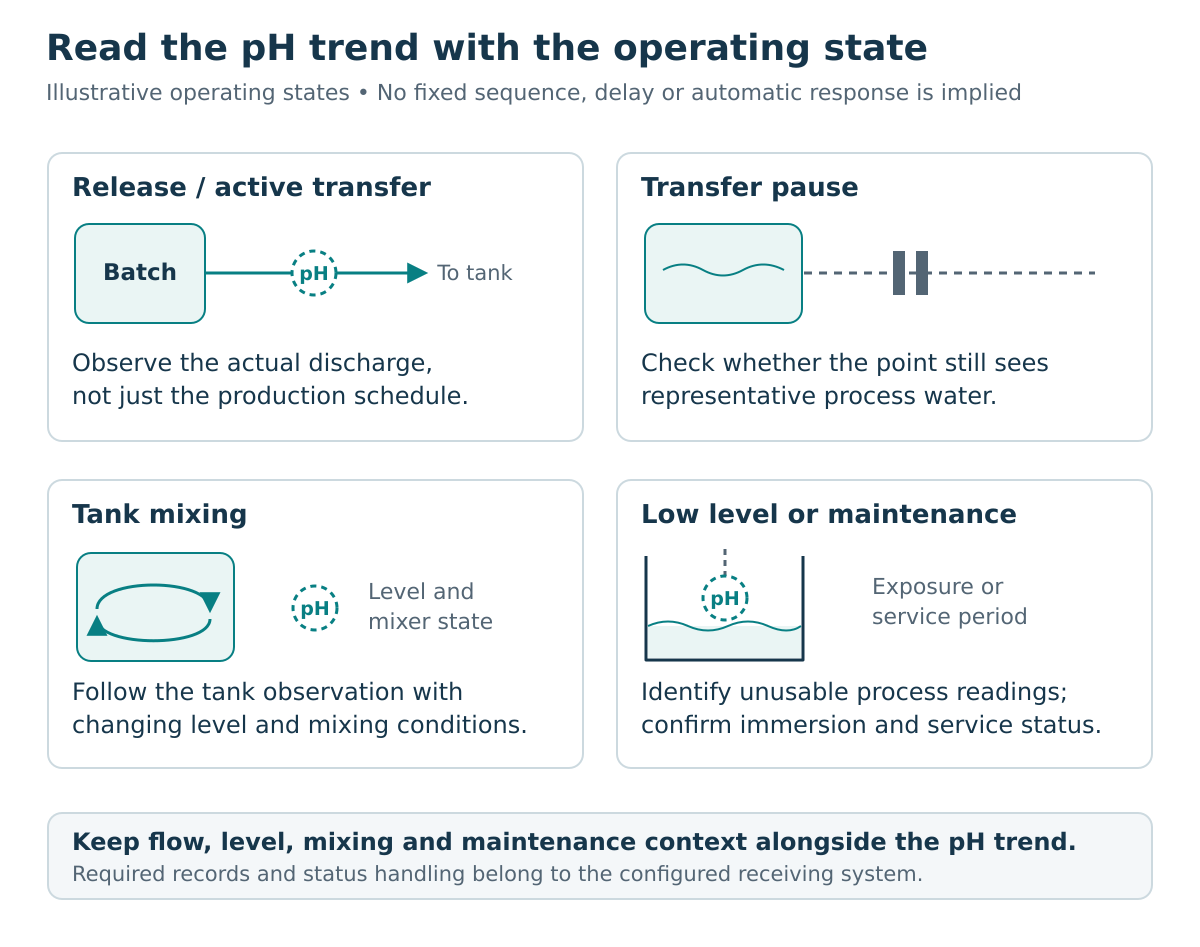
Conceptual operating states for reviewing flow, immersion, mixing and maintenance during a batch cycle.
Summary
Batch wastewater pH monitoring should connect each useful reading to the actual release, transfer and mixing cycle. Select a sensor for the documented exposure, then specify the receiving system's timestamps, operating-state records and invalid-data handling. Confirm these functions during commissioning rather than accepting a changing display as a complete monitoring system. A mixed-tank trend supports investigation, but cannot independently identify a batch source or authorize a treatment response.
Request an equalization-tank pH monitoring review. Share the wastewater sources, batch and pumping pattern, measurement purpose, temperature, existing points, receiver interface and required quantity. Include a simple route sketch when available so the proposed measuring arrangement can be assessed against the actual application.


