Chinese
 Spanish
 French
 Russian
 German
 Portuguese
 Indonesian
 Thai
Thai Vietnamese
 Arabic

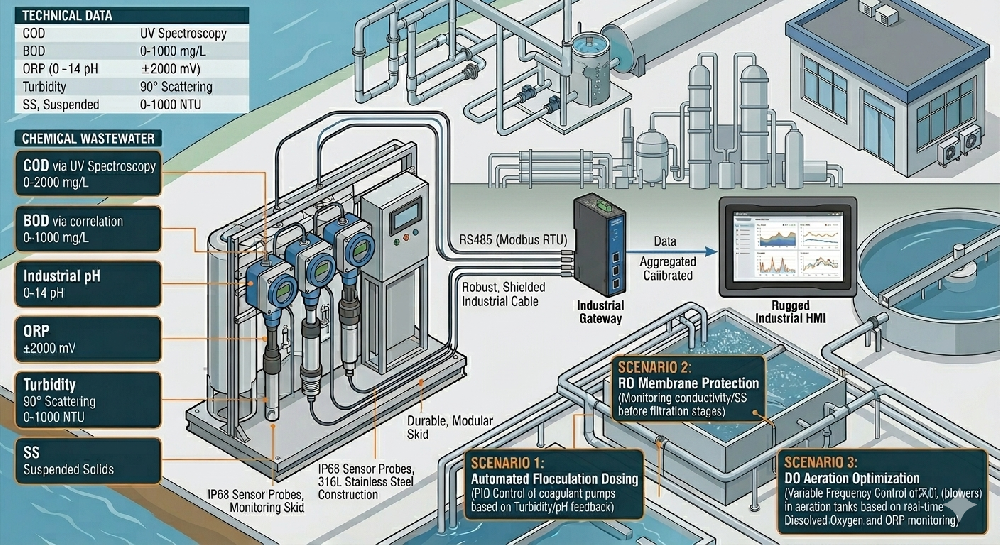
SCADA Integration Needs More Than a Signal Wire
This field plan is prepared for SCADA systems, PLC projects and online water quality dashboards. A buyer needs clear inspection points before selecting an online water quality sensor, including what to check on site, what to include in the quotation and what evidence should be reviewed before acceptance.
For SCADA water quality integration, the first decision is the operating action. The monitoring point should help staff display correct values, separate faults from process alarms and support operator response. If the value does not change operation, alarm response or maintenance planning, the project will look busy but deliver little practical value.
The project should be specified around digital integration accuracy, with parameters selected only when they support that purpose.
For SCADA water quality integration, buyers should confirm site conditions, operator access and data use before selecting the final YexSensor package.
Field Questions That Shape the Specification
The site should identify where digital integration accuracy becomes visible in the process and where a sensor can be maintained without unsafe work.
The monitoring point for SCADA water quality integration should have a clear owner. If nobody owns cleaning, alarm review and verification, online data will lose trust.
| Field condition | What to check | Procurement impact |
|---|---|---|
| Representative point | Check flow, mixing and access | Improves data value |
| Alarm owner | Assign response responsibility | Prevents ignored alarms |
| Maintenance route | Confirm cleaning access | Reduces downtime |
Recommended YexSensor Products
The recommended YexSensor package for SCADA water quality integration keeps model selection clear while leaving room for installation, maintenance and acceptance details.
| Product name | Product image | Specification to confirm | Why it fits this project guidance |
|---|---|---|---|
| YEX-S1-RDO optical oxygen sensor |  | RS485 Modbus RTU, 12-24V DC, IP68, 0-20.00 mg/L | oxygen alarm, aeration review, fish stress warning and biological treatment control |
| YEX-S1-ZS turbidity sensor |  | RS485 Modbus output, optical turbidity measurement, selectable ranges | clarifier outlet, filter release, river events and final water clarity warning |
| YEX-S1-EC conductivity sensor |  | RS485 Modbus RTU, 12-24V DC, IP68, 0-5000 uS/cm, TDS 0-3000 mg/L | source change warning, salinity trend, rinse water and reuse water control |
| YEX-S1-CL residual chlorine sensor |  | RS485 Modbus RTU, 12-24V DC, IP68, 0-2.000 mg/L | disinfection outlet, reuse water, drinking water and cooling water monitoring |
Operation and Maintenance Notes
After commissioning, operators should review whether the values actually support display correct values, separate faults from process alarms and support operator response. If a value does not change a decision, the alarm or placement should be reviewed.
Maintenance for SCADA water quality integration should be recorded with before-and-after values so drift, fouling and real process change can be separated.
| Risk | How to reduce it | Acceptance evidence |
|---|---|---|
| Nuisance alarm | Review threshold and delay | Alarm review log |
| Sensor drift | Clean and verify | Maintenance record |
| Unclear data use | Link value to action | Operator procedure |
Purchasing and Acceptance Notes
The quotation for SCADA water quality integration should include the complete monitoring point: sensor, mounting, cable, power, communication, dashboard label, alarm rule and service accessories.
Acceptance should verify the product model, image-linked product page, signal value, alarm behavior and maintenance method.
Project Details That Should Not Be Missed
The first project detail is ownership. For SCADA water quality integration, someone must own alarm review, cleaning records and comparison sampling. If responsibility is shared loosely between production, maintenance and laboratory teams, the system may collect data without changing the decision it was purchased to support.
The second detail is the physical service route. A monitoring point at SCADA systems, PLC projects and online water quality dashboards should be reachable during normal operation, not only during shutdown. The buyer should ask whether the probe can be removed, cleaned, checked and returned to the same position without special tools or unsafe work.
The third detail is data interpretation. YEX-S1-RDO optical oxygen sensor may be the first recommended product, but its value becomes stronger when operators understand normal daily variation, startup behavior, cleaning effect and abnormal events. This prevents the team from treating every movement as a process failure.
The fourth detail is support after delivery. If YEX-S1-ZS turbidity sensor or another supporting product is added later, the original controller, cabinet and dashboard should already have enough space and documentation. This avoids rebuilding the system when the buyer expands from one monitoring point to several points.
For scada water quality integration, the buyer should also confirm who will receive alarms, who will clean the probes, and who will compare online values with manual checks during the first month. This keeps the monitoring point connected with daily operation and makes the quotation easier to evaluate.
FAQ
Q1 Which product should be considered first for SCADA water quality integration?
Start with YEX-S1-RDO optical oxygen sensor because it is tied most directly to the operating action in this scenario: display correct values, separate faults from process alarms and support operator response. Confirm RS485 Modbus RTU, 12-24V DC, IP68, 0-20.00 mg/L before purchase, then decide whether the value will be used for alarm, manual inspection, control logic or only historical reporting.
Q2 How should the recommended YexSensor package be reviewed?
For SCADA water quality integration, one focused recommendation package is easier for buyers to use. The rest of the specification should focus on site conditions, installation details, commissioning checks and maintenance risk.
Q3 How should the installation point be chosen?
Choose a point where digital integration accuracy is represented and the probe can be cleaned safely. Avoid dead zones, chemical shocks, heavy bubbles and positions that cannot be reached.
Q4 What should be included in the quotation?
Ask for product model, range, output, mounting accessories, cable length, controller or gateway, commissioning support and spare parts.
Q5 When should a supporting sensor be added?
Add YEX-S1-ZS turbidity sensor or another supporting sensor only when it explains a decision that the primary value cannot answer alone. Supporting products should help diagnose source change, dosing risk, solids carryover, nutrient load, disinfection condition or biological process status.
Q6 How can operators avoid false alarms?
For SCADA water quality integration, false alarms are reduced by stable placement, cleaning access, maintenance hold, realistic alarm delay and a baseline period after commissioning. The alarm name should describe the real point, such as pond, tank, channel, outlet or station, so staff can respond quickly.
Q7 How should online values be verified?
Verification for SCADA water quality integration should compare the online value with the same water condition, not a random sample from another point. The record should include date, technician, cleaning status, manual value, online value, sample location and any abnormal operation such as chemical dosing, stormwater or equipment shutdown.
Q8 How does this guidance help a purchasing team?
It gives the team a scenario, a product recommendation, field checks, acceptance evidence and FAQ guidance for SCADA systems, PLC projects and online water quality dashboards. That combination helps a buyer request a serious quotation from YexSensor instead of asking only for a unit price.
Summary
Scada water quality integration should be handled as a practical engineering purchase. The buyer needs to know which value matters, where the sensor should be installed, how the signal will be used and what maintenance evidence will keep the data credible.
The recommended starting point is YEX-S1-RDO optical oxygen sensor, supported by the other YexSensor products in the recommendation package when the site needs additional context. Model selection should stay concise so field use, installation and acceptance details remain clear.
For SCADA systems, PLC projects and online water quality dashboards, the strongest result is a monitoring point that supports display correct values, separate faults from process alarms and support operator response. A complete order should include the model, range, output, power, bracket, cable, controller or gateway, alarm logic, cleaning method and verification routine.
Procurement detail 1 for SCADA water quality integration: the buyer should ask the supplier to mark which accessories are included and which are optional. This is especially useful for SCADA systems, PLC projects and online water quality dashboards because mounting hardware, cable protection and cleaning tools can decide whether YEX-S1-RDO optical oxygen sensor becomes a stable field measurement or a difficult maintenance item. This note is specific to the operating action: display correct values, separate faults from process alarms and support operator response.
Acceptance detail 2 for SCADA water quality integration: the project team should record the actual displayed value, the controller value, the alarm threshold and the maintenance hold state. These records give the buyer evidence that the monitoring point was delivered as a working system, not as loose equipment. This note is specific to the operating action: display correct values, separate faults from process alarms and support operator response.
Expansion detail 3 for SCADA water quality integration: the buyer should keep point names, cable labels and dashboard tags consistent from the first installation. That discipline makes later additions easier and reduces the chance that operators respond to the wrong pond, tank, channel, outlet or station. This note is specific to the operating action: display correct values, separate faults from process alarms and support operator response.
Procurement detail 4 for SCADA water quality integration: the buyer should ask the supplier to mark which accessories are included and which are optional. This is especially useful for SCADA systems, PLC projects and online water quality dashboards because mounting hardware, cable protection and cleaning tools can decide whether YEX-S1-RDO optical oxygen sensor becomes a stable field measurement or a difficult maintenance item. This note is specific to the operating action: display correct values, separate faults from process alarms and support operator response.
Acceptance detail 5 for SCADA water quality integration: the project team should record the actual displayed value, the controller value, the alarm threshold and the maintenance hold state. These records give the buyer evidence that the monitoring point was delivered as a working system, not as loose equipment. This note is specific to the operating action: display correct values, separate faults from process alarms and support operator response.
Expansion detail 6 for SCADA water quality integration: the buyer should keep point names, cable labels and dashboard tags consistent from the first installation. That discipline makes later additions easier and reduces the chance that operators respond to the wrong pond, tank, channel, outlet or station. This note is specific to the operating action: display correct values, separate faults from process alarms and support operator response.
Procurement detail 7 for SCADA water quality integration: the buyer should ask the supplier to mark which accessories are included and which are optional. This is especially useful for SCADA systems, PLC projects and online water quality dashboards because mounting hardware, cable protection and cleaning tools can decide whether YEX-S1-RDO optical oxygen sensor becomes a stable field measurement or a difficult maintenance item. This note is specific to the operating action: display correct values, separate faults from process alarms and support operator response.
Acceptance detail 8 for SCADA water quality integration: the project team should record the actual displayed value, the controller value, the alarm threshold and the maintenance hold state. These records give the buyer evidence that the monitoring point was delivered as a working system, not as loose equipment. This note is specific to the operating action: display correct values, separate faults from process alarms and support operator response.
Expansion detail 9 for SCADA water quality integration: the buyer should keep point names, cable labels and dashboard tags consistent from the first installation. That discipline makes later additions easier and reduces the chance that operators respond to the wrong pond, tank, channel, outlet or station. This note is specific to the operating action: display correct values, separate faults from process alarms and support operator response.
Procurement detail 10 for SCADA water quality integration: the buyer should ask the supplier to mark which accessories are included and which are optional. This is especially useful for SCADA systems, PLC projects and online water quality dashboards because mounting hardware, cable protection and cleaning tools can decide whether YEX-S1-RDO optical oxygen sensor becomes a stable field measurement or a difficult maintenance item. This note is specific to the operating action: display correct values, separate faults from process alarms and support operator response.
Good guidance for SCADA water quality integration should help a real buyer move from review to action: review the site, select the product package, request a quotation, prepare installation and check the system after commissioning.