Chinese
 Spanish
 French
 Russian
 German
 Portuguese
 Indonesian
 Thai
 Vietnamese
 Arabic


A portable wastewater testing kit can support on-site COD and nutrient analysis when the site can provide the selected method, matched reagents, suitable power, a controlled workspace and quality control. Carrying a colorimeter to the sampling point does not establish that the complete test can be performed there. Decide where preparation, digestion, cooling and reading will take place before choosing the kit.
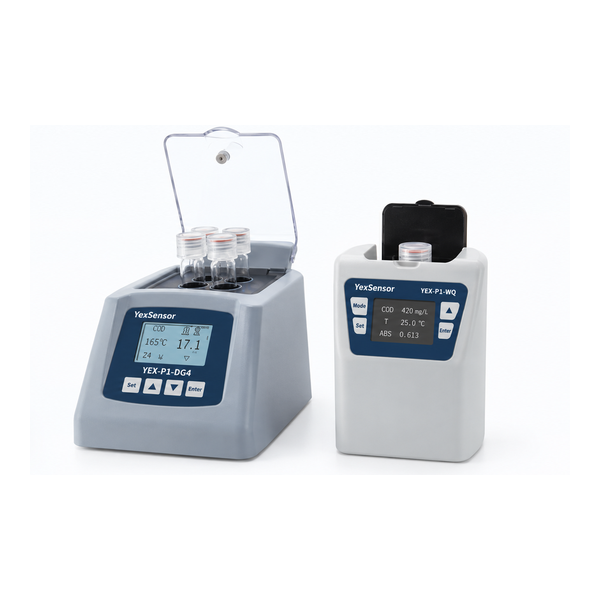
For distributors, service teams and buyers, YEX-P1-WQ-KIT procurement involves a battery-powered colorimeter and a separately powered four-position digester. Their different duties and supply requirements determine where the work can be completed.
The omissions that stop field testing after delivery
An instrument and parameter list do not define a complete workflow. The correct meter still needs a usable digester supply, matched reagents, sufficient tubes and a safe place for hot reactions.
Start with the decision the result must support: investigating a loading change, comparing treatment stages or reporting under a specified method. These tasks can require different handling, quality controls and acceptance evidence. Agree the method and responsibilities before treating a field indication as an accepted result.
What the portable wastewater testing kit actually supplies
The YEX-P1-WQ-KIT specification and configuration guidance separate the optical meter, heating block and analytical programs. Keep that separation in the equipment schedule.
| Component | Documented specification | Procurement consequence |
|---|---|---|
| YEX-P1-WQ colorimeter | Two 1.5 V AA batteries; LED wavelengths of 420, 520 and 620 nm | Plan meter batteries and select the matching installed program; the meter supply does not power digestion. |
| YEX-P1-DG4 digester | 12 VDC, 10 A supply; four heating wells; programmable 50–180 °C | Confirm the supplied adapter and site input. These supply specifications do not establish measured consumption or battery runtime. |
| Program set | 13 separate programs covering CODCr, ammonia nitrogen, total phosphorus, total nitrogen and CODMn | Specify the analyte, method, range and reagent code together. A parameter list alone does not define the ordered chemistry. |
| Reaction vessels | 16 mm tubes; quantities depend on the kit configuration | Count blank, sample, quality-control and spare vessels against the actual daily work. |
| Records | Up to 3,000 records; USB export to History.csv | Include record export and sample identification in acceptance. Do not assume a continuous industrial control interface. |
Match the analytical program to the purchase specification
The 13 programs are divided between the following method and range groups. These are published program ranges, not universal quantification limits or proof of performance in every matrix. Select the matching reagent instructions, blank and verification plan with the program.
| Parameter and method | Published program ranges (mg/L) | Decision before ordering |
|---|---|---|
| CODCr | 10–150; 100–1,500; 1,000–15,000 | Match the expected load to the selected CODCr program and reagent set. |
| Ammonia nitrogen: salicylic acid | 0.02–2.5; 0.4–50 | Specify this method and its range; do not substitute a Nessler reagent. |
| Ammonia nitrogen: Nessler | 0.05–10; 10–100 | Identify the required reagent family and safety documents separately from the salicylic-acid option. |
| Total phosphorus: molybdate | 0.02–2; 2–20 | Include the prescribed TP digestion and reaction workflow in the equipment schedule. |
| Total nitrogen: digestion/colorimetry | 0.5–50; 50–500 | Allocate capacity for the TN procedure; an ammonia result does not replace total nitrogen. |
| CODMn: permanganate index | 0.5–5; 5–25 | Keep the required index identifiable; do not combine these ranges with CODCr. |
Choose the testing path by the decision and site resources
| Testing path | Suitable task | Resources needed | When to use another path |
|---|---|---|---|
| Portable colorimeter without digestion | A selected method whose instructions do not require heating | Matched program and reagents, controlled reaction conditions, clean tubes and required quality controls | The required method includes digestion or the site cannot control the reaction. |
| Colorimeter plus four-position digester | Supported chemical tests at a prepared plant or service bench | Approved digester supply, safe heating and cooling space, chemical handling and waste arrangements | Power, safe workspace or required quality-control capacity is unavailable. |
| Fixed laboratory workflow | Greater preparation needs or a workload beyond the field batch | Method-controlled preparation, personnel, equipment and sample transport arrangements | Transport could compromise the required observation; reassess the sampling and analysis plan. |
| Continuous online monitoring | Following process changes between discrete tests | A separately selected sensor, installation, power and data path | A discrete chemical reference result or specified reporting method is required. |
Select the portable chemical kit when controlled testing can follow the sampling work. Select a laboratory path when the necessary preparation cannot be maintained on site. Where continuous observations are required, define that monitoring task separately. The wastewater laboratory configuration guide covers the fixed-bench decision; the portable water quality meter guide addresses other field measurement forms.
Three site conditions that change the configuration
Illustrative planning scenarios follow.
A staffed treatment-plant workbench
A plant has trained staff, suitable ventilation, a stable bench, power and waste collection. The full kit can be evaluated for its chosen chemical methods. Check whether influent and effluent need different program ranges, then allocate tubes and quality controls. The useful configuration is the one that handles those matrices and that batch, rather than the largest advertised concentration span.
A mobile team visiting several sites
A service team needs representative samples and consistent records across locations. Identify which steps can be completed at each prepared workstation and which must return to a laboratory. Record transfer times and follow the method's preservation and holding requirements. Do not create one universal storage or neutralization procedure for all five parameter groups.
An unsupported outdoor sampling point
A roadside or waterside location lacks a safe chemical bench or approved digester supply. Use it for the planned sampling task, not improvised hot digestion. Suitable non-heated work still requires the applicable reaction conditions and safety arrangements. Transportability does not establish weather protection or permission to perform every reaction outdoors.
Plan the power, batch and complete result record
Confirm the digester adapter against the available site supply before mobilization. The documented 12 VDC, 10 A specification is not evidence that an arbitrary vehicle socket, battery or inverter will operate the system correctly. Have the proposed supply and connections approved for the delivered equipment. Keep the colorimeter and transport case clear of the hot working area.
Four wells provide four tube positions, not necessarily four different sample results. An illustrative batch could contain one reagent blank, sample A, a parallel test of A and sample B. All four wells are occupied, but only two different samples are represented. A required standard or matrix spike may occupy additional positions or require another run. This example explains capacity; it does not prescribe a universal quality-control schedule.
Separate groups that require different digestion programs when planning runs. The usable turnaround includes preparation, heating, prescribed cooling, reaction development, reading and quality-control review. A listed digestion time alone is not the time at which a result is ready for an operational decision.
For each batch, retain sample identification, collection and analysis times, instrument serial numbers, program, reagent code and lot, dilution, digestion conditions, blank and quality-control results, operator and any failed checks. Run History Export before connecting the powered colorimeter by USB and copying History.csv. Check the exported records against the batch sheet; a saved value without its method and sample context is insufficient for comparison.
Define the ordered method and consumable workflow
An equipment schedule should identify each parameter, expected concentration range, sample matrix, required method and daily workload. Include known color, suspended material, salinity, disinfectants or other matrix conditions so the appropriate reagent instructions and validation requirements can be assessed. Do not transfer an interference limit from one reagent formulation to another.
Itemize the colorimeter, digester, adapter and input supply, rack, vessels, pipetting accessories, reagent codes and quantities, spares, batteries, USB cable and case. Include operating instructions, reagent safety data sheets, storage and waste requirements, language, destination and plugs. Record price, delivery, warranty and any certification requirements in the quotation.
Acceptance should demonstrate the ordered program and reagent combination on agreed standards and representative matrices, with the required quality controls and exported records. Set acceptance criteria through the governing method and project quality plan. Photographs and a generic accuracy specification cannot replace a defined packing list or a method-specific acceptance test.
Specify the field-testing task
Provide the parameters and ranges, sample matrices, daily batch size, required methods, site power and workspace, quality-control plan, destination and consumable quantities. These inputs support configuration of the YEX-P1-WQ-KIT colorimeter and digester system.
Frequently asked questions
Q1. Does a battery-powered colorimeter mean COD digestion is battery powered?
A1. No. The YEX-P1-WQ uses two 1.5 V AA batteries, while the YEX-P1-DG4 has a documented 12 VDC, 10 A supply requirement. Confirm the supplied adapter and approved site power arrangement separately. The electrical supply specification does not provide a measured energy demand or runtime. A field-power proposal therefore needs verification against the delivered equipment rather than an assumption based on the word portable.
Q2. Can CODCr and CODMn use the same program, reagent or acceptance result?
A2. No. CODCr and CODMn use different oxidation methods, and the kit lists separate programs and ranges for them. Select the required parameter before selecting reagents or preparing the blank. Keep its method identity in the exported result and batch record. If a customer specifies one method, a result from the other is not an automatic substitute; agree the required procedure and acceptance evidence before ordering.
Q3. How many reportable samples can a four-well batch actually accommodate?
A3. The answer depends on the method's quality-control allocation, not just the number of wells. A blank, sample A, a parallel test of A and sample B occupy four positions but represent two different samples. A standard or spike may require more positions or another run. Before specifying daily throughput, map the required controls, compatible digestion conditions, cooling and reading steps across the complete batch.
Q4. When should a team carry only the colorimeter rather than the full kit?
A4. Consider the colorimeter alone only when the selected method can be completed without a digestion stage at that location. The published kit guidance distinguishes ammonia color-development procedures from the listed heated procedures, but the current reagent instructions still control the exact workflow. Verify reaction conditions, timing, safety and quality controls first. Omit the digester from a visit because the task does not need it, not because suitable power is missing.
Q5. How do matrix and expected concentration determine the ordered program and reagent?
A5. Match the expected concentration to a defined program and its reagent instructions, then assess the matrix. A program range does not prove that colored, turbid, saline or chemically complex samples will meet the required performance. Use the applicable controls, pretreatment or validated dilution and document the factor. Give the supplier representative matrix information and the reporting requirement so the quotation covers the correct chemistry and verification work.
Q6. When is a fixed laboratory or online instrument the better choice?
A6. Choose a fixed laboratory workflow when the required preparation, safe workspace or sample volume cannot be supported efficiently at the field workstation. Consider online monitoring when the decision requires observations between discrete sampling events. These paths address different tasks and may coexist. Compare transport and analysis delay, matrix validation, staffing and records before procurement; neither a portable kit nor an online reading automatically replaces a required reference method.
Q7. What should a complete site-readiness and delivery acceptance check contain?
A7. Check the ordered equipment and consumables against the packing list, then verify site power, reaction space, ventilation, chemical protection and waste arrangements for the selected methods. Demonstrate the program and reagent combination with agreed standards, representative samples and quality controls. Include record export and sample identification. Acceptance limits must come from the method and project quality plan; equipment delivery alone does not establish reportable analytical performance.
Q8. Which details belong in a portable wastewater testing kit RFQ?
A8. Specify parameters, required methods, expected ranges, matrices, daily workload, quality controls and the field-to-laboratory work split. Add site power, plug requirements, reagent codes and test quantities, tube and pipetting needs, safety documents, language and destination. Require the quotation to distinguish equipment, consumables and supporting documents. This allows competing configurations to be compared by the work they can actually complete instead of by a case photograph or parameter count.
Summary
A portable wastewater testing kit fits a field program when the site supports the complete selected method. For YEX-P1-WQ-KIT procurement, separate the battery-powered optical meter from the externally supplied four-position digester, match each program to its reagents and range, and count quality-control positions before estimating workload.
Define the sample path, safe workstation, power and exported batch record together. Where those conditions cannot be supported, assign the work to a laboratory or specify a separate continuous-monitoring task. Tie the equipment and consumables to real matrices, required methods and a witnessed acceptance plan.