


 Chinese
 Spanish
 French
 Russian
 German
 Portuguese
 Indonesian
 Thai
Thai Vietnamese
 Arabic


Products Description
YEX-P1-WQ-KIT Portable Multiparameter Water Quality Testing Kit: One Organized System for COD, Ammonia, Total Phosphorus, Total Nitrogen, and CODMn
- Five water quality parameters in one kit: Factory programs cover COD, ammonia nitrogen, total phosphorus, total nitrogen, and permanganate-index COD across 13 defined program ranges.
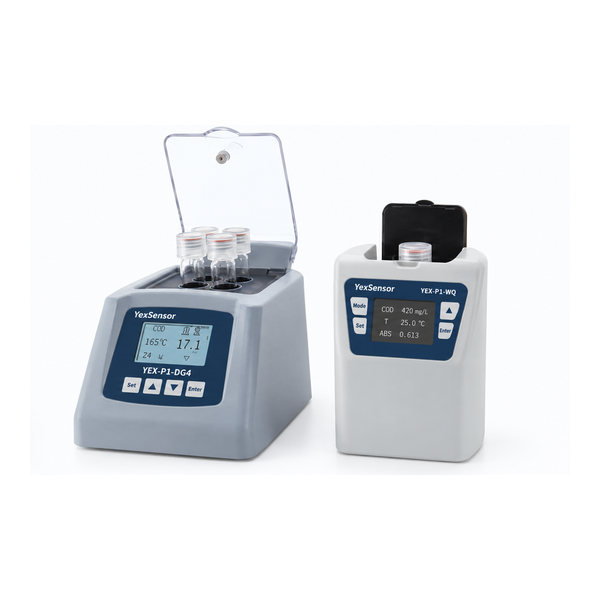
- Measurement and digestion matched as a system: The portable YEX-P1-WQ colorimeter works with the four-position YEX-P1-DG4 digester for methods that require controlled heating.
- Portable records, clear method control: The battery-powered colorimeter stores up to 3,000 records and exports History.csv through USB, while range selection, digestion, reaction time, and matrix control remain visible to the operator.
Product Overview
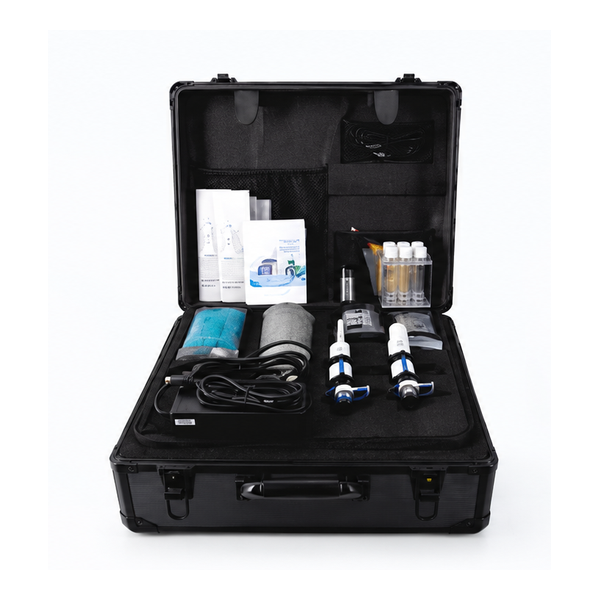
The YexSensor YEX-P1-WQ-KIT is a portable water quality testing kit for trained technicians who need several routine colorimetric parameters without transporting a separate meter for each analyte. It combines the YEX-P1-WQ portable colorimeter, YEX-P1-DG4 four-position digester, protective carrying case, 16 mm tubes, pipetting accessories, and order-specific reagent sets. The system is intended for laboratory work and field-support testing where samples can be handled with the required chemical safety, temperature control, timing, and waste-management procedures.
The colorimeter measures visible-light absorbance using LED wavelengths at 420, 520, and 620 nm. Installed programs guide measurements for COD, ammonia nitrogen, total phosphorus, total nitrogen, and CODMn. The digester supplies controlled heating up to 180 °C for CODCr, total phosphorus, total nitrogen, and permanganate-index procedures. Together, the two instruments create a practical workflow from sample preparation and digestion to blank zeroing, sample reading, record storage, and USB export.
Selection Considerations and Method Boundaries
Select the parameter and range before selecting reagents
The kit does not use one universal reagent for every sample. It contains 13 instrument programs divided by analyte, range, and method. The buyer should identify the expected concentration of each water matrix, then select the lowest program that safely contains the expected result. Samples above the installed range require a validated dilution and correct application of the dilution factor. The reagent code, blank preparation, sample volume, digestion condition, reaction time, and instrument program must remain matched.
Portable equipment still requires controlled chemical work
The colorimeter operates from two AA batteries, but several methods require the powered digester, corrosive acids, strong alkalis, oxidizers, mercury- or chromium-containing reagents, hot tubes, ventilation, chemical-resistant gloves, eye protection, a stable tube rack, and controlled hazardous-waste collection. “Portable” refers to organized transport and compact measurement equipment. It does not remove the need for a safe bench, appropriate power, a fume hood where required, or trained personnel.
Instrument readings do not replace the governing analytical method
The current reagent instructions, applicable standard, laboratory quality plan, local regulations, blanks, duplicates, spikes, quality-control standards, and holding-time rules determine whether a result is reportable. The equipment manual lists reference methods including HJ/T 399-2007, HJ 536-2009, GB 11892-89, GB 11893-89, and HJ 535-2009. Laboratories should confirm whether the selected program and reagent formulation satisfy the method required by their customer or regulator.
Key Technical Advantages
Broad concentration coverage without sacrificing range discipline
Segmented programs extend COD to 15,000 mg/L, ammonia nitrogen to 100.00 mg/L, total phosphorus to 20.00 mg/L, total nitrogen to 500.00 mg/L, and CODMn to 25 mg/L. Separate low- and high-range programs help the operator choose a concentration window appropriate to the sample rather than treating the full span as one undifferentiated calibration. Detection limits and reagent codes are stated program by program for procurement and method planning.
Controlled four-sample digestion
The YEX-P1-DG4 provides four heating wells, a programmable range of 50–180 °C, temperature-control precision of ±0.1 °C, and temperature tolerance of ±1 °C. Four tubes can be processed simultaneously under the transparent protective cover. The operator can set the method-specific combination of temperature and time, including 165 °C for 20 minutes for CODCr, 150 °C for 15 minutes for total phosphorus, 125 °C for 30 minutes for total nitrogen, and 100 °C for 30 minutes for CODMn.
Repeatable optical handling and record traceability
The colorimeter specifies accuracy of ≤±5%, repeatability of ≤±3%, and zero drift of ≤±0.3% full scale per 30 minutes. Reliable use still depends on correct blanking, clean and consistently oriented tubes, removal of fingerprints and bubbles, complete reaction time, and reading within the method window. Up to 3,000 valid records can be stored for later review and exported as a CSV file after the History Export command is run.
Compact kit organization for service teams
The protective case keeps the colorimeter, digester, tubes, pipetting accessories, cables, and selected reagents organized for transport. The colorimeter weighs 300 g including batteries, while the digester weighs 918 g. This separation allows the operator to carry the optical meter for non-digestion programs and deploy the complete kit when heated digestion is required. Final case contents and reagent quantities follow the sales order and packing list.
Technical Specifications
| Component | Parameter | Specification |
|---|---|---|
| Complete kit | Kit model | YEX-P1-WQ-KIT |
| Colorimeter | Instrument model | YEX-P1-WQ |
| Colorimeter | Light source and wavelengths | LED; 420 nm, 520 nm, and 620 nm |
| Colorimeter | Accuracy | ≤±5% |
| Colorimeter | Repeatability | ≤±3% |
| Colorimeter | Zero drift | ≤±0.3% F.S. per 30 min |
| Colorimeter | Data storage | 3,000 records |
| Colorimeter | Power | Two 1.5 V AA batteries |
| Colorimeter | Operating environment | 0–50 °C; 0–80% RH, non-condensing |
| Colorimeter | Storage temperature | -10–55 °C |
| Colorimeter | Dimensions and weight | 90 × 70 × 125 mm; 300 g including batteries |
| Digester | Instrument model | YEX-P1-DG4 |
| Digester | Temperature ranges | Control: room temperature to 180 °C; programmable: 50–180 °C |
| Digester | Temperature performance | Control precision ±0.1 °C; tolerance ±1 °C |
| Digester | Capacity | 4 heating wells; four samples simultaneously |
| Digester | Power supply | 12 VDC, 10 A |
| Digester | Dimensions and weight | 110 × 170 × 125 mm; 918 g |
Measurement Programs and Ranges
| No. | Program | Range | Detection limit | Method |
|---|---|---|---|---|
| 1 | COD S201 LR 150 | 10–150 mg/L | 10 mg/L | CODCr |
| 2 | COD S201 HR 1500 | 100–1500 mg/L | 100 mg/L | CODCr |
| 3 | COD S202 HR 15000 | 1000–15000 mg/L | 1000 mg/L | CODCr |
| 4 | Ammonia A113 LR 2.5 | 0.02–2.5 mg/L | 0.02 mg/L | Salicylic acid |
| 5 | Ammonia A114 HR 50 | 0.4–50 mg/L | 0.4 mg/L | Salicylic acid |
| 6 | Total phosphorus A101 LR 2 | 0.02–2 mg/L | 0.02 mg/L | Molybdate |
| 7 | Total phosphorus A102 HR 20 | 2–20 mg/L | 0.2 mg/L | Molybdate |
| 8 | Total nitrogen A101 LR 50 | 0.5–50 mg/L | 0.5 mg/L | Digestion/colorimetry |
| 9 | Total nitrogen A102 HR 500 | 50–500 mg/L | 50 mg/L | Digestion/colorimetry |
| 10 | COD B101 LR 5 | 0.5–5 mg/L | 0.5 mg/L | Permanganate index |
| 11 | COD B102 HR 25 | 5–25 mg/L | 2.5 mg/L | Permanganate index |
| 12 | Ammonia A201 LR 10 | 0.05–10 mg/L | 0.05 mg/L | Nessler |
| 13 | Ammonia A202 HR 100 | 10–100 mg/L | 0.5 mg/L | Nessler |
Program ranges are not interchangeable. Procurement teams should confirm the expected matrix and range before ordering reagents. When a sample is near a range boundary, use laboratory quality-control data to decide whether a higher program or validated dilution provides the more reliable result.
Application Scenarios
Wastewater treatment process checks
Operators can screen COD, ammonia nitrogen, total phosphorus, and total nitrogen at influent, process, and effluent points. Segmented ranges support both relatively clean treated water and higher-strength process samples. Results can help identify loading changes, aeration or nutrient-removal issues, and samples that should be sent for confirmatory laboratory analysis.
Industrial effluent and pretreatment surveys
The kit supports rapid comparison of production streams, equalization tanks, pretreatment stages, and final discharge samples. Industrial matrices often contain chloride, metals, oxidizers, reducers, color, suspended solids, or toxic chemicals, so dilution, pretreatment, spike recovery, and an alternate approved method may be necessary.
Surface water and source-water field support
The protective case and battery-powered colorimeter suit sampling campaigns where samples are collected away from the main laboratory. Non-heated steps can be organized near the sampling location, while digestion should be performed only at a controlled, ventilated workstation with suitable power and hazardous-waste arrangements.
Aquaculture and nutrient monitoring
Ammonia, total nitrogen, total phosphorus, and COD-related indicators can support routine observation of ponds, recirculating systems, intake water, and discharge. The selected range must fit the site, and salinity, hardness, disinfectants, algae, turbidity, and suspended material should be evaluated as potential matrix effects.
Service, teaching, and multi-site inspection teams
A single organized kit helps engineers demonstrate method steps, compare multiple sites, and retain records without carrying several dedicated photometers. For regulated reporting, the responsible laboratory must still apply the required standard, competence controls, traceable reagents, and documented acceptance criteria.
Digestion and Measurement Workflow
| Parameter group | Digestion setting | Operational control |
|---|---|---|
| CODCr | 165 °C for 20 min | Use matched blank and sample tubes; cap, mix, digest under the cover, then cool as directed. |
| Total phosphorus | 150 °C for 15 min | Cool before color development; complete the reading within the specified window after activator addition. |
| Total nitrogen | 125 °C for 30 min | Keep digestion and color-development tubes separate; prevent external nitrogen contamination. |
| CODMn | 100 °C for 30 min | Follow the reagent instruction for caps because the reaction cannot withstand high pressure; keep timing error below 1 min. |
For routine operation, place the digester on a level, heat-resistant, nonflammable bench with clear ventilation. Confirm that all wells are clean and dry, connect only the supplied 12 VDC, 10 A adapter, and keep the colorimeter, reagents, cables, and case away from the hot block. Prepare the exact blank and sample volumes, close the protective cover during digestion, move hot tubes with heat-resistant gloves, and cool them in a stable rack.
For colorimetric reading, select the exact program and range, clean the outside of the blank tube, remove droplets and bubbles, insert it in a consistent orientation, and press Zero. Insert the fully reacted sample in the same orientation and press Read. Delayed programs must complete their required reaction time before the delay is skipped or the result is read.
Sample Reagent and Interference Control
Good field logistics do not compensate for weak sample control. Use clean labeled containers, collect a representative sample, and analyze promptly. When the applicable procedure permits preservation, COD, total phosphorus, total nitrogen, or ammonia samples may be acidified to pH ≤2 with sulfuric acid and refrigerated at 4 °C, then returned to room temperature and carefully neutralized to approximately pH 7 before analysis. The governing method controls the holding time and any exceptions.
COD is particularly sensitive to chloride, reagent preparation, digestion time, tube handling, and suspended material. The manual states approximately 1,000 mg/L chloride tolerance for one prepared-reagent procedure and up to approximately 1,500 mg/L for the applicable prefilled-tube set. These values belong to their specific reagent procedures and must not be transferred to another kit formulation. A matrix above the stated condition requires validation or another method.
Ammonia methods can be affected by temperature, residual chlorine, sulfide, hardness, metals, reducing or oxidizing substances, organic matter, low pH, and turbidity. The salicylic-acid color-development range is preferably controlled at 23–27 °C. Total phosphorus can be affected by phosphorus in the blank, arsenate, sulfide, heavy metals, nitrite, and failed color development. Total nitrogen requires clean dedicated tubes and control of acidity and halides. Use blanks, duplicates, matrix spikes, standards, or approved distillation and pretreatment where the method requires them.
Data Export Cleaning and Maintenance
The YEX-P1-WQ stores up to 3,000 valid records. To retrieve the latest records, first run History Export from Function Settings, then connect the powered meter to a computer with the USB data cable. Open the removable drive and copy History.csv from the history folder. USB is provided for local record transfer and authorized software updates. The manual does not specify RS-485, Modbus, wireless, cloud, LIMS, or SCADA connectivity.
After testing, place chromium-, mercury-, acid-, alkali-, oxidizer-, and sample-contaminated waste in compatible labeled containers for an authorized hazardous-waste contractor. Do not discharge reagent waste to a drain. Rinse and clean reusable tubes according to the method, replace scratched or cloudy optical tubes, keep the colorimeter chamber dry, let the digester cool before cleaning, inspect cables and adapters, and remove AA batteries during long-term storage.
Configuration and RFQ Checklist
For a technically useful quotation, provide the required parameters, expected concentration ranges, sample matrices, number of samples per day, preferred reagent methods, tests per reagent lot, field and laboratory work split, applicable standards, quality-control plan, and known interferences such as chloride, color, turbidity, disinfectants, salinity, metals, or extreme pH. Also state the destination, plug requirement, interface language, desired number of tubes and pipettes, and whether additional consumables are required.
YexSensor will use these inputs to confirm the YEX-P1-WQ program set, YEX-P1-DG4 digester, tube and pipetting quantities, reagent codes and test quantities, USB cable, adapter, carrying case, documentation, and delivery configuration. Reagent composition and quantities are order-specific. The sales order and final packing list, not a generic product photograph, determine what is delivered.
Typical Kit Components and Order Defined Packing
| Component | Purpose | Typical quantity |
|---|---|---|
| YEX-P1-WQ | Portable colorimetric measurement and data storage | 1 |
| YEX-P1-DG4 | Four-position temperature-controlled digestion | 1 |
| Protective carrying case | Transport and organized storage | 1 |
| 16 mm tubes and caps | Blank, sample, digestion, and color development | According to kit |
| Tube rack | Cooling and organizing hot or reacted tubes | 1 |
| Pipettes and tips | Accurate transfer of samples and reagents | According to kit |
| Reagent sets | Method-specific reactions | According to order |
| Power adapter and USB cable | Digester power and colorimeter data transfer | 1 set |
| Optical cleaning cloth | Cleaning the outside of measurement tubes | 1 |
Inspect the delivered kit immediately. Report missing, broken, leaking, or mismatched items before use. Consumable quantities, reagents, accessories, and any optional items must be confirmed against the quotation and packing list.
Quality Assurance and After Sales Information
YexSensor recommends documenting instrument model and serial numbers, reagent code and lot, sample matrix, selected program, dilution, digestion settings, blank and quality-control results, operator, and date for each batch. When a result is unexpected, review range selection, volumes, tube cleanliness, bubbles, temperature, timing, reagent condition, matrix interference, and quality-control recovery before concluding that the instrument is faulty.
The standard warranty period is one year from the purchase date. Keep the warranty card and proof of purchase. Free warranty repair excludes damage caused by use contrary to instructions, unauthorized dismantling or repair, force majeure, consumables, normal wear, or products outside the warranty period. When requesting support, provide the kit model, both instrument serial numbers, reagent program and lot, sample matrix, settings, observed result, photographs, and a clear fault description.
Frequently Asked Questions
1. Which parameters can the YEX-P1-WQ-KIT measure?
The installed program set covers COD by dichromate methods, ammonia nitrogen by salicylic-acid and Nessler methods, total phosphorus, total nitrogen, and CODMn or permanganate index. There are 13 defined programs with separate ranges and detection limits. Confirm the required analytes, expected concentrations, and reagent codes before ordering because the delivered reagent sets are configured to the sales order.
2. What are the maximum measurement ranges?
The highest installed ranges are COD 1000–15000 mg/L, ammonia nitrogen 10–100 mg/L, total phosphorus 2–20 mg/L, total nitrogen 50–500 mg/L, and CODMn 5–25 mg/L. Lower ranges are also provided for better fit to lower-concentration samples. These ranges belong to specific programs and reagents; they should not be combined into one continuous calibration or transferred to a different method.
3. Does every parameter require digestion?
No. CODCr, total phosphorus, total nitrogen, and CODMn procedures in the manual use defined digestion settings. The ammonia procedures use color-development reactions without the listed digester steps. Always follow the current reagent instruction because it governs exact volume, cap condition, temperature, time, cooling, reaction sequence, and read window.
4. Can the kit be used directly at an outdoor sampling point?
The colorimeter is battery powered and the protective case supports transport, but hot digestion and hazardous reagents require a controlled workstation, suitable 12 VDC/10 A power through the supplied adapter, ventilation or a fume hood where required, PPE, a tube rack, and compliant waste collection. A field team can collect samples and perform suitable non-heated steps, then complete digestion in a safe field laboratory or permanent laboratory.
5. How are results exported?
The colorimeter stores up to 3,000 valid records. Run History Export in the instrument menu, connect the powered meter to a computer with the USB data cable, and copy History.csv from the history folder on the removable drive. The manual does not specify RS-485, Modbus, Bluetooth, Wi-Fi, cloud, LIMS, or SCADA communication, so any broader integration must not be assumed.
6. How should an over-range or difficult sample be handled?
First verify that the correct analyte and program were selected. Choose a higher installed range when appropriate, or perform a validated dilution with approved water and multiply by the correct factor. For colored, turbid, saline, chlorinated, metal-rich, highly acidic, reducing, oxidizing, or organic matrices, apply the governing method's pretreatment and verify recovery with suitable quality-control samples.
7. Are all reagents and accessories shown in the photograph included?
Not necessarily. The typical kit includes the colorimeter, digester, case, tube rack, power adapter, USB cable, and optical cleaning cloth, while tube, pipette, tip, and reagent quantities depend on the kit configuration and order. The quotation and final packing list define delivery. Buyers should specify programs, test quantities, spare tubes, consumables, and required reagent lots before confirmation.
8. What information should be sent for a quotation?
Provide the sample types, required parameters, expected ranges, daily test volume, preferred reagent methods, applicable standards, field conditions, power and plug requirements, known interferences, quality-control plan, requested reagent quantities, extra tubes or pipettes, language, destination, and acceptance requirements. YexSensor can then confirm the program set, consumables, accessories, packing, and support scope without relying on assumptions.
Summary
The YEX-P1-WQ-KIT is suited to trained water-quality teams that need a compact, organized system for multi-parameter colorimetry and four-position digestion. Its value comes from defined program ranges, matched digestion and measurement hardware, a battery-powered colorimeter, 3,000-record storage, USB CSV export, and a protective transport case. Its method boundaries are equally important: safe chemical handling, correct reagents, controlled digestion, clean optical tubes, matrix evaluation, quality control, and compliant waste disposal remain essential to defensible results.
For a configuration aligned with real samples, send YexSensor the analytes, expected concentrations, matrices, test volume, standards, reagent preferences, known interferences, field-work plan, power requirements, consumable quantities, destination, and acceptance criteria. These inputs allow the program selection, reagent range, accessory count, delivery list, and operating workflow to be confirmed before shipment.

