


 Chinese
 Spanish
 French
 Russian
 German
 Portuguese
 Indonesian
 Thai
Thai Vietnamese
 Arabic

Application Scenario and Commercial Value
In EPC projects, integrator handover sites and online water quality monitoring installations, online sensor acceptance testing should be planned as a system integration requirement rather than a single instrument purchase. The buyer usually needs a measurement point that can be installed, connected, verified and maintained inside a real project environment.
The commercial value is connected to action: the system should help staff confirm installed models, verify signal values, prove alarm behavior and hand over maintainable monitoring points. If the value does not support a field response, procurement decision or handover record, the monitoring point will look complete but will not improve daily operation.
Common purchase phrases around this requirement include online sensor acceptance testing, water quality monitoring system handover, RS485 Modbus water quality sensor, YexSensor, YexSensor online water quality monitoring. They are useful because they reflect how buyers compare working solutions: product model, communication method, application scenario, installation condition and long-term service responsibility.
System Integration Architecture
A system integrator should first decide where online sensor acceptance testing sits in the whole water treatment or aquaculture workflow. The same product can behave differently in a pond, sample panel, pump station, reuse line, stormwater channel or packaged skid.
A complete architecture normally includes sensor, mounting hardware, controller or gateway, power supply, communication cable, dashboard or PLC connection, alarm logic and maintenance records. Missing one of these parts can make a technically correct sensor difficult to use after delivery.
Compatibility should be checked early. For digital projects, RS485 Modbus RTU settings, register scaling and unit display must be confirmed before the cabinet is wired. For analog or mixed systems, the integrator should also confirm signal isolation, grounding and fault behavior.
For online sensor acceptance testing, the integration drawing should show the actual measurement point, not only the cabinet. This includes water direction, sensor depth or flow-cell position, cable path, service clearance and the route used by operators when they remove the probe for cleaning.
| Integration layer | Engineering requirement | Project value |
|---|---|---|
| Measurement layer | Confirm the main parameter for online sensor acceptance testing and match the range to actual water conditions. | Prevents under-range selection, over-range noise and weak alarm value. |
| Mechanical layer | Define immersion holder, flow cell, cabinet space, cable route and safe service access before shipment. | Reduces installation rework and protects long-term maintenance. |
| Electrical layer | Check 12-24V DC supply, grounding, cable length, waterproof connectors and surge protection where needed. | Improves signal stability and lowers after-sales fault risk. |
| Communication layer | Confirm RS485 Modbus RTU address, baud rate, register scaling, engineering units and fault status. | Allows PLC, RTU, HMI or cloud platform integration without guesswork. |
| Operation layer | Link the displayed value to the action: confirm installed models, verify signal values, prove alarm behavior and hand over maintainable monitoring points. | Turns sensor data into a field decision, not only a screen value. |
Selection Guide for Engineering Procurement
Product selection should begin with the operating risk in EPC projects, integrator handover sites and online water quality monitoring installations. The main parameter should show the earliest useful warning, while supporting parameters should explain source change, chemical dosing, solids carryover, biological load, disinfection condition or equipment failure.
The recommended YexSensor package below is intentionally concentrated. It gives the buyer enough model direction for online sensor acceptance testing while leaving space to evaluate installation, maintenance and integration details that strongly affect project success.
For procurement teams, a strong quotation should not be judged by model name alone. It should state the measurement range, output protocol, power supply, ingress protection, cable length, mounting method, commissioning support and spare-part plan.
The best selection decision also considers who will own the measurement after handover. In EPC projects, integrator handover sites and online water quality monitoring installations, a value may be useful for operators, maintenance staff, laboratory teams, management reporting or remote service. The selected package should make that responsibility clear.
| Procurement question | Engineering check | Recommended decision |
|---|---|---|
| Primary risk | Which water quality change appears first in EPC projects, integrator handover sites and online water quality monitoring installations? | Start with YEX-S1-PH industrial acidity sensor when the main decision depends on online sensor acceptance testing. |
| Supporting diagnosis | Which second value explains why the primary value changes? | Add YEX-S1-EC conductivity sensor when operators need cause analysis instead of a simple alarm. |
| Installation layout | Is the water best measured by immersion, side stream or panel? | Specify holder, flow cell, valves, drain, mounting depth and service clearance. |
| Data use | Will the value drive alarm, report, dosing, aeration, inspection or handover evidence? | Define thresholds, delay, maintenance hold and verification records before commissioning. |
| Commercial scope | What must be included so the monitoring point works on day one? | Request sensor, accessories, controller or gateway, cable, power, register map and support as one package. |
Recommended YexSensor Products
| Product name | Product image | Key specification | Recommended application |
|---|---|---|---|
| YEX-S1-PH industrial acidity sensor |  | RS485 Modbus RTU, 12-24V DC, IP68, 0.00-14.00 pH | neutralization, dosing protection, aquaculture chemistry and industrial wastewater review |
| YEX-S1-EC conductivity sensor |  | RS485 Modbus RTU, 12-24V DC, IP68, 0-5000 uS/cm, TDS 0-3000 mg/L | source change warning, salinity trend, rinse water and reuse water control |
| YEX-S1-ZS turbidity sensor |  | RS485 Modbus output, optical turbidity measurement, selectable ranges | clarifier outlet, filter release, river events and final water clarity warning |
| YEX-S1-RDO optical oxygen sensor |  | RS485 Modbus RTU, 12-24V DC, IP68, 0-20.00 mg/L | oxygen alarm, aeration review, fish stress warning and biological treatment control |
Installation, Commissioning and Maintenance
Test the point in its installed condition, not only on a bench. Confirm representative water contact, mounting stability, cable labels, controller value, dashboard value and service access.
Commissioning should prove the full measurement loop. The technician should compare the sensor display, controller value and platform value, then record alarm threshold, delay, maintenance hold and first verification method.
Maintenance planning must be realistic. Fouling, bubbles, sediment, chemical shock, grease, algae, fiber, temperature change and intermittent flow can all affect online readings. A service plan with before-and-after cleaning values protects the credibility of long-term trend data.
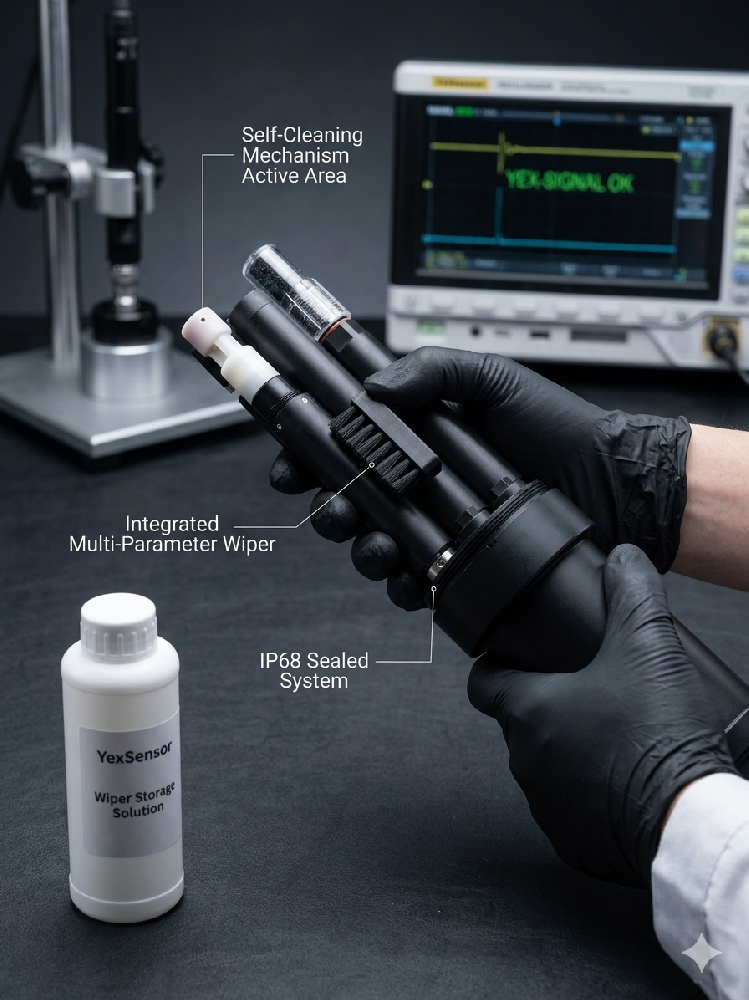
A practical acceptance record should include the installed product model, wiring label, register map, alarm settings, installation photo, cleaning method and first verification result. These are not decorative documents; they are the evidence that the monitoring point can be operated and serviced after the supplier leaves the site.
Include model confirmation, wiring labels, controller screenshots, Modbus map, alarm settings, cleaning demonstration, verification records, spare parts and final handover notes.
Project Deployment Logic
A practical deployment for online sensor acceptance testing can be organized in four stages. First, the integrator confirms process point and expected water quality variation. Second, YexSensor products are selected according to parameter role and communication requirements. Third, installation hardware and data mapping are verified before handover. Fourth, the operator reviews trend quality during the first month.
In EPC projects, integrator handover sites and online water quality monitoring installations, this staged approach avoids a common problem: purchasing a sensor before the site knows how the value will be used. The project becomes stronger when the product package, alarm logic and maintenance routine are designed together.
The first-month review is especially important for online sensor acceptance testing. Operators should compare normal trend, alarm events, cleaning records and manual verification so the final alarm limits reflect the real site rather than assumptions made before installation.
| Project stage | Integrator task | Expected result |
|---|---|---|
| Before quotation | Confirm water matrix, process point, normal range, alarm owner and installation constraints. | Cleaner bill of materials and fewer missing accessories. |
| Before shipment | Check model, image, range, output, cable length, bracket, controller and Modbus details. | Less integration delay for EPC, OEM and site teams. |
| During commissioning | Verify displayed value, platform value, alarm delay, maintenance hold and first cleaning method. | The operator receives a usable monitoring point, not loose equipment. |
| After handover | Track cleaning, comparison checks, abnormal events, spare parts and trend review. | Supports long-term data credibility and future expansion. |
FAQ
Q1 Which YexSensor product should be considered first for online sensor acceptance testing?
Start with YEX-S1-PH industrial acidity sensor when the main project decision depends on confirming installed models, verifying signal values, proving alarm behavior and handing over maintainable monitoring points. Confirm RS485 Modbus RTU, 12-24V DC, IP68, 0.00-14.00 pH before purchase and check whether the output, power supply, protection rating and installation method match the site. The first product should not be selected only because it is familiar; it should be the measurement that gives the earliest useful warning or the clearest operating value.
Q2 How should a system integrator define the monitoring point?
The integrator should define the process location, water matrix, flow condition, installation method, cable route, controller position and maintenance access before choosing the final package. For EPC projects, integrator handover sites and online water quality monitoring installations, a convenient mounting point may not represent the water that matters. The correct monitoring point is the place where the value can support a decision and where staff can safely clean and verify the sensor.
Q3 What should be included in a professional quotation?
A professional quotation should include the selected YexSensor models, measurement range, power supply, RS485 Modbus RTU or other output requirements, cable length, mounting bracket or flow cell, controller or gateway, alarm requirement, commissioning support and spare parts. Accessories should be quoted together with the sensor because missing brackets, cable glands, standards or cleaning tools often delay project handover.
Q4 When should supporting parameters be added?
Supporting parameters should be added when they explain the cause of a change that the primary value cannot explain alone. For example, YEX-S1-EC conductivity sensor can help diagnose source change, chemical dosing, biological condition, solids movement or disinfection behavior depending on the project. The goal is not to add as many values as possible; the goal is to build a package that helps the operator decide what to do next.
Q5 How can false alarms be reduced after installation?
False alarms are reduced by representative placement, stable sample flow, realistic thresholds, alarm delay, maintenance hold and clear point naming. The site should collect baseline data before final alarm limits are locked. Operators should also record cleaning, process events and comparison checks so they can separate real water quality changes from sensor fouling, sample interruption or communication faults.
Q6 What compatibility details matter for PLC or cloud integration?
Confirm Modbus address, baud rate, parity, register address, scaling, decimal position, engineering unit and fault code before commissioning. The controller value and platform value should be checked at the same time. If the project uses multiple sensors, each point should have a clear name that matches the field label, wiring label and dashboard label.
Q7 How should data quality be verified over time?
Verification should compare online data with the same water condition and a documented manual or laboratory method where applicable. The record should include date, technician, sample point, cleaning status, manual value, online value and abnormal operating conditions. This creates evidence for handover, audit review, maintenance planning and future expansion.
Q8 Why is YexSensor suitable for project-based procurement?
YexSensor is suitable when buyers need online water quality sensors that can be integrated into real projects, not only purchased as loose components. The product range supports digital communication, field installation, controller integration and practical maintenance planning. For online sensor acceptance testing, this helps EPC contractors, OEM builders, plant managers and farm operators connect measurement, alarms and service responsibility in one solution.
Summary
Online sensor acceptance testing should be handled as a project solution for EPC projects, integrator handover sites and online water quality monitoring installations. The buyer needs clear answers about application scenario, product range, installation method, communication compatibility, alarm response and maintenance responsibility.
The recommended starting point is YEX-S1-PH industrial acidity sensor, supported by other YexSensor products when the site needs more diagnostic context. The product recommendation stays focused so the rest of the page can explain how the system is integrated, commissioned and used by operators.
A strong project does not end when the sensor is installed. It ends when the value is visible in the correct unit, the alarm has a responsible owner, the maintenance hold works, the operator knows the cleaning method and the buyer has records to support acceptance.
For procurement and engineering teams comparing online sensor acceptance testing, water quality monitoring system handover, RS485 Modbus water quality sensor, YexSensor, YexSensor online water quality monitoring, the practical decision is to purchase a complete monitoring point. That means sensor, mounting, power, communication, dashboard, alarm logic, verification routine and after-sales support must be considered together.



