


 Chinese
 Spanish
 French
 Russian
 German
 Portuguese
 Indonesian
 Thai
 Vietnamese
 Arabic


Conductivity supports a defined rinse decision
CIP final rinse conductivity can help assess the decline of ionic cleaning residues when the relationship has been validated for the actual water and cleaning chemistry. Compare the return water with an appropriate supply-water baseline on the same temperature basis. Conductivity alone does not demonstrate removal of all organic residues, microbiological cleanliness or satisfactory cleaning of every surface.
For an equipment buyer, two approvals are required: the measurement must be suitable for the endpoint decision, and the sensor assembly must be suitable for the installation. A useful trend from a laboratory trial does not qualify a general-purpose probe for a hygienic process line.
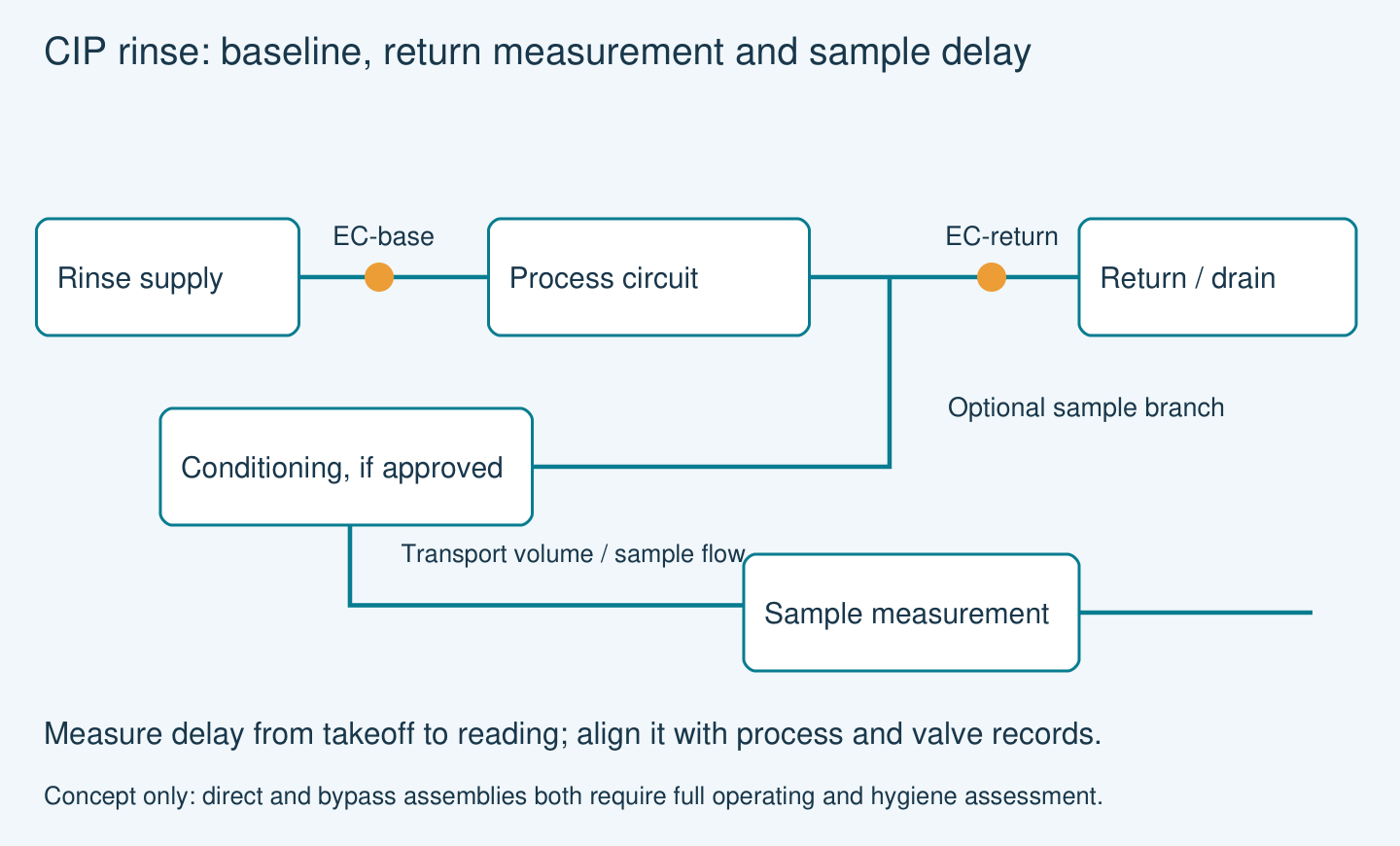
Two purchasing risks: false release and unsuitable hardware
A wide measurement span may cover the displayed value while failing to resolve the small difference that matters near the rinse endpoint. Specify the required decision margin, not only the maximum reading. An attractive display resolution does not establish measurement accuracy or total installed uncertainty.
The second risk is selecting by nominal water temperature while ignoring hot cleaning stages, chemical exposure or pressure excursions. If a sensor remains connected during other stages, it experiences those conditions too. A hygienic installation additionally requires evidence for the complete wetted assembly, connection and cleaning behaviour; an IP rating is not proof of hygienic suitability.
Check conductivity range and installation qualification
The official YEX-S1-EC Modbus product page describes a 0–5000 µS/cm variant with RS485 Modbus RTU. This is evidence for an industrial conductivity channel, not evidence of hygienic CIP qualification. Other range options must be tied to their own confirmed order configuration and manual.
This guide does not recommend YEX-S1-EC as a CIP endpoint sensor. Its industrial specifications are included as an exclusion example: an interface and measurement span do not qualify a probe for this duty. The documented 0–50°C working limit rules out exposure to hotter cleaning stages for this configuration. A sanitary connection additionally requires documented qualification of the complete assembly. If the project requires that service, obtain explicit supporting documentation for a suitable assembly or select a verified alternative.
Product reference: YEX-S1-EC specifications and integration information.
Specification boundaries for the quotation
| Check | Evidence boundary | Purchase implication |
|---|---|---|
| Linked product variant | 0–5000 µS/cm; RS485 Modbus RTU | Confirm performance around the rinse baseline; span alone does not prove endpoint discrimination. |
| Manual working envelope | 0–50°C; pressure below 0.6 MPa | Exclude exposure above 50°C or at/above 0.6 MPa; being within these limits alone does not establish CIP suitability. |
| Range selection | The manual lists separate conductivity ranges | Specify the exact ordered range and its documentation; do not assume automatic range switching or transfer accuracy between variants. |
| Hygienic qualification | Not established by the reviewed documentation | Do not approve direct sanitary process connection; obtain a qualified assembly or an independently assessed sampling design. |

Worked range check: resolution is not endpoint accuracy
The S1-EC manual lists a precision of ±1% of full scale. Applied to its 0–5000 µS/cm configuration, that is ±50 µS/cm, calculated as 5000 × 0.01. The listed 1 µS/cm resolution does not reduce that specification to ±1 µS/cm. This calculation concerns this range only; it is not a performance claim for the other order configurations.
For an illustrative project requiring a 10 µS/cm decision margin, that full-scale specification alone would not justify the selection. The 10 µS/cm value is a hypothetical purchasing example, not a recommended rinse endpoint. Assess the complete measurement uncertainty, baseline variation and the actual acceptance method before selecting an instrument; a suitable range still does not establish hygienic or chemical compatibility.
Compare direct, bypass and sampled measurements
A direct return-line installation can reduce transport delay but exposes the complete assembly to the line conditions. A conditioned bypass may reduce exposure, yet adds transport time, possible contamination and sample-representativeness questions. Neither architecture is inherently acceptable without a documented design.
Independent samples are useful for development and cross-checks, but their collection and handling must match the question being investigated. A cooled sample compared with an uncompensated hot online value may appear to disagree even when both instruments are operating as configured.
| Arrangement | Question answered | Purchase decision |
|---|---|---|
| Direct return line | Shorter sample transport | Require verified full-cycle temperature, pressure, chemical and hygienic suitability. |
| Conditioned bypass | Controlled measurement environment | Quantify delay and contamination risk; verify sample representativeness and isolation. |
| Independent sampling | Endpoint development and verification | Specify handling, temperature basis and reference method; do not assume continuous coverage. |
| Dedicated qualified hygienic assembly | Mandatory sanitary process connection | Select only against documented project requirements; do not infer qualification from IP68. |
Develop an endpoint rule from the actual process
Begin with the normal variability of the water used for the final rinse. Compare supply and return measurements on an explicitly defined temperature basis. Evaluate the real detergent or rinse chemistry over the range relevant to the endpoint; do not assume all residual chemicals produce the same response.
Then establish whether the proposed conductivity criterion can distinguish acceptable from unacceptable conditions using the project’s independent residue assessment. An endpoint tolerance must leave room for measurement uncertainty, baseline variation and sampling effects. If it cannot, a more suitable instrument or a different analytical method is needed.
Tetra Pak’s cleaning guidance treats conductivity as one monitored process parameter and discusses separate verification of the cleaning effect. That distinction is essential: a control signal can support a validated cleaning programme without becoming a stand-alone certificate of cleanliness.
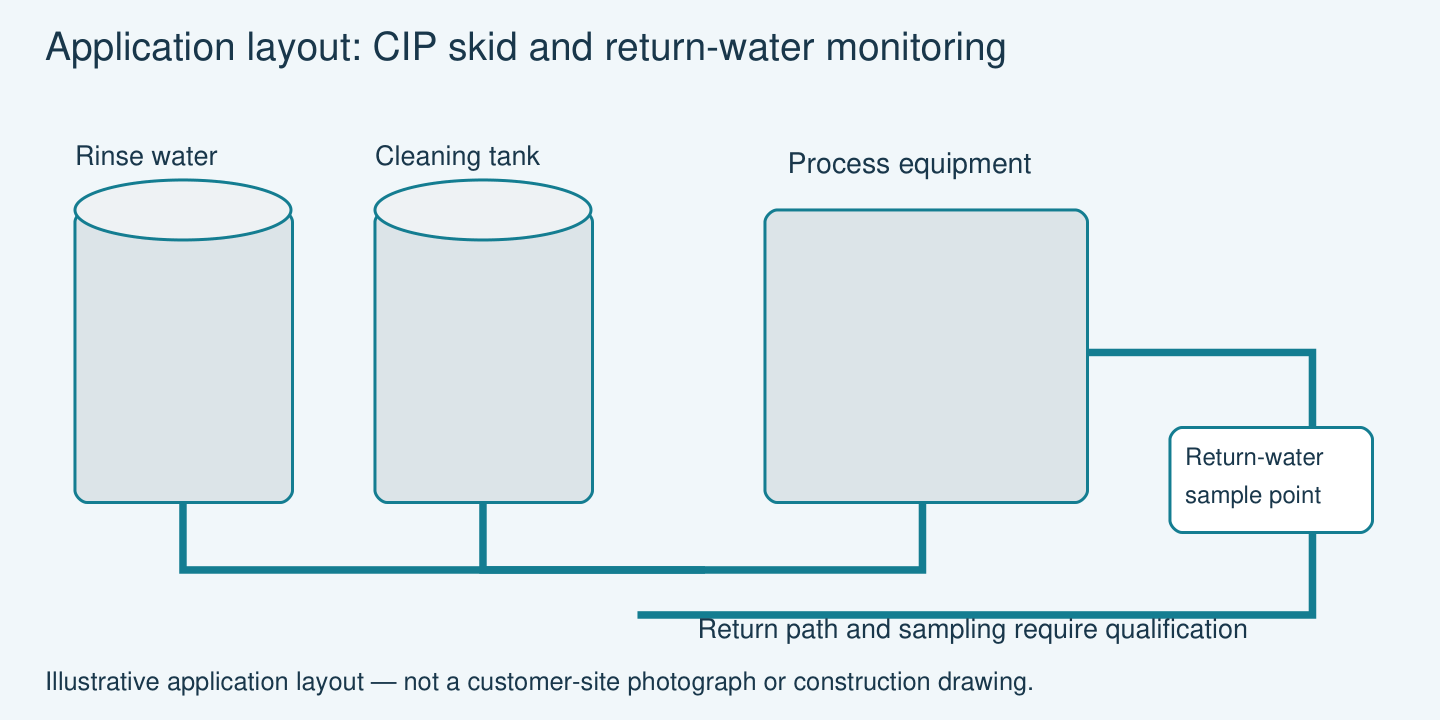
Field scenarios and integration checks
When source-water conductivity changes, a fixed absolute threshold may become misleading. Investigate the supply baseline before interpreting the return trend as extra detergent. A paired arrangement may help, but its instruments must share an agreed measurement basis.
When a long bypass is used, its displayed endpoint may describe water that left the process earlier. Estimate and measure sample delay, then incorporate it into the control sequence. Avoid adding an arbitrary delay merely to make a trend look stable.
When the circuit switches between products or cleaning recipes, review whether the established relationship still applies. Retain recipe identification, temperature, flow status and valve state with conductivity records.
Controller logic should inhibit endpoint acceptance when data are stale, the sample flow is absent, or the measurement is outside the validated conditions. Confirm the signal scaling and units, timestamp alignment, power-loss behaviour and alarm handling. Any automatic release function requires project validation of the whole sequence, not just a successful Modbus connection.
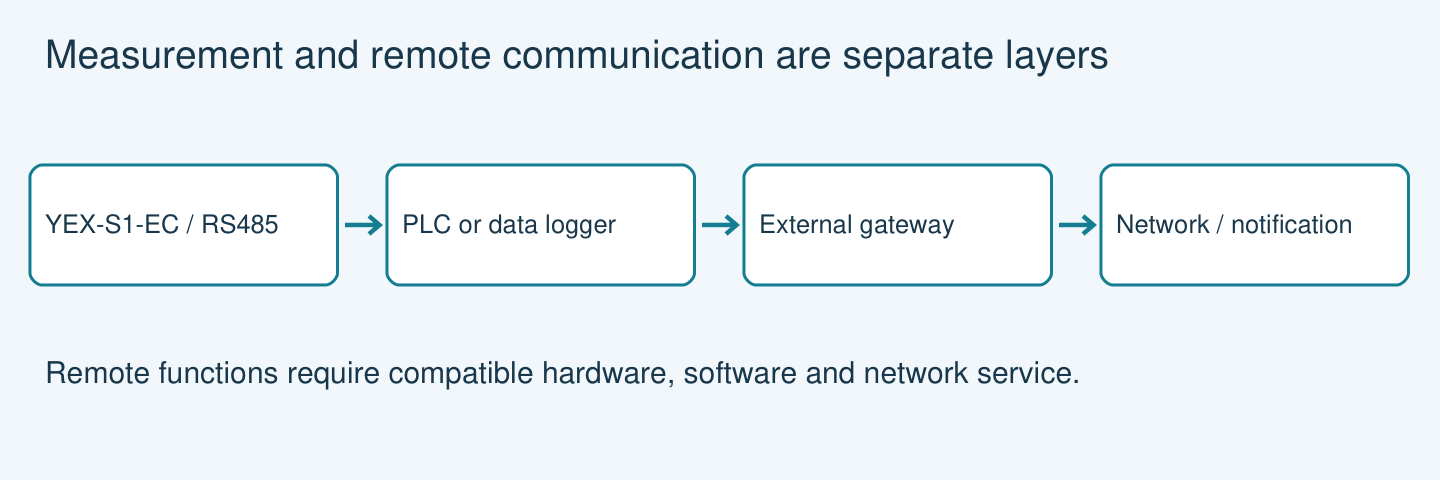
The diagram shows the published RS485 interface of YEX-S1-EC as a communication example; it does not qualify this sensor for a CIP circuit. A compatible PLC or data logger reads the signal and implements the approved monitoring logic. Remote notifications require a separately specified gateway, network service and software; they are not inherent features of the probe.
The water quality sensor range provides an overview of measurement options. Select the sensing method first, then establish the operating and hygienic qualification of the complete assembly.
RFQ checklist: define the evidence the supplier must return
Provide cleaning chemicals and concentrations, final-rinse water composition and conductivity, the expected endpoint difference, the temperature basis and the full temperature/pressure exposure profile. Include a process diagram showing whether the sensor remains exposed during cleaning, disinfection and idle periods.
State required wetted materials, seals, sanitary connections, documentation and certification requirements explicitly. For a bypass, include flow, transport volume, cooling, drainage and contamination controls. Request demonstrated performance near the proposed endpoint, not only full-scale coverage.
Separate the sensor quotation from sample conditioning, hygienic hardware, controller work and validation services. Require written confirmation of suitability before issuing a purchase order for a process-connected assembly.
Technical references
Discuss Your Project Requirements
Send the project data listed in the RFQ checklist above, together with your quantity, destination, installation drawing and acceptance requirements. Identify any mandatory documentation and the decision the measurement must support.
Compare the YEX-S1-EC industrial specifications with the required exposure and qualification. This reference is not a CIP product recommendation; request a documented suitable assembly and endpoint validation for your process.
- Rinse-water baseline, endpoint decision margin and acceptance method
- All cleaning chemicals, concentrations, temperatures and pressures throughout exposure
- Connection and wetted-material requirements, sampling layout, quantity and documentation needs
FAQ
Q1. Does low conductivity prove that cleaning is complete?
No. It can support an endpoint for ionic residues when that relationship has been validated, but it does not establish removal of every soil or microbiological cleanliness. Keep the project’s independent cleaning verification and acceptance procedure.
Q2. Why compare the final rinse with supply water?
Supply water contributes its own conductivity and can vary. Comparing on the same temperature basis helps distinguish background changes from return-water changes. Define the baseline method and allowable variation before configuring an endpoint alarm.
Q3. Can a TDS value replace conductivity for this decision?
Do not substitute an estimated TDS display without validation. It is derived using a conversion relationship and does not identify cleaning chemicals. Specify conductivity units and temperature treatment directly when the validated endpoint procedure uses conductivity.
Q4. Can YEX-S1-EC be installed directly in a hot CIP line?
No: the documented 0–50°C working range does not support exposure above 50°C. This guide does not recommend this model for hot CIP or hygienic endpoint service. Specify a suitable assembly with full-cycle temperature, pressure, chemical and hygienic evidence; an industrial Modbus interface is not qualification.
Q5. Is a wider range always preferable?
No. The important question is performance around the endpoint difference, including accuracy, repeatability and installed uncertainty. Request evidence near the expected rinse baseline and select the configuration that can distinguish the required conditions.
Q6. Does a cooled bypass solve every compatibility problem?
No. It can alter temperature exposure but introduces delay, sample handling and possible contamination issues. The pressure, materials, isolation and cleaning of the sample system still need review. Order the complete assessed arrangement rather than an unsupported probe-and-tube combination.
Q7. What information is essential for a quotation?
Supply the chemical programme, baseline water, endpoint requirement, complete exposure profile, connection design and required documentation. Identify whether the measurement only records a trend or participates in automatic release, because the required acceptance scope is different.
Q8. What must be demonstrated before automatic endpoint control?
Show that the measurement criterion correlates with the agreed acceptance method under the validated process conditions. Test sample delay, missing data, absent flow and abnormal valve states. Approve the complete control sequence and retain the results with the commissioning documents.
Q9. What if hygienic qualification cannot be supplied?
Do not approve the proposed assembly for a hygienic process connection. Ask for a documented suitable alternative or reconsider the measurement architecture with the project engineer. A general industrial sensor price does not resolve a missing qualification requirement.
Summary
Use conductivity within a validated final-rinse procedure, with supply-water background, temperature and sampling delay explicitly controlled. YEX-S1-EC is not recommended for CIP endpoint service by this guide. Select an assembly with documented full-cycle operating and hygienic suitability and demonstrated performance near the actual rinse baseline. Confirm the complete installation and controller behaviour, and send the chemical programme, endpoint margin, exposure profile and qualification requirements with the RFQ.


