


 Chinese
 Spanish
 French
 Russian
 German
 Portuguese
 Indonesian
 Thai
Thai Vietnamese
 Arabic


Products Description
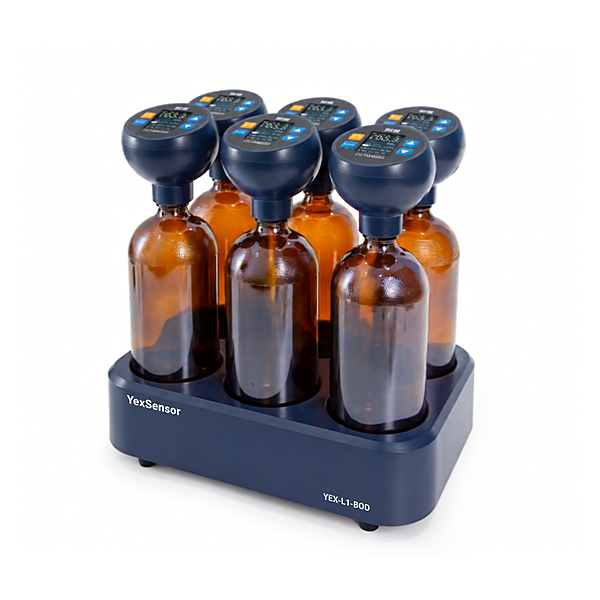
YEX-L1-BOD Digital BOD Analyzer: run six pressure-difference BOD tests in parallel with controlled incubation and traceable terminal records
- Wide working range: 0–4000 mg/L with eight prescribed sample volumes from 500 mL to 25 mL, allowing many samples below 4000 mg/L to be tested without dilution when the correct range is selected.
- Six independent positions: six sealed 580 mL amber culture bottles, six pressure-monitoring terminal heads, and continuous magnetic stirring support simultaneous testing of up to six samples.
- Method-focused quality control: selectable 1–30 day tests, BOD5 operation at 20 ± 1 °C, local intermediate and final records, and a glucose-glutamic acid check with an expected BOD5 result of 180–230 mg/L.
Product Overview
YexSensor YEX-L1-BOD is a digital respirometric BOD analyzer for laboratories that need to evaluate organic loading, wastewater-treatment performance, biodegradability, or process changes without relying on repeated dissolved-oxygen measurements during the incubation period. The system uses a sealed-bottle pressure-difference method. Microorganisms consume dissolved oxygen while degrading oxidizable matter; oxygen in the bottle headspace replenishes the sample; generated carbon dioxide is absorbed by sodium hydroxide; and the resulting pressure decrease is converted to a BOD value.
The analyzer accepts up to six samples at one time and supports a selectable test duration from 1 to 30 days. For a conventional BOD5 determination, the programmed period is five days and the complete stirring system remains in a dark, temperature-controlled incubator at 20 ± 1 °C. Each bottle has its own terminal head for setting sample volume, test duration, delay, terminal number, time, and display brightness. The terminal stores intermediate readings during the active run and automatically saves the final result when the programmed period ends.
Selection Considerations and Method Boundaries
The analyzer does not replace incubation and method control
The standard instrument package does not include a temperature-controlled incubator. A dark incubator capable of maintaining 20 ± 1 °C is required and must hold the assembled six-position stirring system. Temperature changes affect headspace pressure and can cause measurement error. Laboratories also remain responsible for blanks, dilution and seed corrections, replicate testing, inhibitor use, acceptance limits, reagent control, and reporting under the governing BOD method.
Range depends on the exact sample volume
The terminal converts pressure change according to the selected sample volume. The volume entered in the terminal must therefore match the volume placed in the 580 mL culture bottle. Choose the largest sample volume whose range will not be exceeded to reduce error. A result above the selected range requires a new test with a smaller aliquot or a validated dilution. Samples expected above 4000 mg/L require dilution before testing.
Sample biology and interferences must be assessed
pH, chlorine, toxic metals, salinity, microbial population, algae, suspended particles, nitrification, freezing, and prior treatment can change the observed oxygen demand. Some samples require neutralization, dechlorination, dilution, homogenization, nutrients, buffer, seed, filtration, or a nitrification inhibitor. These decisions belong in the laboratory method and should be defined before the instrument configuration and reagent quantities are quoted.
Key Technical Advantages
Parallel six-sample operation
Six independent terminal heads allow different samples or replicates to run in parallel on one stirring base. Unique terminal numbers help operators distinguish positions. The amber 580 mL bottles limit light exposure, while continuous magnetic stirring supports oxygen transfer between the headspace and sample. Parallel operation is useful for sample sets, duplicates, seeded and unseeded comparisons, inhibitor studies, or GGA checks when the laboratory plan permits.
Direct digital pressure monitoring
Each terminal measures pressure change, applies the factor for the selected sample volume, displays the current BOD value, and stores test data. The four-key interface provides direct access to sample volume, test days, constant-temperature delay, terminal number, system time, detail data, and history. Automatic sleep reduces unnecessary battery use, while the terminal can be awakened at any point to review the current result.
Eight range and volume combinations
The prescribed aliquots cover 0–20, 0–40, 0–80, 0–160, 0–320, 0–800, 0–2000, and 0–4000 mg/L. This structured selection connects the expected concentration to a defined sample volume instead of relying on a single bottle volume for every matrix. When no better estimate is available, approximately 60% of CODCr may be used as an initial BOD estimate, followed by confirmation under the laboratory method.
Quality verification with a GGA standard
Instrument and method performance can be checked using glucose and glutamic acid. The source procedure dries both materials, prepares a seeded 1 L standard containing 150 mg of each, and tests parallel bottles through the complete BOD5 procedure. The expected mean result is 180–230 mg/L. An out-of-range result triggers review of dilution water, seed, temperature, reagent preparation, seals, sample volume, and terminal settings rather than an unsupported numerical accuracy claim.
Technical Specifications
| Parameter | Specification |
|---|---|
| Model | YEX-L1-BOD |
| Measurement range | 0–4000 mg/L |
| Accuracy check | Meets the BOD5 glucose-glutamic acid accuracy check; expected result 180–230 mg/L |
| Test duration | 1–30 days |
| Number of samples | Up to 6 |
| Data retention | BOD5 result data for up to 10 years |
| Culture bottle volume | 580 mL |
| Incubation temperature | 20 ± 1 °C |
| Power supply | 110–220 V AC, 50/60 Hz |
| Rated power | 10 W |
| Main unit dimensions | 272 × 185 × 81.5 mm |
| Main unit weight | 2.4 kg |
| Terminal battery | CR123 3 V lithium battery |
| Measurement method | Sealed-bottle pressure difference with carbon dioxide absorption |
Range and Sample Volume Selection
Estimate the expected BOD before selecting a range. Use the largest listed aliquot that is unlikely to exceed its limit, and enter that exact volume in the corresponding terminal. Mix particulate, highly diluted, or previously frozen samples thoroughly before removing the aliquot.
| Range | Expected BOD concentration | Sample volume |
|---|---|---|
| 1 | 0–20 mg/L | 500 mL |
| 2 | 0–40 mg/L | 450 mL |
| 3 | 0–80 mg/L | 400 mL |
| 4 | 0–160 mg/L | 300 mL |
| 5 | 0–320 mg/L | 200 mL |
| 6 | 0–800 mg/L | 100 mL |
| 7 | 0–2000 mg/L | 50 mL |
| 8 | 0–4000 mg/L | 25 mL |
Application Scenarios
Municipal wastewater treatment
Evaluate influent, biological-treatment stages, secondary effluent, and final discharge for organic loading and process performance. Parallel positions support routine samples, duplicates, seeded checks, or inhibited and uninhibited comparisons. Chlorinated effluent and samples rich in nitrifying bacteria require the pretreatment and method controls described below.
Industrial wastewater laboratories
Assess biodegradability and treatment response in food, beverage, pharmaceutical, chemical, paper, textile, and other industrial waters. Samples containing toxic metals, cyanide, extreme pH, residual chlorine, or concentrations above 4000 mg/L may need neutralization, dechlorination, seeding, dilution, or additional verification before a valid test can be obtained.
Environmental and public laboratories
Run controlled BOD studies for surface water, effluent, and project samples where a traceable incubation record and defined sample volume are required. The terminal history supports review of final results, while the latest detail-data set helps assess curve behavior and investigate an abnormal run. Regulatory reporting still follows the locally accepted method and quality-control plan.
Research, education, and method development
Use the selectable 1–30 day period to study oxygen-demand development, biodegradation behavior, seeding effects, or inhibition under controlled conditions. Multiple positions make it practical to compare sample treatments, while the GGA check provides a recognized process-control reference for training and method verification.
Contract laboratories and multi-sample workflows
Six independent terminals allow several customer samples or replicates to share one incubated stirring platform. A documented workflow should assign bottle and terminal numbers, record the aliquot, range, pH adjustment, dilution, seed, inhibitor, start and end times, reagent lots, temperature, operator, and deviations for each position.
Installation and Standard Test Workflow
Install the complete stirring system in a dark, temperature-controlled incubator maintained at 20 ± 1 °C. The incubator must accommodate the base, assembled bottles, terminals, adapter cable, and airflow without pressing against the terminal heads. Use the supplied 15 V DC / 2 A adapter for the base and a stable 110–220 V AC, 50/60 Hz supply. The analyzer, terminals, cables, and accessories are not waterproof and must be protected from condensation, splashes, and immersion.
Bring the sample to 20 ± 1 °C, check pH, select the range, and transfer the exact aliquot to a clean, dry bottle. Add a clean stir bar gently, then aerate and stir the open bottle in the 20 °C incubator for one hour. Place approximately 3–5 sodium hydroxide pellets, about 0.5 g, in the absorbent cup without contaminating the sample. Install the cup and terminal, tighten the seal, enter the exact sample volume and test duration, start the test, and confirm stirring. Avoid unnecessary incubator opening. At completion, the terminal stops the run and saves the final result.
Special Sample Pretreatment and Method Control
| Sample condition | Control stated in the manual | Procurement or method note |
|---|---|---|
| Acidic or alkaline wastewater | Adjust the sample or diluted sample to pH 6–8; ordinary samples are adjusted to pH 6.7–7.5, preferably 7.2 | A pH meter is recommended; document acid or alkali addition |
| Residual or combined chlorine | Allow a small free-chlorine residual to dissipate for 1–2 hours or use a validated sodium sulfite procedure | Verify dechlorination without overdosing the sample |
| Particles, large dilution, or frozen sample | Homogenize thoroughly before taking the aliquot | Record the preparation and maintain representative sampling |
| High algae content | For higher accuracy, filter through a 1.6 µm membrane and report the pore size | Use only when permitted by the governing method |
| Conductivity below 125 µS/cm | Add nutrient and buffer solutions so conductivity exceeds 125 µS/cm | Confirm reagent preparation and addition volumes |
| Expected BOD above 4000 mg/L or toxic substances | Dilute with properly prepared seeded dilution water into a suitable range | Record the dilution ratio and apply the required correction |
| Insufficient microorganisms | Add seed solution equal to approximately 2% of the total sample volume | Apply any seed correction required by the governing method |
| Nitrification interference | Add 2 mL/L of 1.0 g/L allylthiourea when carbonaceous demand must be distinguished | Record inhibitor use in the test report |
Accuracy Verification and Maintenance
Verify the complete BOD5 process with a glucose-glutamic acid solution. Dry glucose and glutamic acid at 130 °C for one hour, weigh 150 mg of each, dissolve in seeded dilution water, and dilute to 1 L. Test parallel samples through the normal procedure. The mean result should be 180–230 mg/L. If it is outside this interval, review temperature, dilution water, seed activity, reagent preparation, seals, bottle volume, terminal settings, and handling before attributing the result to the instrument.
After each test, empty and rinse the bottles safely, wash with warm soapy water and a bottle brush, remove all detergent, finish with distilled or deionized water, and air-dry naturally. The 580 mL bottles are not heat treated and must not be dried or baked in an oven. Clean stir bars and absorbent cups thoroughly. Do not wash or immerse the electronic terminal heads. Replace terminal batteries only with CR123 3 V lithium batteries of the approved type and polarity, and dispose of used batteries through an approved channel.
Configuration and RFQ Checklist
For a technically complete quotation, provide the sample types, expected minimum and maximum BOD, applicable BOD method, number of samples per batch, daily or weekly workload, required test duration, incubation capacity, expected pH, chlorine, toxicity, salinity, seeding, dilution, and nitrification conditions. State whether the laboratory needs only routine BOD5 or also longer kinetic studies, parallel controls, or additional bottles and terminals.
The quotation should identify the six-position base, terminal heads, culture bottles, bottle rack, stir bars, absorbent cups, adapter, tools, pH checks, standards, nutrient salts, buffer, sodium hydroxide, inoculum, replacement batteries, consumable quantities, plug type, language, shipping destination, and acceptance procedure. If printing is required, specify the required output and confirm the available configuration in the sales order because the manual does not define a standard communications interface or printer in the packing list.
Standard Packing List
| Type | Item | Quantity | Preparation or use |
|---|---|---|---|
| Hardware | BOD terminal head | 6 pcs | Pressure measurement, display, settings, and data storage |
| Hardware | Six-position stirring base | 1 unit | Continuous magnetic stirring during incubation |
| Hardware | 580 mL amber BOD culture bottle | 6 pcs | Sealed incubation vessel |
| Hardware | Culture-bottle rack | 1 pc | Bottle preparation and handling |
| Hardware | Magnetic stir bar | 6 pcs | Sample mixing |
| Hardware | Absorbent cup | 6 pcs | Holds sodium hydroxide above the sample |
| Hardware | 15 V DC / 2 A power adapter | 1 pc | Powers the stirring base |
| Accessory | Plastic tweezers | 1 pc | Transfers sodium hydroxide pellets |
| Accessory | Precision pH paper, pH 6.7–7.5 | 1 pack | Routine pH check; a pH meter is recommended for adjustment |
| Document | Quick start guide | 1 copy | Initial workflow reference |
| Document | User manual | 1 copy | Operation, safety, and method guidance |
| Document | Certificate and warranty card | 1 set | Acceptance and service record |
| Reagent | 210 mg/L standard-solution kit | 1 set | Dilute to 1 L with purified water as instructed |
| Reagent | Nutrient salts | 1 set | Dissolve in 300 mL purified water |
| Reagent | Buffer | 1 set | Dissolve in 100 mL purified water |
| Reagent | Sodium hydroxide pellets | 10 g | Carbon dioxide absorbent and pH-adjustment solution preparation |
| Reagent | Inoculum | 2 g | Dissolve 0.2 g in 100 mL purified water per batch and use the supernatant |
The confirmed sales order and packing slip govern the delivered configuration. Inspect glassware and reagents immediately after receipt. The temperature-controlled incubator, laboratory glassware, thermometer, pipetting equipment, wash bottle, bottle brush, and dilution-water preparation equipment are user supplied unless separately listed in the quotation.
Quality Assurance and After-Sales Information
Each analyzer is inspected before leaving the factory. The standard warranty period is one year from the purchase date unless the sales agreement states otherwise, and chargeable maintenance remains available afterward. Free repair does not cover incorrect installation or use, unsuitable environments, human error, accidents, improper storage or transport, force majeure, unauthorized dismantling or modification, repair by an unauthorized party, a broken anti-tamper seal, damage from non-approved consumables, or purchase through an unauthorized channel.
Batteries, reagents, glass bottles, seals, and other consumable or wear items are outside the free-repair scope unless a manufacturing defect is confirmed. Keep the warranty card, proof of purchase, serial number, and original packaging. When requesting support, provide the model, terminal number, purchase date, incubation conditions, sample and reagent context, fault description, and relevant photos or videos.
Frequently Asked Questions
1. What principle does the YEX-L1-BOD use?
It uses a sealed-bottle pressure-difference method with carbon dioxide absorption. Microorganisms consume oxygen while degrading oxidizable matter; headspace oxygen replenishes the liquid; sodium hydroxide absorbs generated carbon dioxide; and the terminal converts the resulting pressure decrease to BOD. The method still requires correct sample preparation, sealing, stirring, temperature control, and quality assurance.
2. What range and sample capacity are available?
The working range is 0–4000 mg/L, divided into eight sample-volume settings. Up to six samples can be tested simultaneously. Select 500, 450, 400, 300, 200, 100, 50, or 25 mL according to the expected concentration and enter the exact volume in the terminal. Samples expected above 4000 mg/L require validated dilution.
3. Is this a direct BOD5 analyzer?
The system runs a programmed BOD test and displays the pressure-derived BOD value during incubation. For BOD5, set five days and maintain the complete system in darkness at 20 ± 1 °C. The final validity of a BOD5 result also depends on the laboratory method, sample preparation, blanks, seeding, dilution, corrections, replicates, and acceptance criteria.
4. How is accuracy checked?
The manual specifies a glucose-glutamic acid check. Prepare seeded GGA standard solution, run parallel samples through the full five-day procedure, and calculate the mean. The expected result is 180–230 mg/L. If the result is outside this range, investigate temperature, seed, dilution water, reagents, seals, sample volume, settings, and handling.
5. Is the incubator included?
No temperature-controlled incubator appears in the standard packing list. The laboratory supplies a dark incubator capable of holding the complete stirring system at 20 ± 1 °C. Confirm internal dimensions, power routing, temperature uniformity, recovery after door opening, and monitoring before procurement. Other routine glassware and preparation equipment are also user supplied unless quoted separately.
6. How are intermediate and historical data handled?
The terminal stores intermediate data during a run and automatically stores the final result. Only the latest detail-data set is retained, while BOD5 result data can be retained for up to ten years. Historical deletion is irreversible, so record or export required information by the laboratory’s approved process before deleting a current record or all records. The manual does not specify a standard digital communications interface.
7. Which samples need special pretreatment?
Review pretreatment for industrial wastewater, chlorinated effluent, samples above 4000 mg/L, toxic matrices, biological-treatment effluent rich in nitrifying bacteria, low-conductivity water, samples with algae or heavy particles, frozen samples, and samples with insufficient microorganisms. Depending on the method, controls can include neutralization, dechlorination, homogenization, filtration, nutrients, buffer, dilution, seed, or allylthiourea.
8. What should be provided for a quotation?
Provide sample matrices, expected BOD range, required method, test duration, batch size, workload, incubator availability, pH and chlorine conditions, dilution and seeding needs, nitrification control, reagent consumption, additional bottle or terminal requirements, plug type, language, destination, and acceptance test. YexSensor can then confirm the analyzer, accessories, reagent quantities, consumables, packing list, and service scope.
Summary
YEX-L1-BOD is suited to laboratories that need six-position respirometric BOD measurement over 0–4000 mg/L with selectable 1–30 day tests, controlled sample-volume factors, terminal-based data review, and GGA process verification. Its selection boundary is equally important: valid results require a separate 20 ± 1 °C dark incubator, correct sample biology and pretreatment, leak-free bottle assemblies, continuous stirring, and the laboratory’s full BOD quality-control procedure.
For an application-matched proposal, send YexSensor the sample types, expected range, governing method, batch size, test duration, incubation setup, special pretreatment needs, reagent plan, required spares, destination, and acceptance criteria. Those details allow the range strategy, bottle and terminal quantity, reagent supply, user-supplied equipment, packing list, and commissioning checks to be confirmed before shipment.

