Chinese
 Spanish
 French
 Russian
 German
 Portuguese
 Indonesian
 Thai
 Vietnamese
 Arabic


A chlorophyll sensor laboratory comparison should first decide whether the station must detect a trend or predict a named laboratory result. Match the water, collection time and reference method before fitting a correction. In-situ pigment fluorescence and extracted laboratory chlorophyll-a can share µg/L units without being interchangeable. YEX-S1PRO-CHLO can be evaluated for continuous trends within its published limits; numerical laboratory equivalence needs representative paired sampling and independent validation.
Why matching units does not establish matching results
The expensive mistake is buying a probe against a laboratory tolerance that has never been demonstrated in the site's water. A factory specification describes the instrument under its stated test conditions. The field relationship also depends on algae composition, physiological state, light history and optical interference. An apparent mismatch can therefore persist even after a clean, correctly configured probe passes its instrument checks.
Separate three questions in the purchase specification: does the instrument operate correctly, does the station track the environmental change of interest, and can its reported values predict the selected laboratory result within an agreed uncertainty? These require different evidence. A laboratory result is also subject to sampling, preservation, extraction and analytical uncertainty. Neither number should automatically be treated as an error-free description of an entire reservoir.
What YEX-S1PRO-CHLO specifications establish
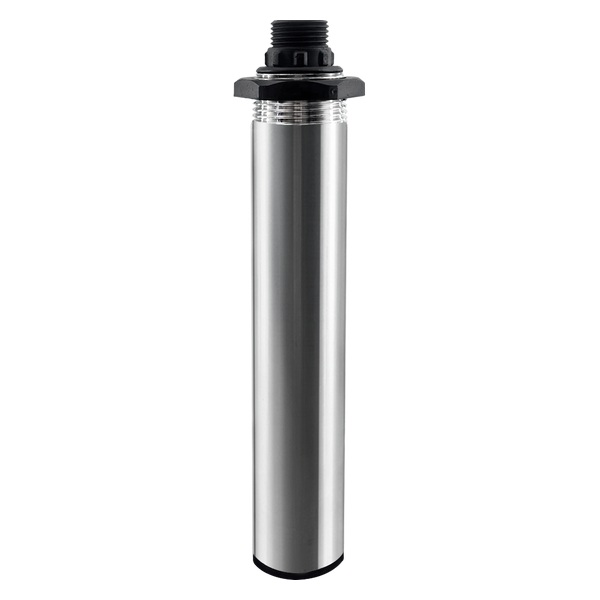
The YEX-S1PRO-CHLO online chlorophyll sensor uses narrow-band LED fluorescence and reports chlorophyll and temperature. Its current product page explicitly identifies fluorescence as an in-situ proxy that may differ from extracted laboratory chlorophyll-a. The following specifications belong to this model; a different chlorophyll probe or customized configuration needs its own evidence.
| Model and published item | Condition or boundary | Purchase consequence |
|---|---|---|
| YEX-S1PRO-CHLO: 0–400.00 µg/L; customization listed | Published chlorophyll reporting range | Compare expected baseline and event concentrations; document any ordered customization separately. |
| YEX-S1PRO-CHLO: ±3% of reading; linearity 0.999 R² | Published instrument specifications | Do not interpret either figure as demonstrated agreement with local laboratory extraction. |
| YEX-S1PRO-CHLO: 30 s response; temperature ±0.1°C | Published response and temperature-channel accuracy | Retain stabilized values and temperature with paired samples; these figures do not include sample-line delay. |
| YEX-S1PRO-CHLO: 0–50°C, non-freezing; pressure <0.2 MPa | Published operating envelope | Check lowest winter water temperature and maximum installation pressure before selecting the point. |
| YEX-S1PRO-CHLO: RS-485 Modbus RTU; optional 4–20 mA, select one | Order-specific output configuration | Choose the receiving interface and approve the delivered mapping; simultaneous outputs are not assumed. |
| YEX-S1PRO-CHLO: 12–24 VDC; approximately 0.4 W; default 5 m cable | Four-core shielded standard cable | Check station power and cable routing; specify extensions and accessories as separate scope. |
| YEX-S1PRO-CHLO: immersion, NPT 3/4; optional self-cleaning | 316L stainless steel + ABS; IP68 | Provide retrieval access and name the cleaning option in the order instead of assuming it is standard. |
Chlorophyll sensor laboratory comparison: choose the acceptance purpose
Choose the evidence standard from the decision the project must support. A trend-warning station and a contractual laboratory-equivalence requirement should not share an undefined acceptance statement.
| Required decision | Approach | Evidence and trade-off |
|---|---|---|
| Detect a developing change | Continuous optical trend with reference sampling | Demonstrate useful event detection and manageable false alarms. Preserve laboratory testing for confirmation. |
| Estimate a named laboratory result | Site-specific relationship plus independent validation | Evaluate prediction error across the intended matrix and range. This adds sampling cost and periodic revalidation. |
| Meet a prescribed reporting method | Use the required laboratory method for the report | Keep online measurements as supporting operational information unless the reporting authority accepts an alternative. |
| Identify species, cell numbers or toxins | Add the appropriate biological or chemical analysis | Chlorophyll alone does not supply a universal cell-count conversion, species identification or toxin concentration. |
Select trend monitoring when useful warning and a confirmation workflow meet the project need. Budget for continuing paired analysis when a laboratory-equivalent number is required. A narrower instrument specification alone cannot establish agreement between methods.
Which conditions can change the comparison?
A shallow station reads lower around midday
Strong light can change fluorescence yield as algae adjust how absorbed energy is dissipated. A daytime decrease need not mean that pigment concentration fell by the same proportion. Compare readings and paired samples across the daily light cycle, while retaining depth and weather context. Keep the probe within 0–50°C non-freezing service. Do not hide a repeatable pattern with an untested fixed multiplier or assume a dark-adapted bottle measurement represents the original in-situ condition.
Rain introduces colored water and suspended material
Color and particles can alter the optical measurement independently of pigment concentration. A turbidity increase alone does not establish the size or direction of chlorophyll error. Add matched laboratory samples during the changed matrix and inspect the optical window for deposits. If the trial only covered clear water, treat the storm period as outside that demonstrated relationship. An accompanying turbidity record adds context; it is not proof that this chlorophyll model automatically compensates for turbidity.
A relationship established in spring drifts later
Different populations and physiological conditions can change fluorescence per unit extracted pigment. Retain sampling across seasonal or operational changes, including changes in intake depth. A winter comparison can support winter commissioning, but it does not by itself validate a later bloom. Use a staged acceptance scope with a named seasonal follow-up rather than claiming an annual relationship from a short campaign.
Build a comparison that can survive commissioning
Pair the same water and preserve its identity
Place the reference-sampling point beside the sensing volume at the same representative depth, without disturbing bottom material or introducing bubbles. Record the actual collection time and pair it with a stable online observation over a documented interval. Account for transport time if the probe is in a side stream; a sample taken at the intake is not automatically synchronous with water arriving later at the sensor.
Give each pair an identifier linking the online value, unit, temperature, depth, timestamp and quality flag to the laboratory sample. Include weather or light context, visible water color, relevant turbidity observations, cleaning state and the configuration revision. Follow the laboratory's chosen filtration, preservation and holding procedure. Transporting a bottle to the laboratory and reading it hours later with another optical probe is not an extracted-pigment reference result.
Validate the relationship separately from fitting it
Cover the normal range, the intended warning band and representative changes in light or water matrix. Agree the sampling plan with the laboratory and end user; there is no universal sample count that makes every site valid. Retain additional pairs not used to derive any correction, then evaluate their prediction errors. Keep original online and laboratory values so later reviewers can distinguish instrument configuration from a post-processing adjustment.
A hypothetical pair illustrates the distinction: an online result of 30 µg/L against a laboratory result of 20 µg/L differs by +10 µg/L, or +50% relative to that laboratory value. This is a comparison calculation, not a YexSensor test result. One pair cannot establish a slope, diagnose the cause or prove a failed probe. Across the validation set, examine absolute error, proportional error and patterns with concentration or matrix. A high correlation alone can coexist with unacceptable bias.
Define agreement at the decision band, not only across the entire study. Use absolute differences where low reference values make percentages unstable; retain laboratory reporting-limit qualifiers instead of replacing them with zero. Agree how missed warning events and false alarms will be reviewed if the purpose is trend detection. These criteria answer different questions from the factory accuracy specification.
State where the accepted relationship stops
Hypothetical scope example: a relationship demonstrated in clear water from 10–40 µg/L does not establish prediction at 100 µg/L after a colored runoff event. Both concentrations can lie inside the sensor reporting range while the field relationship remains untested. Keep those observations and their original readings; flag the numerical estimate as outside the demonstrated scope rather than extending a correction automatically.
Attach a validated concentration and matrix envelope to the acceptance record, with a named owner for these review triggers.
| Change or finding | Evidence needed | Accepted-role decision |
|---|---|---|
| Sampling depth, intake or sample-line arrangement changes | New matched pairs with the revised water path and delay documented | Do not carry the old numerical relationship over solely because the same probe is used. |
| Algal population, season or colored-water conditions leave the demonstrated envelope | Independent paired results representing the changed conditions | Restrict numerical prediction until revalidated; retain the trend only with its quality and interpretation limits visible. |
| Cleaning, sensor replacement or range/output settings change | Instrument checks plus comparison of pre/post settings and receiving-system scaling | Separate maintenance recovery from a new numerical calibration; approve and version any changed relationship. |
| Validation errors or warning performance fail the agreed criterion | Root-cause review, corrected sampling/configuration and another independent check | Limit the data role to what the evidence supports; do not revise the tolerance retrospectively to obtain a pass. |
Verify the entire signal path
The probe supplies the selected measurement output. The PLC or logger applies the approved scaling, timestamps and quality handling; a gateway provides the separately specified remote connection. For Modbus, use the delivered register document, including data type and word order. Do not infer raw-fluorescence registers from the measurement principle. For analog orders, agree the transmitted parameter, endpoints and fault behavior before programming.
Compare the received value with the probe's configured output, test communication loss and power recovery, and identify cleaning periods in the record. The published 30 s response does not guarantee a 30 s alarm-to-operator response through every station. Agree acceptance tolerances, data exclusions and revalidation triggers before reviewing results, so limits are not adjusted afterward to make an unsuitable relationship appear acceptable.
RFQ checklist for a defensible comparison program
- Decision: trend warning, laboratory-result estimation or a prescribed reporting method; expected baseline, warning band and credible maximum.
- Water and season: site, depth, dominant algae information when available, temperature envelope, colored-water and solids events, daylight exposure and freezing risk.
- Delivered configuration: YEX-S1PRO-CHLO range, one selected output, cable route, mounting, cleaning option, power supply and controller or gateway responsibilities.
- Comparison scope: named laboratory and method, sampling point, paired-record fields, independent validation, tolerances, exclusions and seasonal follow-up.
- Handover: current product sheet, mounting information, wiring and protocol revision, approved settings, maintenance procedure, spares and written commercial terms.
Price the sensor hardware, station integration and laboratory campaign separately. This exposes whether an apparently lower quotation simply excludes the work needed to demonstrate the requested result.
Send the project data for configuration review
Provide the water type, expected concentrations, temperature and pressure, installation sketch, output, cable distance, quantity and proposed laboratory method. Include the acceptance purpose and known seasonal gaps. Review the YEX-S1PRO-CHLO configuration and Send Your Project Requirements.
Frequently asked questions
Q1. Why do online and extracted chlorophyll results differ when both use µg/L?
A1. Units describe the reporting scale, not the measurement procedure. The online probe observes in-situ pigment fluorescence, affected by the organisms present, their physiological condition and light history. Extraction changes the sample before pigment analysis. First check sample identity, timing and the named laboratory method. Then use paired local results to establish whether the relationship is adequate for the intended decision; equal units alone do not establish equivalence.
Q2. Does the listed ±3% accuracy guarantee ±3% agreement with the laboratory?
A2. No. The YEX-S1PRO-CHLO product page lists ±3% of reading as an instrument specification, while also warning that fluorescence can differ from extracted chlorophyll-a. Site comparison adds matrix, sampling and laboratory effects. The listed 0.999 R² linearity is likewise not a measured correlation for your reservoir. Specify field acceptance separately and evaluate independent paired results before assigning a laboratory-equivalent reporting role.
Q3. Can temperature compensation remove sunlight and turbidity effects?
A3. Automatic temperature compensation does not establish correction for every biological or optical influence. Light history can change fluorescence yield; color, particles, bubbles and fouling can affect the measurement path. Retain temperature and the relevant environmental observations, inspect the window and compare representative paired samples. Do not purchase this model on the assumption that an accompanying temperature channel proves automatic sunlight or turbidity compensation.
Q4. When is a trend-monitoring probe sufficient?
A4. A trend-monitoring probe can be sufficient when earlier indication of change is the agreed purpose and laboratory confirmation remains available. Define which events matter, how missed events and false alarms will be reviewed, and what staff do after a warning. A trend demonstration does not establish a numerical laboratory threshold for automatic action. That decision rule needs separate validation in the site water, including conditions near the action level and the intended sample depth.
Q5. Should a chlorophyll sensor laboratory comparison use one universal correction factor?
A5. No universal factor is justified across water bodies, seasons or algal populations. Define the concentration and matrix envelope actually represented by independent validation, and retain the original values beside any corrected result. A clear-water relationship demonstrated at 10–40 µg/L does not establish a prediction at 100 µg/L during colored runoff; this is an illustrative scope example, not product test data. Flag out-of-scope estimates and obtain new paired evidence before extending numerical acceptance.
Q6. Should the comparison use direct immersion or a side stream?
A6. Direct immersion minimizes sample transport but needs a representative, continuously wetted and retrievable point. A side stream may improve service access, yet introduces delay, possible bubbles and changes in light exposure. For either arrangement, check the model's pressure and temperature limits and pair samples with the water actually reaching its sensing volume. Select the arrangement from representativeness and maintenance requirements, then document the resulting timing.
Q7. What evidence belongs in the acceptance package?
A7. Include the delivered configuration, installation and protocol records, original paired observations, laboratory method and quality records, correction revision and independent validation results. Name the concentration and matrix envelope, agreed error criteria, exclusions and warning-performance checks. Assign ownership for review after depth, season, maintenance or configuration changes. The handover should state whether a result is an accepted numerical estimate, a limited trend or outside demonstrated scope, rather than leaving those roles to later interpretation.
Q8. How should a distributor quote a project with little historical laboratory data?
A8. Separate the hardware supply from a staged site-validation service. Define the initial monitoring purpose, sampling responsibilities, laboratory costs and conditions that must be represented before broader acceptance. Use published model limits for configuration, while keeping numerical equivalence conditional on trial evidence. The quotation should identify who evaluates the comparison, what happens if it fails and which later seasonal checks remain in scope.
Summary
A useful comparison starts with a decision boundary: continuous fluorescence can support trends, while numerical agreement with laboratory chlorophyll-a needs local evidence. YEX-S1PRO-CHLO offers a published 0–400.00 µg/L reporting range, selectable output and an immersion configuration within stated temperature and pressure limits. Representative sampling, traceable paired records, correct signal mapping and independent validation determine the station's accepted role. The RFQ should define that role, the water and seasonal envelope, delivered accessories, laboratory method, acceptance limits and follow-up responsibility.