Chinese
 Spanish
 French
 Russian
 German
 Portuguese
 Indonesian
 Thai
Thai Vietnamese
 Arabic


Products Description
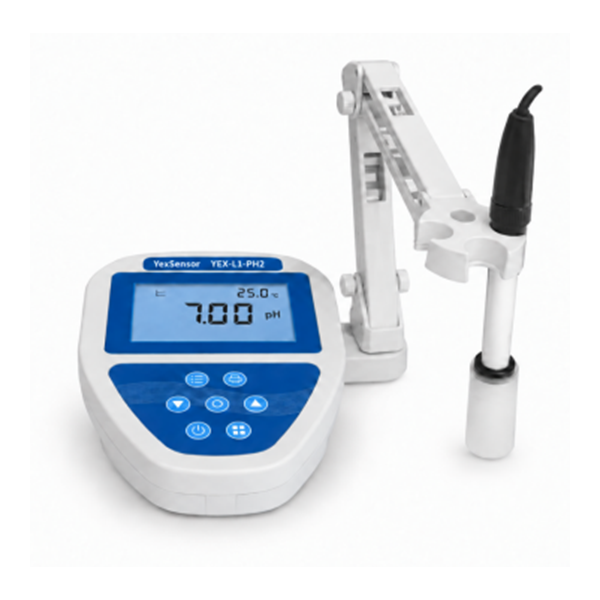
YEX-L1-PH2 Benchtop pH Meter: controlled calibration and stable endpoint recognition for routine laboratory pH testing
- Broad laboratory range: pH measurement from −2.00 to 16.00 with temperature from −10.0 to 110.0 °C; optional ORP measurement from −2000 to 2000 mV with a compatible ORP electrode.
- Structured pH calibration: automatic buffer recognition, NIST and USA buffer groups, up to five calibration points, and review of zero offset plus acid- and alkaline-range slopes.
- Routine-ready operation: automatic or manual temperature compensation, stable-reading lock, 256 stored records, dual battery/adapter power, and an electrode stand that can be installed on either side.
Product Overview
The YexSensor YEX-L1-PH2 is a compact benchtop pH meter for laboratories that need repeatable acidity and alkalinity measurements without occupying excessive bench space. It combines pH and temperature measurement with a large backlit LCD, automatic stable-reading lock, automatic or manual temperature compensation, and guided calibration. With the appropriate optional ORP electrode installed, the same instrument can display oxidation-reduction potential in millivolts.
The instrument is intended for professional laboratory use in water treatment, environmental monitoring, research, education, aquaculture, food production, pharmaceuticals, petrochemicals, papermaking, agriculture, electric power, printing and dyeing, textiles, municipal testing, and general industrial laboratories. Reliable results depend on the complete measurement system: the meter, electrode type, temperature compensation method, buffer group, calibration practice, sample handling, cleaning, and storage procedure must all match the application.
Selection Considerations and Measurement Boundaries
pH is the primary function and ORP is an optional extension
The YEX-L1-PH2 is primarily a pH meter. Normal pH operation requires a suitable pH electrode. ORP measurement is available only when a compatible ORP electrode is fitted and ORP/mV mode is selected; the standard pH electrode cannot measure ORP. Buyers should identify whether the project requires pH only or both pH and ORP, then confirm the ordered electrodes and supplied accessories on the quotation and packing slip.
Resolution and indication error answer different questions
The pH display resolution is 0.01 pH, while the specified pH indication error is ±0.2% F.S. A finer displayed increment is not the same as guaranteed measurement accuracy. Procurement and method-validation teams should base acceptance limits on the stated error, the electrode specification, calibration uncertainty, buffer quality, temperature control, sample behavior, and the laboratory's verification procedure.
Temperature compensation requires a defined workflow
Automatic temperature compensation is used when a compatible temperature probe is connected. Manual compensation requires the operator to enter the sample temperature correctly. Compensation adjusts the electrode response for temperature; it does not make chemically different samples directly comparable or replace sample-temperature control where a method specifies a particular measurement temperature.
Key Technical Advantages
Up to five calibration points with two recognized buffer groups
The instrument supports automatic recognition and calibration at up to five pH points. The NIST group provides pH 1.68, 4.00, 6.86, 9.18, and 12.46, while the USA group provides pH 1.68, 4.00, 7.00, 10.01, and 12.46. Selecting the correct group before calibration reduces operator ambiguity, while multi-point calibration allows the working range to be bracketed for acidic, neutral, or alkaline samples.
Calibration review supports electrode condition assessment
Saved calibration information includes zero offset, acid-range slope, and alkaline-range slope where displayed. These values help the operator judge whether a pH electrode is responding normally after conditioning and cleaning. They should be reviewed together with buffer verification, response time, repeatability, and the laboratory's acceptance limits rather than used as a standalone pass/fail decision.
Stable-reading lock and interference-conscious bench design
Automatic stable-reading lock helps operators capture a result after the signal has settled. The compact meter and adjustable electrode stand keep the sensing elements vertical and away from the beaker wall and bottom. For dependable operation, place the instrument on a dry, level bench away from strong electromagnetic fields, direct sunlight, heat, vibration, and corrosive vapors.
Flexible power and local result storage
The meter can operate from four AAA batteries or a 100–220 V power adapter. Specified battery life is more than 500 hours under the stated product conditions, making the instrument useful where bench power is inconvenient. Up to 256 measurement records can be stored for later review. The manual does not specify USB export, RS-485, Modbus, Bluetooth, Wi-Fi, cloud, LIMS, or SCADA connectivity.
Technical Specifications
The measurement matrix below places each measured quantity on one row so range, display resolution, and error limits can be compared without repeated category labels. ORP measurement remains optional and requires a compatible ORP electrode.
Measurement Performance
| Measured Quantity | Measurement Range | Display Resolution | Accuracy / Indication Error |
|---|---|---|---|
| pH | −2.00 to 16.00 pH | 0.01 pH | ±0.2% F.S. |
| ORP (optional) | −2000 to 2000 mV | 1 mV | ±0.2% F.S. |
| Temperature | −10.0 to 110.0 °C | 0.1 °C | ±0.2 °C |
Instrument Specifications
| Item | Specification |
|---|---|
| Model | YEX-L1-PH2 |
| Power source | Four AAA batteries or 100–220 V power adapter |
| Battery life | >500 hours |
| Operating environment | −5 to 60 °C; relative humidity <90% |
| Data storage | 256 measurement records |
| Dimensions / weight | 150 × 200 × 60 mm (W × L × H); 660 g |
Calibration and Quality Control
| Buffer group | Available pH values |
|---|---|
| NIST | 1.68, 4.00, 6.86, 9.18, 12.46 |
| USA | 1.68, 4.00, 7.00, 10.01, 12.46 |
Before calibration, allow the meter, electrode, buffers, and temperature probe to reach a similar temperature. Select the correct buffer group, rinse the electrode with deionized water, and blot gently with a lint-free tissue. Begin with the neutral buffer, normally pH 6.86 or 7.00, then add acidic and/or alkaline points that bracket the expected sample range. Up to five points may be used.
Use fresh, uncontaminated buffers and never return used solution to the original container. Review the saved zero offset and acid/alkaline slopes after calibration. Recalibrate when a point is rejected, after electrode cleaning or replacement, following long storage, when verification fails, or whenever the laboratory's quality procedure requires it.
Application Scenarios
Drinking-water and wastewater laboratories
Measure pH during source-water assessment, treatment-process checks, finished-water verification, hospital wastewater testing, domestic wastewater monitoring, and municipal laboratory work. Define the expected pH range and select calibration points that bracket the samples instead of relying on a neutral-only check.
Food, beverage, pharmaceutical, and fermentation work
Support incoming-water checks, formulation, process monitoring, cleaning verification, and batch comparison where pH influences product behavior or process control. Confirm that the selected electrode materials, junction, and cleaning procedure are compatible with viscous, protein-rich, oily, low-conductivity, or otherwise challenging samples.
Aquaculture, agriculture, and environmental monitoring
Use the benchtop format for collected water, soil extracts, nutrient solutions, pond samples, and environmental laboratory samples. Control holding time, sample temperature, mixing, and carbon-dioxide exchange because these factors can change pH before the reading is taken.
Petrochemical, paper, textile, leather, and general industry
Compare raw materials, process baths, rinse water, boiler or cooling-water samples, and effluent at defined control points. Select an electrode suited to the chemical matrix and confirm whether the sample requires cooling, dilution, filtration, or a dedicated preparation procedure before measurement.
Research institutes, universities, and method development
The selectable buffer groups, up-to-five-point calibration, temperature compensation, stable lock, calibration review, and local result memory support teaching and controlled method work. Where results inform compliance or release decisions, use traceable buffers, independent check samples, documented acceptance limits, and a defined electrode-maintenance schedule.
Installation and Routine Measurement
Place the meter on a stable, dry, level laboratory bench away from strong electromagnetic fields, direct sunlight, heat, corrosive vapor, and vibration. Install the electrode stand on the left or right side and adjust it so the electrode remains vertical, approximately 90° to the bench. With the meter switched off, connect the pH electrode and the temperature probe if supplied. Keep every connector clean and dry, support the cables, and avoid pulling, pinching, or sharp bends.
Install four AAA batteries with correct polarity or connect the specified adapter to a 100–220 V AC supply. Do not mix old and new batteries. Condition the pH electrode according to its instructions, select pH mode, choose automatic temperature compensation when a temperature probe is connected or enter the temperature manually, and calibrate with fresh buffers. Rinse and gently blot the electrode before placing the sensing bulb, junction, and temperature sensor in the sample.
Keep the sensors away from the beaker wall and bottom, stir gently without introducing bubbles, and wait for the stable-reading indication. Record or save the result, then rinse before the next sample. For optional ORP measurement, install a compatible ORP electrode, select ORP/mV mode, immerse the sensing element and reference junction, and wait for the millivolt reading to stabilize.
Records, Settings, and Operating Controls
| Function | Documented capability | Laboratory use |
|---|---|---|
| Measurement modes | pH and optional ORP | Select the mode that matches the installed electrode |
| Temperature compensation | Automatic or manual | Use automatic compensation with a compatible connected probe; otherwise enter temperature manually |
| Stable-reading lock | Automatic | Apply one stability rule across comparable samples |
| Record memory | 256 measurement records | Confirm that each required result is saved and review memory before it is needed |
| Calibration review | Zero offset, acid slope, alkaline slope | Assess electrode behavior together with independent verification |
| Temperature offset | Adjustable setting | Change only under a documented verification procedure |
| Automatic power-off | Selectable | Balance battery conservation with the laboratory workflow |
The manual specifies local record storage and review but does not specify a USB data-export workflow or any industrial or wireless communication interface. Laboratories that require electronic transfer to LIMS, PLC, SCADA, cloud, or another system should define a separate validated transcription or data-management process before purchase.
Maintenance and Troubleshooting
Rinse the pH electrode after every measurement and use a cleaning solution suitable for the contamination and electrode type. Keep the glass bulb and reference junction hydrated in the recommended storage solution; do not store a pH electrode long-term in deionized water. Do not touch, scrape, or wipe the glass sensing bulb. Clean the meter with a soft, slightly damp cloth, keep the connectors and battery compartment dry, and remove batteries before extended storage.
For unstable or slow readings, check electrode hydration and cleanliness, bubbles, cable and connector condition, sample uniformity, temperature difference, and electrode age. If calibration fails, confirm the selected buffer group, buffer validity, stabilization time, and electrode condition. If temperature is incorrect, reconnect the temperature probe or correct the manually entered value. If ORP is unavailable, confirm that a compatible ORP electrode is installed and ORP/mV mode is selected.
Configuration and RFQ Checklist
For a technically complete quotation, provide the sample type, expected pH range, optional ORP requirement, target uncertainty or acceptance limits, sample temperature, automatic or manual temperature-compensation preference, daily sample count, calibration points, buffer group, record-retention procedure, power preference, destination, plug type, quantity, and required documents.
Also identify the required pH electrode, optional ORP electrode, temperature probe, electrode stand, buffers, storage solution, cleaning solution, spare electrodes, adapter, batteries, and any certificates. Electrode body material, junction type, reference system, cable length, connector, and chemical compatibility should be confirmed for the actual sample matrix rather than inferred from a generic product photograph.
Order Confirmation and Supply Boundary
| Item | Manual-defined status | Order confirmation note |
|---|---|---|
| YEX-L1-PH2 meter | Primary product | Confirm model, quantity, serial-number documentation, and destination |
| Electrode stand | Referenced during unpacking | Confirm supplied quantity and holder configuration |
| pH electrode | Required for pH measurement; configuration-dependent | Specify sample compatibility, cable, connector, and quantity |
| ORP electrode | Optional | Required only when ORP measurement is ordered |
| Temperature probe | If supplied | Required for automatic temperature compensation |
| Power adapter | Referenced power option | Confirm rating and destination plug |
| AAA batteries | Four required for battery operation | Confirm whether batteries are included or sourced locally |
| Buffers, storage and cleaning solutions | Application-dependent | List each required solution and quantity on the order |
| Documentation | Referenced during unpacking | Confirm manual, certificate, language, and acceptance records |
The manual does not define a universal fixed packing quantity for every electrode, probe, solution, battery, or accessory. The signed sales order and final packing slip govern the delivered configuration. Inspect the shipment before use and report model mismatch, physical damage, moisture, missing parts, or incorrect quantities promptly.
Quality Assurance and After-Sales Information
Warranty coverage and service conditions follow the applicable sales agreement. Keep the purchase record, product certificate, model, serial number, calibration history, and a clear fault description when requesting support. Damage caused by unauthorized disassembly, incorrect power, unsuitable operating conditions, misuse, improper storage or transport, consumable electrodes, or force majeure may be excluded from free warranty service.
Stop using the instrument and contact YexSensor if the enclosure, adapter, battery compartment, connector, cable, electrode, glass bulb, or temperature probe is damaged, or if acceptable calibration cannot be restored after correct conditioning, cleaning, buffer selection, and setup. Do not open or modify the meter.
Frequently Asked Questions
1. What does the YEX-L1-PH2 measure?
Its primary function is pH measurement from −2.00 to 16.00 pH with temperature from −10.0 to 110.0 °C. With a compatible optional ORP electrode, it also measures oxidation-reduction potential from −2000 to 2000 mV. The pH and ORP functions require different electrodes, so the quotation must identify the required measurement modes and supplied sensors.
2. Is an ORP electrode included as standard?
The manual defines ORP as an optional extension and states that the supplied configuration may vary by order. A standard pH electrode cannot measure ORP. If ORP is required, list a compatible ORP electrode explicitly on the quotation and final sales order, together with its cable, connector, quantity, and any required verification solution.
3. How many pH calibration points are supported?
The meter supports automatic recognition and calibration at up to five points. The NIST group contains pH 1.68, 4.00, 6.86, 9.18, and 12.46; the USA group contains pH 1.68, 4.00, 7.00, 10.01, and 12.46. Select the group first, then use fresh points that bracket the expected sample range.
4. Does 0.01 pH resolution mean ±0.01 pH accuracy?
No. Resolution is the smallest displayed increment. The manual specifies a pH indication error of ±0.2% F.S. Overall result quality also depends on the electrode, buffers, calibration range, temperature compensation, sample matrix, stabilization, and quality-control procedure. Acceptance criteria should not be based on display resolution alone.
5. What is the difference between automatic and manual temperature compensation?
Automatic compensation uses the connected compatible temperature probe. Manual compensation uses a temperature value entered by the operator. In either case, compensation corrects electrode response for temperature; it does not eliminate chemical changes in the sample or replace method-specific temperature control. Confirm the temperature probe in the ordered configuration when automatic compensation is required.
6. Can records be exported by USB or sent by RS-485 or Modbus?
The manual documents storage for 256 measurement records and later review on the instrument. It does not specify USB export, RS-485, Modbus, Bluetooth, Wi-Fi, cloud, LIMS, or SCADA communication. A project requiring electronic transfer should establish a separate validated recording workflow or select a different analyzer with documented connectivity.
7. How should the pH electrode be stored and maintained?
Rinse it after every measurement, remove deposits with a cleaning solution suitable for the electrode and contamination, and keep the glass bulb and reference junction hydrated in the recommended storage solution. Do not store it long-term in deionized water, touch or scrape the glass bulb, or use incompatible cleaners. Recalibrate after cleaning, replacement, or long storage.
8. What information is needed for a quotation?
Provide sample type, pH range, optional ORP requirement, acceptance limits, temperature conditions, compensation method, daily workload, calibration points and buffer group, electrode requirements, cable and connector needs, solutions, power preference, plug type, destination, quantity, and documents. YexSensor can then confirm the meter, electrodes, stand, probe, adapter, consumables, and supply boundary.
Summary
The YEX-L1-PH2 is suited to laboratories that need a compact benchtop meter for routine pH and temperature measurement, controlled multi-point calibration, stable endpoint recognition, electrode-condition review, and local storage of 256 results. Optional ORP expands the measurement scope only when a compatible ORP electrode is ordered. The main decision boundaries are electrode selection, temperature-compensation method, calibration group, indication error, sample compatibility, and the absence of documented digital communication interfaces.
For an application-matched proposal, send YexSensor the sample matrix, expected pH and optional ORP ranges, temperature conditions, acceptance criteria, calibration and verification plan, daily workload, electrode and cable requirements, power preference, destination, quantities, and documentation needs. These inputs allow the instrument configuration, probes, buffers, accessories, supply list, and acceptance procedure to be confirmed before shipment.