Chinese
 Spanish
 French
 Russian
 German
 Portuguese
 Indonesian
 Thai
Thai Vietnamese
 Arabic


Products Description
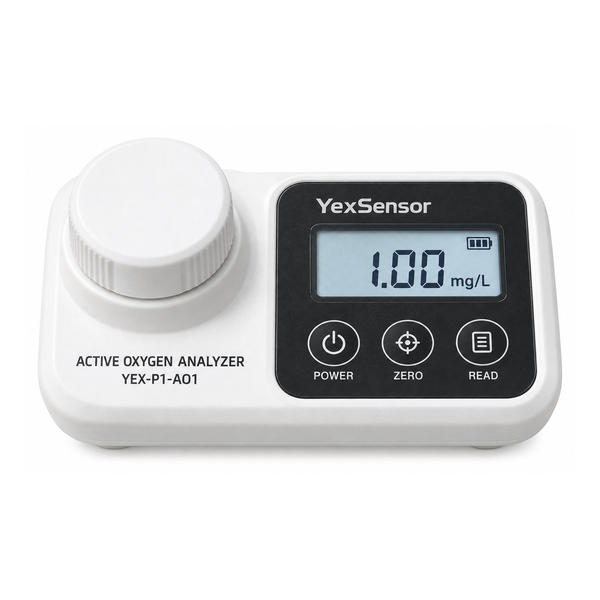
YEX-P1-AO1 Portable Active Oxygen Analyzer: control DPD reaction timing, optical zeroing, and cuvette condition for dependable active oxygen results at the sampling point.
- Defined low-range performance: 0-1 mg/L measurement range, maximum absolute error of 0.02 mg/L below 0.4 mg/L, and maximum relative error of 5% at or above 0.4 mg/L.
- Method-focused optics: a 520 nm LED, factory-stored standard curve, light-shielded chamber, and direct mg/L display support the documented DPD colorimetric workflow.
- Portable operation: IP65 enclosure, more than 24 hours of continuous battery operation, three-key control, 5 mL sample volume, and a carrying case support laboratory and field testing.
Product Overview
The YexSensor YEX-P1-AO1 is a portable colorimetric analyzer for active oxygen measurement in aqueous samples. A 520 nm LED and factory-stored curve convert the color developed by the specified DPD reagent into a direct result in mg/L. Its compact format supports trained operators working in water-supply, wastewater, aquaculture, recreational-water, research, and industrial environments.
The instrument follows a clear blank-and-read method using a 5 mL sample. It reduces manual calculation while leaving the critical method controls visible: representative sampling, correct reagent chemistry, consistent reaction time, clean optical surfaces, bubble removal, and proper zeroing.
Measurement Boundaries
Apply the correct performance rule
The stated range is 0-1 mg/L. Performance uses two acceptance rules: maximum absolute error of 0.02 mg/L below 0.4 mg/L, and maximum relative error of 5% at or above 0.4 mg/L. Apply the rule that corresponds to the measured concentration.
Match the result to the documented DPD chemistry
Use the specified reagent identity, dose, reaction time, and storage condition. Interfering oxidants, sample color or turbidity, contamination, incomplete dissolution, and inconsistent timing can change color development.
Use the analyzer only with aqueous samples
The manual limits use to water samples. Results above 1 mg/L require a validated dilution or another suitable method. Review unusual color, heavy turbidity, oil, solids, strong oxidants, reducing agents, and other reactive components for method compatibility.
Keep the IP65 enclosure out of the sample
IP65 protects the enclosure under suitable field conditions; it does not make the instrument submersible. Keep the analyzer and chamber dry, and insert only a capped cuvette with a clean, dry exterior.
Key Technical Advantages
Stable 520 nm optical path
The chamber positions the 5 mL cuvette in the 520 nm LED path and blocks ambient light. The stored standard curve converts optical response directly into mg/L, reducing calculation and setup steps.
Low sample and reagent consumption
Each test uses a 5 mL sample, limiting reagent consumption and making duplicate or field testing easier. Reagent dose and reaction time still follow the supplied reagent instructions.
Simple three-key workflow
Dedicated POWER, ZERO, and READ keys follow the actual test sequence. The direct display keeps routine operation simple without hiding the blank, timing, and quality-control requirements.
Portable enclosure and battery operation
The 128 x 70 x 48 mm analyzer weighs 188 g including batteries. Three AAA batteries provide more than 24 hours of continuous operation, while automatic power-off and the carrying case support mobile work.
Technical Specifications
| Performance Item | Documented Specification | Method Control |
|---|---|---|
| Measurement range | 0-1 mg/L | Document any validated dilution used above range. |
| Accuracy below 0.4 mg/L | Maximum absolute error: 0.02 mg/L | Apply the absolute-error rule below the 0.4 mg/L boundary. |
| Accuracy at or above 0.4 mg/L | Maximum relative error: 5% | Apply the relative-error rule from 0.4 mg/L to the upper range limit. |
| Measurement principle | DPD spectrophotometric method | Result validity depends on the specified reagent and controlled procedure. |
| Light source and wavelength | LED, 520 nm | Keep the cuvette surfaces clean and close the light shield for every reading. |
| Instrument Item | Documented Specification | Engineering Significance |
|---|---|---|
| Model | YEX-P1-AO1 | Portable analyzer for aqueous samples. |
| Sample volume | 5 mL cuvette | Use a clean, clear, unscratched cuvette with its exterior dry. |
| Power supply | 3 x AAA batteries | Use three matched cells with correct polarity; do not mix types or ages. |
| Battery life | More than 24 hours of continuous operation | Actual operating time depends on battery condition and use. |
| Enclosure protection | IP65 | Not submersible; keep the chamber and battery compartment dry. |
| Dimensions | 128 x 70 x 48 mm | Compact format for carrying cases and mobile sampling kits. |
| Weight | 188 g including batteries | Suitable for portable work and shared laboratory use. |
Specification boundary: The manual does not state a numeric resolution, response time, operating-temperature range, humidity limit, data-storage capacity, export format, or external communication protocol.
DPD Measurement Workflow and Quality Control
Prepare the blank: Collect a representative water sample and bring the analyzer, sample, clean 5 mL cuvette, and reagent to a stable working condition. Rinse the cuvette with a small portion of the sample, fill it with 5 mL, cap it, remove visible bubbles, and wipe the outside with the supplied lint-free cloth. Fingerprints, droplets, scratches, and residue in the optical path can change the result.
Establish the optical zero: Switch on the analyzer, place the untreated sample in the chamber, close the light-shielding cap completely, and press ZERO. Wait for zeroing to finish before removing the cuvette. If the sample batch, blank, or cuvette changes, or if the instrument restarts, repeat the zeroing step.
Develop color and read: Add the specified active oxygen reagent to the zeroed 5 mL sample. Close the cap and mix until the reagent has completely dissolved. Remove foam or visible bubbles, observe the reaction time stated by the reagent instructions, wipe the cuvette again, insert it using a consistent orientation, close the light shield, and press READ. Record the result in mg/L with the sampling location, time, reagent lot, and operator.
Verify the method: Use duplicate samples or a suitable check solution at the frequency required by the applicable quality plan. If a result is unexpected, repeat the complete blank and reagent procedure with a clean cuvette and fresh reagent. Do not repeatedly press READ on a poorly prepared sample and treat the repeated values as independent measurements.
Application Scenarios
| Application | Measurement Purpose | Method Control |
|---|---|---|
| Swimming pools and recreational water | On-site active oxygen checks at representative sampling points | Follow the local sampling frequency and reporting rule. |
| Drinking water and municipal waterworks | Routine low-range checks in treated-water samples | Apply the correct accuracy rule on each side of 0.4 mg/L. |
| Hospital and domestic wastewater | Spot testing of compatible aqueous samples | Evaluate color, turbidity, oxidant interference, contamination control, and operator PPE. |
| Aquaculture water | Portable checks where active oxygen treatment is used | Keep location and test timing consistent. |
| Research, universities, and industrial laboratories | Controlled comparative measurements and method demonstrations | Document reagent lot, cuvette control, duplicates, check solutions, and acceptance criteria. |
Method suitability depends on concentration, sample matrix, interfering substances, reagent chemistry, sampling frequency, and record control.
Setup and Routine Measurement
Install three matched AAA batteries according to the polarity marks and close the battery compartment securely. Confirm that the measurement chamber is clean and dry, the light-shielding cap closes fully, the display and battery icon operate, and the 5 mL cuvettes are clear, clean, unscratched, and leak-free. Check the reagent identity, lot, expiry date, package condition, and storage history before testing.
Hold each cuvette by its cap or upper non-optical area. Use the same cuvette and orientation for blank and reacted-sample readings whenever practical. Cap the cuvette before mixing, remove bubbles, and wipe the optical surfaces before every ZERO and READ operation. Do not insert a wet cuvette, leave liquid in the chamber, or measure with the light shield open.
If the automatic power-off function switches the display off during sample preparation, restart the analyzer and repeat ZERO before measuring the treated sample. At the end of the session, rinse the cuvette thoroughly, dry it, switch off the analyzer, close the chamber cap, and return the instrument and accessories to the carrying case.
Data Handling and Battery Management
The display provides the result in mg/L and an approximate battery indication. Record the sample identity, location, date and time, reagent lot, operator, result, and any dilution in the approved field or laboratory record.
The manual does not specify internal record capacity, USB export, RS-485, Modbus, Bluetooth, Wi-Fi, cloud service, LIMS, or SCADA connectivity.
Replace all three AAA batteries together when the low-battery indication appears or the analyzer cannot complete a measurement. Use matched cells of the same type and age, observe polarity, and do not mix new and used batteries. Remove the batteries for long-term storage and stop using the instrument if a cell leaks or overheats.
More than 24 hours of continuous operation is the documented battery-life specification. Actual service time may vary with battery quality, storage condition, automatic power-off behavior, ambient conditions, and operating pattern. For field programs, carry a matched spare battery set and repeat optical zeroing after any restart or battery replacement.
Maintenance and Troubleshooting
Protect the cuvette and optical chamber
Rinse the cuvette after each use and allow it to dry. Do not use abrasive cleaners on its optical surfaces. Replace a cuvette that is cloudy, stained, scratched, chipped, or leaking. Keep the chamber clean and dry, and remove dust only with a soft, clean, lint-free tool. Do not insert cloth, sharp tools, liquid cleaners, or compressed contaminants into the optical path.
Respond systematically when zeroing is unstable
Check for fingerprints, droplets, a wet chamber, bubbles, external light, sample movement, or a damaged cuvette. Clean and dry the cuvette and chamber, remove bubbles, close the light shield, and repeat ZERO. If the problem remains after routine cleaning and a known-good cuvette is used, stop testing and contact YexSensor.
Investigate unexpectedly high or low results
High results can be caused by contamination, reagent carryover, fingerprints, sample color, excessive reaction time, or interfering oxidants. Low results can result from expired or insufficient reagent, incomplete mixing, short reaction time, a wrong blank, or a concentration above range. Repeat the full procedure with a fresh sample, clean cuvette, correct reagent, and controlled timing rather than changing one step without documentation.
Protect the enclosure during cleaning and transport
Wipe the analyzer with a soft damp cloth and then dry it. Do not use strong solvents, rinse it under running water, or immerse it. Store the instrument, cuvettes, and reagent in the carrying case, protected from impact, freezing, excessive heat, moisture, and direct sunlight. Store reagents according to their label and safety data sheet.
Configuration and RFQ Checklist
For quotation, provide the sample type, expected concentration, acceptance limit, test method, tests per day, operating environment, known interferences, and reporting requirement.
Specify reagent and cuvette quantities, transfer accessories, spare batteries, certificates, manual language, and service needs. If electronic records or system integration are mandatory, state the required capacity, format, host system, and protocol for separate confirmation.
Packing List and Order Confirmation
| Documented Item | Typical Quantity | Receipt Check |
|---|---|---|
| YEX-P1-AO1 analyzer | 1 | Verify the model, enclosure, chamber, keys, and serial information. |
| Active oxygen reagent | Per sales order | Verify the method, lot, expiry, storage, and delivered quantity. |
| 5 mL cuvette with cap | 2 | Inspect for cloudiness, stains, scratches, chips, and leakage. |
| Transfer pipette | 1 | Use for clean sample transfer according to the method. |
| Syringe | 1 | Use only as instructed for sample or reagent handling. |
| Needle / venting accessory | 1 | Verify safe handling and supplied purpose. |
| Screwdriver | 1 | Battery-compartment service accessory. |
| AAA battery | 3 | Install as a matched set with correct polarity. |
| Lens cloth | 2 | Keep clean for wiping cuvette optical surfaces. |
| User manual | 1 | Retain for operation and method control. |
| Product certificate | 1 | Retain with product and traceability records. |
| Warranty card | 1 | Retain with proof of purchase and serial information. |
| Carrying case | 1 | Use for protected transport and storage. |
The documented quantities are typical, and reagent quantity is defined by the sales order. Accessories may be updated or configured for the order. The signed sales order and final packing list take precedence. On receipt, compare the delivered model, reagent, cuvettes, accessories, batteries, documents, and ordered options with those records before first use.
Warranty and Service Information
The standard warranty period is one year from the purchase date unless the sales contract states otherwise. Keep the warranty card, proof of purchase, product certificate, model, and serial number. Support after the warranty period may be subject to applicable charges.
Typical exclusions include damage caused by operation, reagent handling, battery installation, cleaning, storage, or transport contrary to the manual; unauthorized dismantling, modification, repair, or optical adjustment; impact, liquid ingress, fire, flood, lightning, chemical exposure, or force majeure; and normal use of consumables such as reagents, cuvettes, batteries, pipettes, and cleaning cloths. The signed sales contract and supplied warranty document remain controlling.
For efficient support, provide the model and serial number, reagent name and lot, sample description, displayed result, battery status, photographs, and the troubleshooting already completed. Stop using the analyzer if liquid enters the enclosure, the display or keys fail, the chamber is damaged, or repeated zeroing and check-solution tests fail after routine cleaning.
Frequently Asked Questions
1. What does the YEX-P1-AO1 measure?
It measures active oxygen in aqueous samples over 0-1 mg/L using the documented DPD spectrophotometric method. A 520 nm LED measures the developed color, and the stored standard curve displays the result directly in mg/L. The analyzer should not be selected for nonaqueous samples or concentrations above the stated range without a validated dilution or alternate method.
2. How is accuracy specified across the range?
Below 0.4 mg/L, the maximum absolute error is 0.02 mg/L. At or above 0.4 mg/L, the maximum relative error is 5%. Use the rule that matches the result concentration.
3. Is the analyzer waterproof?
The enclosure is rated IP65, but the analyzer is not submersible. Keep the housing, battery compartment, measurement chamber, display, and keys dry. Do not pour sample into the chamber or insert a wet cuvette. Applications that require an immersed sensor or continuous online measurement need a different product architecture.
4. Why must the sample be zeroed before adding reagent?
Zeroing uses the untreated sample as the optical blank, helping account for the sample and cuvette before color development. Use the same clean cuvette and orientation for zeroing and reading whenever practical. Repeat ZERO when the sample batch, blank, or cuvette changes, or after the analyzer restarts.
5. What can cause unstable or inaccurate readings?
Common causes include fingerprints, droplets, scratches, bubbles, a wet or dirty chamber, ambient light, incomplete reagent dissolution, inconsistent reaction time, expired reagent, sample color or turbidity, and interfering oxidants. Repeat the complete procedure with a representative sample, clean cuvette, fresh reagent, controlled timing, and the light shield fully closed.
6. Does the YEX-P1-AO1 export data or connect to a control system?
No external data or communication interface is documented. Record results in the approved field or laboratory system.
7. Which consumables and spare items should be planned?
Routine items include the active oxygen reagent, clean 5 mL cuvettes, matched AAA batteries, transfer accessories, and lint-free lens cloths. Reagent quantity should reflect daily tests, duplicates, quality-control checks, expected retests, shelf life, storage conditions, and delivery interval. Spare cuvettes are advisable because scratches or stains can affect optical readings.
8. What project information helps configuration?
Provide the sample matrix, expected concentration, applicable method, tests per day, likely interferences, reagent demand, required accessories, certificates, language, and service expectations.
Summary
The YEX-P1-AO1 is designed for portable measurement of active oxygen in aqueous samples from 0-1 mg/L. It uses the DPD photometric method with a 520 nm LED and displays results directly in mg/L. Maximum error is 0.02 mg/L below 0.4 mg/L and 5% at or above 0.4 mg/L. The 5 mL cuvette, IP65 enclosure, and three AAA batteries support field and laboratory use; the analyzer must not be immersed. Reliable results depend on reagent condition, reaction timing, zeroing, cuvette cleanliness, and interference control.
Contact YexSensor to confirm sample compatibility and reagent requirements before ordering.