Chinese
 Spanish
 French
 Russian
 German
 Portuguese
 Indonesian
 Thai
Thai Vietnamese
 Arabic

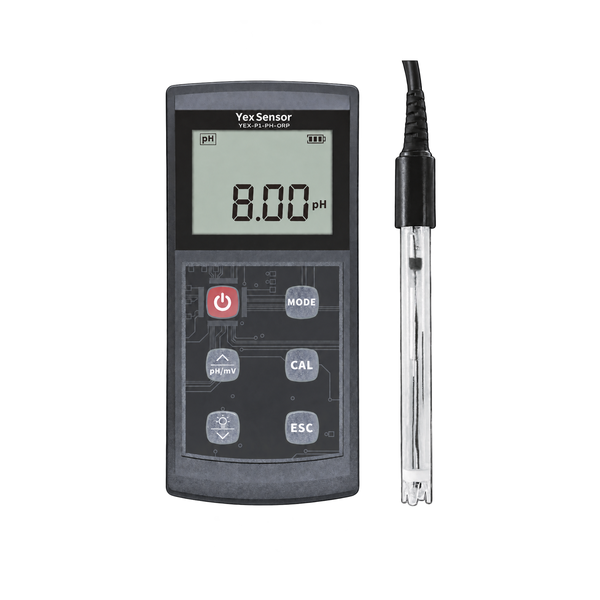

Products Description
SEO Description: YexSensor YEX-P1-PH-ORP is a portable pH ORP meter for aqueous samples, measuring 0.00-14.00 pH, -1999 to 1999 mV, and temperature with automatic pH temperature compensation.
Keywords: YEX-P1-PH-ORP portable pH ORP meter, handheld pH meter, portable ORP meter, pH meter with temperature compensation, field water pH meter, oxidation reduction potential meter
Product Overview
YEX-P1-PH-ORP Portable pH ORP Meter: obtain stable pH, oxidation-reduction potential, and temperature results without carrying separate field instruments.
- Three related measurements: pH from 0.00 to 14.00, ORP from -1999 to 1999 mV, and temperature from 0.0 to 80.0 °C.
- Controlled pH workflow: 0.01 pH resolution, ±0.02 pH accuracy, one-key calibration, and automatic temperature compensation when the temperature sensor is correctly connected and immersed.
- Portable operation: backlit display, three replaceable AAA dry batteries, fold-out stand, anti-slip pad, and carrying case support laboratory and field work.
The YexSensor YEX-P1-PH-ORP is designed for aqueous-sample measurements in environmental monitoring, petroleum and chemical facilities, pharmaceutical operations, power plants, universities, and research organizations. A BNC connector accepts a compatible pH or ORP electrode, while a separate 3.5 mm connector accepts the temperature sensor used for temperature display and automatic pH compensation.
The instrument combines portable measurement with practical controls for calibration, mode selection, backlighting, stable-result display, and routine record handling. Its value is not simply that three values appear on one meter. The main engineering benefit is a repeatable workflow in which electrode condition, calibration solutions, immersion, temperature equilibrium, and sample carryover can be controlled in both laboratory and field conditions.
Selection Considerations and Measurement Boundaries
Match the method to the documented range and accuracy
Select the meter only when the required pH, ORP, and temperature values fall within the documented specifications. The pH channel covers 0.00-14.00 pH with 0.01 pH resolution and ±0.02 pH accuracy. The ORP channel covers -1999 to 1999 mV with 1 mV resolution and ±0.1% F.S. accuracy. Temperature covers 0.0-80.0 °C with 0.1 °C resolution and ±0.5 °C accuracy. Resolution is the smallest displayed increment; it is not a substitute for the stated accuracy.
Use the instrument only for aqueous samples
The manual limits use to aqueous samples and instructs operators not to immerse the meter body or connectors. It does not assign an IP rating to the instrument. Keep the meter, BNC connection, temperature connector, and battery compartment above the sample and dry. For aggressive, oily, highly contaminated, or unusual matrices, confirm electrode compatibility and the approved cleaning procedure before ordering.
Confirm the electrode configuration before purchase
The documented packing list includes one combination pH electrode, but it does not list an ORP electrode or a separate temperature sensor. ORP measurement requires a compatible ORP electrode connected to the BNC socket. Automatic pH temperature compensation requires the temperature sensor to be connected to the 3.5 mm socket and immersed in the same sample. If ORP measurement or automatic compensation is required, identify those items explicitly in the RFQ and final sales order.
Do not assume an undocumented communication interface
The manual describes integrated data-processing functions for stable display and routine record handling, but it does not state a record capacity, export format, sample-ID field, USB connection, RS-485, Modbus, Bluetooth, Wi-Fi, cloud service, or direct LIMS/SCADA integration. Treat the meter as a portable local-measurement instrument unless a specific interface is confirmed in writing for the ordered configuration.
Key Technical Advantages
Defined pH and ORP measurement performance
The pH specification combines a full 0.00-14.00 range with 0.01 pH resolution and ±0.02 pH accuracy. The ORP channel reports millivolt values across -1999 to 1999 mV with 1 mV resolution and ±0.1% F.S. accuracy. These specifications allow buyers to compare the instrument with the acceptance limits in a laboratory method, field plan, or equipment specification instead of selecting only by display resolution.
Automatic compensation with a clear operating condition
Automatic temperature compensation applies to pH when the temperature sensor is connected correctly and immersed near the pH electrode. The temperature channel covers 0.0-80.0 °C. Compensation corrects the electrode response slope; it does not convert a sample to the pH it would have at another temperature and cannot correct contamination, an expired buffer, inadequate immersion, or a damaged electrode.
Portable hardware for bench and field use
The 165 × 75 × 51 mm meter weighs 270 g excluding batteries. A fold-out stand supports readable benchtop positioning, while the anti-slip pad improves stability on a dry surface. Three replaceable AAA dry batteries avoid dependence on a fixed power outlet. The backlit screen supports low-light work, but operators should use the backlight only when needed to conserve battery life.
Simple connection and calibration workflow
The BNC connection supports electrode replacement without changing the meter, and the separate 3.5 mm connector keeps temperature sensing distinct. One-key calibration and on-screen prompts reduce the number of manual steps, while reliable results still depend on fresh certified buffers, clean vessels, correct electrode conditioning, removal of air bubbles, thermal equilibrium, and verification after calibration.
Technical Specifications
| Measurement | Range | Resolution | Accuracy | Selection Note |
|---|---|---|---|---|
| pH | 0.00-14.00 pH | 0.01 pH | ±0.02 pH | Use fresh certified buffers that bracket the expected sample value. |
| ORP | -1999 to 1999 mV | 1 mV | ±0.1% F.S. | A compatible ORP electrode is required and is not listed in the documented standard packing list. |
| Temperature | 0.0-80.0 °C / 32.0-176.0 °F | 0.1 °C / 0.1 °F | ±0.5 °C | Allow the sensor and sample to reach thermal equilibrium before recording a result. |
| Item | Documented Specification | Engineering Significance |
|---|---|---|
| Model | YEX-P1-PH-ORP | Portable pH, ORP/electrode-potential, and temperature meter |
| Electrode input | BNC connector | Accepts the compatible pH or ORP electrode for the selected mode. |
| Temperature input | 3.5 mm connector | Supports temperature display and automatic pH compensation when the sensor is connected. |
| Power supply | 3 × AAA dry batteries | Use three matched batteries with correct polarity; do not mix types or ages. |
| Instrument dimensions | 165 × 75 × 51 mm | Compact handheld format with a fold-out stand for dry benchtop use. |
| Instrument weight | 270 g, excluding batteries | Suitable for portable sampling kits and shared laboratory work. |
| Electrode dimensions | Approximately Ø32 × 167.5 mm | Confirm vessel opening, immersion depth, and storage space. |
Specification note: The manual does not provide an ingress-protection rating, operating-humidity limit, data-capacity value, communication protocol, or numeric response time. Do not add these items to a tender specification unless YexSensor confirms them for the exact ordered configuration.
pH Calibration and ORP Measurement Control
Calibrate pH before first use, after electrode replacement or maintenance, after extended storage, at the interval required by the method, and whenever verification fails. Prepare fresh certified buffers that bracket the expected sample value. Bring the buffer, electrode, and temperature sensor to a similar temperature, rinse the probes with deionized water, blot gently without wiping the glass bulb, and immerse them without touching the vessel.
Open the pH calibration function, confirm the certified buffer value shown by the instrument, wait for stability, and accept the calibration point. Repeat with additional points when required by the quality procedure. After calibration, verify with a fresh buffer or independent check solution. If verification fails, check buffer identity, expiry, preparation, temperature, contamination, electrode hydration, junction condition, bubbles, and the BNC connection before replacing the electrode.
For ORP measurement, connect a compatible ORP electrode, select ORP mode, rinse the electrode, immerse the sensing element and reference junction, remove bubbles, and allow sufficient stabilization time. When the quality plan requires verification, use a fresh certified ORP standard suitable for the expected range. Follow the standard certificate and the instrument prompts rather than applying a pH buffer procedure to the ORP channel.
ORP values depend on electrode type, reference system, temperature, sample composition, and equilibration time. Compare ORP results only when the procedure is consistent. Record the electrode identification, standard used, sample temperature, stabilization rule, and any unusual matrix condition whenever the result supports process or quality decisions.
Application Scenarios
| Application | Relevant Measurements | Method and Purchase Check |
|---|---|---|
| Environmental field monitoring | pH, ORP, and temperature spot checks in aqueous samples | Define stabilization time, sample handling, weather protection, and field calibration records. |
| Petroleum and chemical facilities | pH and oxidation-reduction trend checks on compatible aqueous samples | Confirm electrode and cleaning compatibility with every expected chemical component. |
| Pharmaceutical laboratories | Method-controlled pH, ORP, and temperature testing | Compare the stated accuracy and documentation functions with the approved internal method. |
| Power-plant water laboratories | Portable checks at designated water-treatment sampling points | Confirm the expected range, sample temperature, electrode conditioning, and verification frequency. |
| Universities and research organizations | Teaching, comparative studies, and controlled aqueous-sample measurements | Specify the required electrodes and keep pH and ORP procedures separate. |
An industry name alone does not confirm suitability. Link each purchase recommendation to the relevant range, accuracy, electrode type, matrix compatibility, temperature condition, calibration procedure, and record requirement. Samples outside an aqueous matrix or applications requiring an immersed transmitter, continuous online signal, or remote control need a different instrument architecture.
Connection and Routine Measurement
Install three matched AAA dry batteries with the correct polarity. Keep the battery compartment clean and dry. With the meter switched off when practical, align the BNC plug, seat it fully, and lock the ring without twisting the cable. Insert the temperature plug fully into the 3.5 mm socket when temperature display or automatic pH compensation is required. Route the cables so they cannot pull the meter into the sample.
Inspect the glass bulb, reference junction, cable, plug, and protective cap before measurement. Condition and store the electrode according to its instructions. Rinse with deionized water and blot gently with lint-free tissue. Select pH, ORP, or temperature mode, rinse with a portion of the sample when the method permits, immerse the required sensing areas, remove bubbles, and wait for a stable reading.
Record the result, unit, sample temperature, electrode identification, calibration status, and any unusual conditions. Rinse between samples to reduce carryover. Use separate clean vessels for standards and samples, and never return used buffer or sample to its original container. After the final measurement, clean and store the electrode correctly rather than leaving the pH bulb dry.
Data Handling and Battery Management
The instrument includes data-processing functions for stable result display and routine record handling. Follow the on-screen prompt to store or review a result where that function is available. If the screen does not provide a dedicated sample-ID field, record the sample identity separately in the field sheet, laboratory worksheet, or approved electronic record.
The manual does not specify the number of stored records, file export, external software, or a communication interface. It also warns that stored-data retention can depend on configuration. Copy any required results into the controlled laboratory or field record before replacing batteries. Procurement documents should not promise permanent memory or electronic export without written confirmation.
Use the backlight only when required. Replace all three AAA batteries together with matched cells, observe polarity, and never mix old and new batteries or different battery types. Remove the batteries for long-term storage. Stop using the meter if batteries overheat or leak, and clean the compartment only after the batteries are removed.
Maintenance and Troubleshooting
Protect the pH glass bulb and reference junction
Rinse after every sample and use only a cleaning method compatible with the electrode and deposit. Keep the glass bulb hydrated in the storage condition specified by the electrode supplier. Do not store the pH electrode dry or in deionized water unless its specific instructions require that condition. Never scrape, polish, or wipe the sensing bulb.
Respond to drift and failed calibration methodically
For pH drift, inspect hydration, contamination, junction blockage, bubbles, temperature change, immersion, and stabilization time. For failed calibration, replace the buffer with a fresh certified solution, use a clean vessel, secure the BNC plug, and repeat verification. Replace the electrode if stable verification cannot be restored.
Control slow or unstable ORP readings
Clean the ORP sensing surface using the approved procedure, remove bubbles, keep the immersion and mixing procedure consistent, and allow more equilibration time. Verify with a suitable certified ORP standard when required. Do not compare values generated with different electrode references or inconsistent stabilization rules without documenting the difference.
Keep the meter body and connectors dry
Wipe the meter with a soft damp cloth and then dry it. Do not use abrasive cleaners, organic solvents, or running water. Keep the BNC connector, 3.5 mm socket, and battery compartment protected. Contact YexSensor if liquid enters the meter, a connector becomes loose, the display or enclosure is damaged, or acceptable calibration cannot be restored.
Configuration and RFQ Checklist
For an accurate quotation, provide the sample type, expected pH and ORP values, sample-temperature range, required accuracy, daily sample count, field or laboratory environment, calibration frequency, buffer and ORP-standard requirements, and the applicable test method. Identify corrosive chemicals, oils, solvents, suspended solids, or other components that could affect electrode compatibility or cleaning.
State whether the order requires pH only or both pH and ORP, and whether automatic pH temperature compensation is required. Confirm the pH electrode, compatible ORP electrode, temperature sensor, cable lengths, standards, spare electrodes, batteries, carrying case, certificates, language, and service expectations. Do not assume the ORP electrode or temperature sensor is included simply because the meter can accept them.
If electronic integration or formal data retention is mandatory, define the required record capacity, sample identification, export format, host system, and protocol. The supplied manual does not specify USB, RS-485, Modbus, Bluetooth, Wi-Fi, cloud, LIMS, or SCADA connectivity. Obtain written compatibility confirmation before including any such function in a project specification.
Packing List and Order Confirmation
| Documented Item | Quantity | Order Confirmation Note |
|---|---|---|
| YEX-P1-PH-ORP meter | 1 | Main portable instrument |
| Combination pH electrode | 1 | Inspect the bulb, junction, cable, and BNC plug on receipt. |
| pH buffer powder | 2 sets | Prepare and use according to the packet instructions. |
| AAA dry batteries | 3 | Install matched batteries with the correct polarity. |
| Screwdriver | 1 | Battery-compartment service accessory |
| User manual / certificate | 1 set | Retain for operation, traceability, and service. |
| Carrying case | 1 | Protective transport and storage case |
The documented packing list does not include an ORP electrode or a separately listed temperature sensor. Final supply must follow the signed sales order and final packing list. On receipt, compare the model, electrode, buffers, batteries, accessories, documents, and ordered options with those documents and report missing, damaged, leaking, or mismatched items before use.
Warranty and Service Information
Warranty scope and period follow the sales contract and the warranty document supplied with the product. Keep the purchase record, product certificate, model, and serial number. Electrodes, batteries, buffer materials, and other consumables have their own service-life and warranty conditions and should not be treated as permanent instrument components.
Typical exclusions include damage caused by operation, calibration, cleaning, storage, or transport contrary to the manual; broken glass bulbs; depleted or leaking batteries; expired buffers; normal consumable wear; unauthorized repair or modification; incompatible electrodes or accessories; immersion of the meter; chemical exposure; impact; and force majeure. The signed sales agreement remains the controlling document.
For support, provide the model and serial number, electrode type, measurement mode, sample description, temperature, calibration or verification solution, exact display message, photographs, and the troubleshooting already performed. This evidence allows YexSensor to distinguish a method issue, electrode condition, connection problem, battery condition, or instrument fault more efficiently.
Frequently Asked Questions
1. What does the YEX-P1-PH-ORP measure?
It measures pH from 0.00 to 14.00, ORP/electrode potential from -1999 to 1999 mV, and temperature from 0.0 to 80.0 °C. The pH, ORP, and temperature channels have different resolution and accuracy specifications, so the purchase decision should be based on the parameter-specific row rather than treating the instrument as one general-purpose accuracy class.
2. Is the ORP electrode included in the standard packing list?
No ORP electrode is listed in the documented standard packing list. The list includes one combination pH electrode. Because ORP measurement requires a compatible ORP electrode connected to the BNC socket, buyers who need ORP should list the electrode explicitly in the RFQ and obtain confirmation in the sales order and packing list.
3. Does the meter provide automatic temperature compensation?
Yes, automatic temperature compensation is available for pH when the temperature sensor is fully connected to the 3.5 mm socket and immersed in the same sample. Allow thermal equilibrium before calibration or measurement. Compensation adjusts electrode slope; it does not correct dirty electrodes, expired buffers, bubbles, poor immersion, or sample carryover.
4. Is the meter waterproof or suitable for immersion?
The manual does not state an IP rating and explicitly instructs the user not to immerse the meter body or connectors. Keep the handheld unit, battery compartment, BNC connector, and temperature socket dry and above the sample. Applications requiring an immersed or permanently installed instrument should use an appropriately rated sensor and transmitter system.
5. How should pH calibration be controlled?
Use fresh certified buffers that bracket the expected sample value, rinse and gently blot the electrode, remove bubbles, and wait for stability at every point. Complete the on-screen calibration workflow and verify with a fresh buffer or independent check solution. Record the standards, temperature, electrode identification, date, and acceptance result.
6. Can results be exported to USB, LIMS, PLC, or Modbus?
The manual describes local data-processing and record-handling functions but does not specify USB export, LIMS or PLC integration, RS-485, Modbus, Bluetooth, Wi-Fi, or cloud connectivity. If electronic integration is a mandatory procurement condition, define the host system, file format, and protocol in the RFQ and obtain written confirmation before ordering.
7. What are the main consumables and maintenance items?
The pH electrode, any separately ordered ORP electrode, batteries, buffer materials, and verification standards require routine attention. Electrode service life depends on sample matrix, storage, cleaning, and usage frequency. Plan for fresh certified standards, approved cleaning materials, correct pH-electrode storage solution, matched AAA batteries, and replacement electrodes.
8. What information should be included in an RFQ?
Provide the sample matrix, expected pH, ORP, and temperature ranges, required accuracy, applicable method, number of samples, calibration and verification frequency, field or laboratory environment, electrode compatibility concerns, required pH/ORP/temperature configuration, accessories, certificates, and service expectations. Identify any data-export requirement separately because no external interface is documented in the manual.
Summary
The YEX-P1-PH-ORP is suitable for users who need portable pH, ORP, and temperature measurements in aqueous samples with defined performance, replaceable dry-battery power, a backlit display, one-key pH calibration, and automatic pH temperature compensation. Its clearest application boundary is equally important: the meter body must remain dry, no IP rating or external communication protocol is documented, and ORP and automatic-compensation accessories must be confirmed against the final order.
For the fastest configuration review, send YexSensor the sample matrix, expected ranges, required accuracy, test method, electrode and compensation needs, calibration plan, field conditions, and required accessories. Those inputs allow the pH electrode, ORP electrode, temperature sensor, standards, carrying case, documentation, and service scope to be confirmed before quotation rather than corrected after delivery.