Chinese
 Spanish
 French
 Russian
 German
 Portuguese
 Indonesian
 Thai
Thai Vietnamese
 Arabic

After several days of heavy rain near Shah Alam, Selangor, the environmental team at a Malaysian industrial park noticed that the water in one drainage channel could change within hours. A clear, shallow flow in the morning could become cloudy after a production shift or a storm. Manual sampling provided useful laboratory results, but each sample was only a snapshot. The team needed continuous data that could show when a change began and how long it lasted.
The selected monitoring point was an open channel receiving runoff and treated drainage from several sections of the park. Water depth changed with rainfall and upstream gate operation. Algae, sediment, leaves and floating debris were common, so the sensor needed both a representative position and physical protection.
Project Overview
| Item | Project Details |
|---|---|
| Location | Industrial park near Shah Alam, Selangor, Malaysia |
| Application | Open drainage channel and combined runoff monitoring |
| Parameters | pH, dissolved oxygen, conductivity, turbidity and temperature |
| Monitoring goal | Continuous trend monitoring and early warning of abnormal drainage events |
The Challenge Behind a Simple Monitoring Point
At first, the channel looked easy to monitor. In practice, its shallow and variable flow created three problems. A probe placed directly on the bottom could be buried by sediment. A freely suspended probe could strike the wall or move out of the main flow. An exposed instrument could also be hit by branches, plastic waste or maintenance tools.
The project team therefore treated installation as part of the measurement system. The sensor had to remain submerged during normal low flow, stay above accumulated sediment and be easy to retrieve for inspection and cleaning.
YexSensor Solution and Products Used
YexSensor supplied a five-parameter online water quality sensor configured to measure pH, dissolved oxygen, conductivity, turbidity and temperature at the same point. Its RS485 Modbus RTU output allowed the readings to be collected by the park monitoring system for trend display and alarm review.
| Product or System Item | Role in the Project |
|---|---|
| YEX-S2-MPS-A Online Multi-Parameter Self-Cleaning Water Quality Sensor | Continuously measures pH, dissolved oxygen, conductivity, turbidity and temperature in one field unit, with self-cleaning support for field deployment. |
| RS485 Modbus RTU Communication | Transfers field data to a data logger, RTU, PLC or remote monitoring platform. |
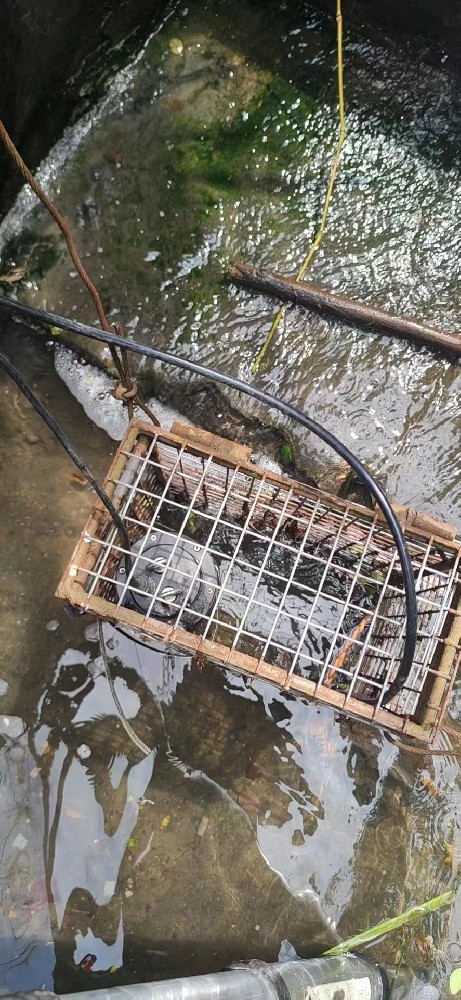
| Protective Basket Installation | Keeps the sensor off the channel bottom, reduces impact from debris and allows the unit to be lifted for cleaning. |
How the Protective Basket Solved the Installation Problem
The field team placed the sensor inside a rigid protective basket and secured the basket at the side of the channel. The openings allowed water to pass around the sensing surfaces while the frame intercepted larger debris. The installation also kept the probe above the sediment layer without fixing it permanently in a position that would be difficult to service.
When maintenance was required, technicians could lift the complete basket, inspect the probe, remove algae or deposits and return it to the same monitoring position. This made routine care faster and helped preserve consistency between readings before and after maintenance.
What the Continuous Data Revealed
Once the station began operating, the environmental team could see the relationship between rainfall, production periods and water-quality changes. A rapid turbidity increase after a storm indicated sediment and runoff entering the channel. A conductivity rise without a similar rainfall signal suggested a change in dissolved ionic load and prompted an upstream inspection. Dissolved oxygen and pH trends added context, while temperature helped the team interpret daily variation.
The system was used as an operational early-warning tool. When several parameters changed together, staff could check the affected drainage section and take a confirmatory sample while the event was still occurring. This was much more useful than discovering an unexplained result from a sample collected hours earlier.
Operation and Maintenance
The site established a simple maintenance routine based on field conditions. Staff checked cable fixation and basket position, removed debris, cleaned the sensing surfaces and compared the online values with portable or laboratory reference results. After heavy rain, the monitoring point received an additional inspection because sediment and floating material could accumulate quickly.
Alarm thresholds were set only after enough baseline data had been collected under dry weather, rainfall and normal production conditions. This reduced unnecessary alarms and allowed the team to distinguish ordinary hydraulic changes from events that required investigation.
Project Result
The Selangor project changed the drainage channel from a manually inspected point into a continuous, remotely traceable monitoring location. The five-parameter sensor supplied the core water-quality trends, while the protective basket gave the probe a stable and serviceable position in a difficult open-channel environment.
The same approach is suitable for industrial park drainage channels, municipal stormwater and wastewater junctions, factory discharge outlets, river tributary inlets, small surface-water stations and temporary environmental monitoring projects where shallow flow, debris and changing water levels make direct probe installation unreliable.